エピソード

  • 06 | How Hugh Loomans built Sylvite
    2026/06/25

    When the United States attacked Iran in April of 2026, Hugh Loomans was already making plans to reroute agricultural supplies head to his Hamilton, Ontario-based company, Sylvite. Staying on top of global events and responding quickly has been key to Hugh’s success as an entrepreneur.


    When Russia attacked Ukraine, Hugh pivoted the same way he did when the Soviet Union collapsed in the 1980s. As an independent supplier of agricultural nutrients and equipment, Sylivte is competing for the market at home in Ontario, Quebec, and in eastern states of the US.


    It’s a highly competitive market with major international players vying to elbow him out of the way. Hugh says, “There have been so many nights at 3 am where I’m pacing the floor, trying to figure out how to make the seemingly impossible work.”


    He’s succeeded! For more than 40 years, Hugh and Sylvite have innovated in sourcing products, packaging them in ways that meet the needs of customers, adding transportation services to his company to lower costs and, in doing so, spawning new divisions of the company.


    Hugh Loomans has met the challenges of the ag sector with the same determination his customers – farmers – do everyday, because just like farming, the ag supply business changes from minute to minute.


    ---


    The Entrepreneurs is a show that features the imaginative, innovative drivers of our economy. For more, see our website at www.theentrepreneurs.ca.

    Hosted on Acast. See acast.com/privacy for more information.

    続きを読む 一部表示
    24 分
  • 05 | How Connor Curran built Local Laundry
    2026/06/08

    Connor Curran’s entrepreneurial journey is a master class in starting a business with nothing, nada, zip, zilch – other than gumption. Determined to be the master of his working destiny, Connor moved to Sweden to clear his head and study entrepreneurism.


    He searched the web for instructions on how to set up a T-shirt company and simply started. No business plan, no money, no product. Why T-shirts? “They are the lemonade stand of today!” says Connor. Print-on-demand means you can design and market your product at no cost and if someone buys it, “that’s the biggest dopamine hit; that’s the fuel that keeps you going,” he says.


    Bit by bit, Connor walks us through the process he followed to build a business, build up a cash reserve, go from print-on-demand to amassing inventory, and refining his marketing strategy – a strategy the White House validated and ignited his sales.


    ---


    The Entrepreneurs is a show that features the imaginative, innovative drivers of our economy. For more, see our website at www.theentrepreneurs.ca.

    Hosted on Acast. See acast.com/privacy for more information.

    続きを読む 一部表示
    9 分
  • 04 | How Allen Eaves built STEMCELL Technologies
    2026/05/27

    Terry Fox worked his way down the rocky shoreline of Newfoundland just outside the city limits of St John’s and dipped his artificial leg in the Atlantic Ocean. He bottled water that lapped at the shore and turned west on his Marathon of Hope – a marathon that brought attention to fighting cancer through research.


    That was on April 12, 1980. Little did Allen and Connie Eaves know that Terry’s crusade to defeat cancer would change their lives. A year after Terry’s heroic marathon ended because his cancer had returned, Allen and Connie came to Vancouver to establish the Terry Fox Research Lab.


    And little did they know that the chain of events that would unfold and lead to the creation of a world renowned biotechnology company, STEMCELL Technologies. Allen and Connie’s story unfolded in a manner that becomes apparent only by looking back.


    The Research Lab was always short of funds for further studies and equipment and supplies. So Allen developed a research related product that the Terry Fox lab needed and he sold the excess to other labs. That product was a hit, so much so that a competitor undercut their price and drove them out of that market. With a researcher’s mindset Allen looked for other products to fill the funding gap for the lab. What he created is still a staple of the company’s business today.


    It’s important to note, he was also the Head of Oncology and Hematology at Vancouver General Hospital where he and a colleague engineered the practice of isolating healthy bone marrow in patients with leukemia. They killed off the unhealthy cells, fostered the regrowth of the healthy cells and transplanted them back to the patient – a procedure that VGH sold to health authorities across Canada, netting the hospital large sums of money.


    When Allen was 54 years of age, the Terry Fox Research Lab told him he had to spin off the company that was developing, producing, and selling products. So he did, working off the side of his desk and, in cooperation with the Lab, STEMCELL Technologies was established


    When Allen turned 65, he was told it was time to retire. The very next day, he was working full-time at STEMCELL, which had grown to more than 50 staff. Today, the company employs more than 2,500 people and sells its products and equipment globally.


    ---


    The Entrepreneurs is a show that features the imaginative, innovative drivers of our economy. For more, see our website at www.theentrepreneurs.ca.

    Hosted on Acast. See acast.com/privacy for more information.

    続きを読む 一部表示
    23 分
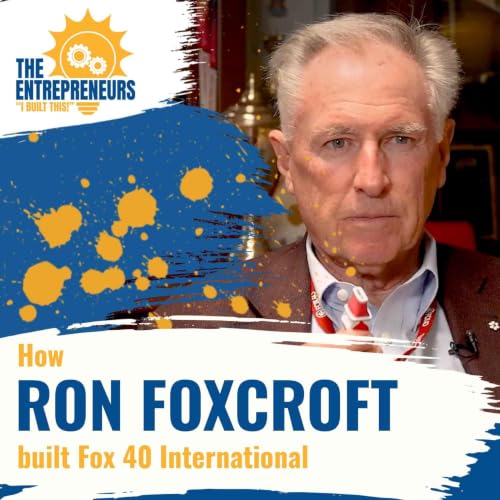
  • 03 | How Ron Foxcroft built Fox 40 International
    2026/05/13

    “If you need anything, just whistle!” is Ron Foxcroft’s signature signoff. He is the grandfather of the professional referee whistle. His story is a journey of the determination to survive. As a teen, his dream of being the quarterback for the Hamilton Tiger-Cats was shattered due to a sporting injury.


    His ambition shattered; he became a basketball referee, which was a part-time job. It wasn’t enough – he needed a job. Through a long-time friend, he managed a leveraged buyout of Fluke Transport. The company was small and money was tight. Ron would work dispatch in the morning and referee games all over the northeastern U.S. in the evening.


    One day, his whistle failed in a high-stakes game in Brazil. “They shoot refs in Brazil,” says Ron, “so I decided to reinvent the whistle.” Easier said than done. He invested $150,000 that he didn’t have and invented the pea-less whistle.


    Over the next forty years, the Fox 40 whistle captured the global referee business. Today, he sells 20,000 whistles per day and his trucking company is a thriving success. None of it was a fluke.


    ---


    The Entrepreneurs is a show that features the imaginative, innovative drivers of our economy. For more, see our website at www.theentrepreneurs.ca.

    Hosted on Acast. See acast.com/privacy for more information.

    続きを読む 一部表示
    24 分
  • 02 | How Amanda Hall built Summit Nanotech
    2026/04/29

    Imagine standing on a mountain in Tibet only to see a monk pull a mobile phone from their pocket. If you’re like Amanda Hall, the founder of Summit Nanotech, you’d be thinking, “What the heck is that person going to do with a mobile phone? They’ve taken a vow of silence.” To her amazement, the monk started typing a text.


    As if that wasn’t a mind blowing revelation, you’d also have to be Amanda Hall to put two and two together and say, “I’m going to go back home to Calgary, quit my job, and start a lithium extraction business.” Her reasoning was, “If lithium batteries are in the mountains of Tibet, they are everywhere. And when I look at the way the Chinese government is ravaging the landscape in Tibet with its lithium evaporation methods, well then, mother nature needs some help.”


    Amanda went home, sat down with a piece of paper, and developed an extraction method that would protect the environment and be of interest to investors. She looked at the human body and mimicked the loop of henle, where salts are separated from liquids. It worked in the lab, but not in the field.


    Back to the drawing board. This time, to develop a membrane. Once again, it worked in the lab but not at scale. Back to the drawing board, refine, test, refine, test, refine, and test again. Smack in the middle of that research and development, COVID hit, shutting down the lab. Calgary banned access to offices within the city limits.


    Innovators always find a way to keep going and in this case, Amanda and team found a barn on the outskirts of town, moved the lab there, and kept going. Confident they had the answer, they sent the test facility to South America, only to have it go missing in shipping.


    Entrepreneurs don’t give up easily; they went on a search for the missing lab, found it, and got it to Chile to start new tests. The results were better but not good enough. Back to the drawing board.


    As of December 2025, Amanda and her team have a winning formula. The next major hurdle is commercialization. Along the way, Amanda was able to continue to attract investment capital – not because everything she touched was a homerun, but because she never surrendered to the idea that her vision was unattainable, proving investors invest in the leader more than the idea.


    ---


    The Entrepreneurs is a show that features the imaginative, innovative drivers of our economy. For more, see our website at www.theentrepreneurs.ca.


    Hosted on Acast. See acast.com/privacy for more information.

    続きを読む 一部表示
    23 分
  • 01 | How Danny Sitnam built Helijet
    2026/04/15

    There are moments you measure your life by, as in before and after. For Danny Sitnam, that day was late August in 1977. He was working as a line cook at the Owl and Oarsman up on a hill overlooking Vancouver.


    He was taking a break when a helicopter landed in the field next to the restaurant. Little did he know, within the next 30 minutes his life would change. The pilot offered him a ride and, from that moment forward, his new life began.


    He abandoned his dream of starting a machine shop with his father and became an aviation innovator. First, figure out how to afford to learn how to fly. He scrapped together enough money to buy a stake in a helicopter that would become a flight school.


    After a stint in the Yukon as a bush pilot, he headed back to Vancouver. Keen to do something more than fly in the back country, one day as he and his wife were driving over the Lions Gate Bridge, they watched sea planes flying passengers to Victoria. “Why don’t you do that with helicopters?” she said, “Nah, that won’t work!” replied Danny.


    But the idea wouldn’t go away. A few days later, he was approached by the owner of a helicopter who was trying to unload the aircraft. Danny convinced him to set aside selling the helicopter and said, “I have an idea, but it’s going to need a bigger aircraft.” Thus Helijet was born.


    It was a logistical nightmare to make it happen – no landing pad in Vancouver or Victoria. So he convinced the federal government to build a couple and he would manage them. Obstacle one hundred of one hundred thousand cleared. Next: money. No one would finance the deal. So his partners fronted the venture.


    The company took flight in November of 1986 and, within months, was on the financial ropes. Then the day came that could have killed the company. They were late on paying the leasing company and a seizure order had been issued.


    Danny got word of the order, which couldn’t be enforced until the Sheriff could attach a decal to the aircraft. Danny, radioed the pilot who was enroute from Victoria to Vancouver: “Don’t land until I tell you.” He quickly got a judge to overrule the order.


    The aircraft landed and the company survived to see another day. On that day, his partners and board called him in and told, “Either double the fares or shut it down.” Danny considered both options to be the deathnail of the company.


    He doubled the prices and expected to see reservations plummet. They didn’t. Instead, they doubled, tripled, quadrupled, and kept growing. Danny later learned that passengers thought the low fares were the sign of an unsafe company. The higher fares represented a professional organization and assured passengers they would be safe.


    Next came a move into air ambulance services and charter flights to and from coastal fishing lodges. The company survived and, forty years later, is thriving.


    Over the years, Helijet has supported many charitable organizations and in 2021, along with son Owen, launched Helicopters Without Borders to service remote and rural indigenous communities in British Columbia with medical services.


    Danny also donated a helicopter to serve as an air ambulance in Ukraine and Helijet is a supporter of Conversations Live.

    Hosted on Acast. See acast.com/privacy for more information.

    続きを読む 一部表示
    24 分