

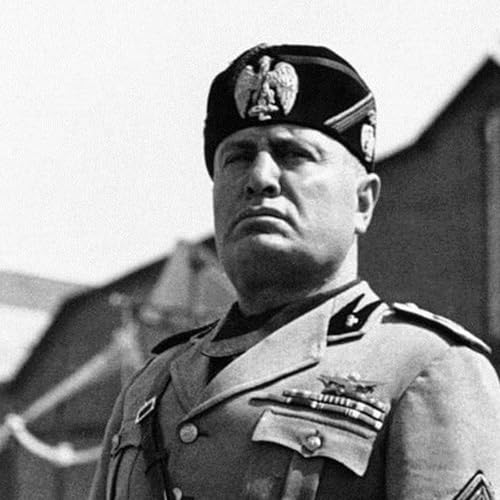
32 - Tenets.
カートのアイテムが多すぎます
ご購入は五十タイトルがカートに入っている場合のみです。
カートに追加できませんでした。
しばらく経ってから再度お試しください。
ウィッシュリストに追加できませんでした。
しばらく経ってから再度お試しください。
ほしい物リストの削除に失敗しました。
しばらく経ってから再度お試しください。
ポッドキャストのフォローに失敗しました
ポッドキャストのフォロー解除に失敗しました

32 - Tenets.
-
ナレーター:
-
著者:
概要
Robert Paxton finds that even though fascism "maintained the existing regime of property and social hierarchy", it cannot be considered "simply a more muscular form of conservatism" because "fascism in power did carry out some changes profound enough to be called 'revolutionary'". These transformations "often set fascists into conflict with conservatives rooted in families, churches, social rank, and property". Paxton argues:
fascism redrew the frontiers between private and public, sharply diminishing what had once been untouchably private. It changed the practice of citizenship from the enjoyment of constitutional rights and duties to participation in mass ceremonies of affirmation and conformity. It reconfigured relations between the individual and the collectivity, so that an individual had no rights outside community interest. It expanded the powers of the executive—party and state—in a bid for total control. Finally, it unleashed aggressive emotions hitherto known in Europe only during war or social revolution.
Ultranationalism.
Ultranationalism, combined with the myth of national rebirth, is a key foundation of fascism. Robert Paxton argues that "a passionate nationalism" is the basis of fascism, combined with "a conspiratorial and Manichean view of history" which holds, "the chosen people have been weakened by political parties, social classes, unassimilable minorities, spoiled rentiers, and rationalist thinkers."[290] Roger Griffin identifies the core of fascism as being palingenetic ultranationalism.
The fascist view of a nation is of a single organic entity that binds people together by their ancestry and is a natural unifying force of people. Fascism seeks to solve economic, political, and social problems by achieving a millenarian national rebirth, exalting the nation or race above all else and promoting cults of unity, strength, and purity. European fascist movements typically espouse a racist conception of non-Europeans being inferior to Europeans. Beyond this, European fascists have not held a unified set of racial views. Historically, most fascists promoted imperialism, although there have been several fascist movements that were uninterested in the pursuit of new imperial ambitions. For example, Nazism and Italian Fascism were expansionist and irredentist. Falangism in Spain envisioned the worldwide unification of Spanish-speaking peoples (Hispanidad). British Fascism was non-interventionist, though it did embrace the British Empire.
Totalitarianism.
Fascism promotes the establishment of a totalitarian state. It opposes liberal democracy, rejects multi-party systems, and may support a one-party state so that it may synthesize with the nation. Mussolini's The Doctrine of Fascism (1932), partly ghostwritten by philosopher Giovanni Gentile, who Mussolini described as "the philosopher of Fascism", states: "The Fascist conception of the State is all-embracing; outside of it no human or spiritual values can exist, much less have value. Thus understood, Fascism is totalitarian, and the Fascist State—a synthesis and a unit inclusive of all values—interprets, develops, and potentiates the whole life of a people."
Fascist states pursued policies of social indoctrination through propaganda in education and the media, and regulation of the production of educational and media materials. Education was designed to glorify the fascist movement and inform students of its historical and political importance to the nation. It attempted to purge ideas that were not consistent with the beliefs of the fascist movement and to teach students to be obedient to the state.
Wikipedia: Text is available under the Creative Commons Attribution-ShareAlike 4.0 License.
This episode includes AI-generated content.
まだレビューはありません