エピソード

  • 9 AI Guardrails to Stay Sharp
    2026/06/30
    Episode 3 - Richard Lalchan

    There's a study from MIT that found 83% of people who used ChatGPT to write an essay couldn't quote a single sentence from what they'd written. That stopped me cold.

    Richard Lalchan is back, and this time we went deep on critical thinking. Not as an abstract virtue, but as something that can be measured, exercised, and apparently lost. Richard is a digital wellbeing and clarity coach, and someone who thinks harder about our relationship with technology than almost anyone I know.

    We started where a lot of these conversations start: with Daniel Kahneman. System one, system two. The fast brain and the slow brain. The point isn't that one is better than the other. You need system one when someone shouts fire. But social media, phone design, and now AI are all pulling us toward the fast brain, toward the dopamine hit, away from the kind of thinking that actually serves us.

    Then Richard walked me through that MIT study. Fifty-four participants, split into three groups: one using ChatGPT, one using Google Search, one using just their brain. Over four months, the ChatGPT group showed significantly reduced cognitive engagement compared to the others. And when they switched them around in the final session, the effect persisted. The conclusion the researchers used was striking: LLM users consistently underperformed at neural, linguistic, and behavioural levels. The phrase that stayed with me came from the study's concept of cognitive debt. Choosing the speed of AI today is borrowing intelligence from the future. At some point, the debt comes due.

    Richard came with guardrails, not lectures. Nine of them. Don't anthropomorphise your tech. Own the first draft. Engage your system two before you hit submit. Do a renewal of the mind audit. Go for a walk without headphones and bring an unsolved problem instead. These aren't anti-AI positions. Richard uses AI every day. They're ways of staying the author of your own thinking rather than outsourcing it quietly, habit by habit, prompt by prompt.

    We ended in territory I hadn't expected: people who have formed genuine emotional attachments to AI companions, including some who wanted to save a version of ChatGPT they considered a life partner. Richard didn't dismiss them. He talked about individual circumstances, about what leads someone to that point, about the fact that no one is beyond help. That felt like the right note. Curiosity over judgement. Understanding before prescription.

    The takeaway I keep turning over: critical thinking doesn't maintain itself. It has to be chosen, practised, and protected. In a world designed to shortcut it at every turn, that takes intention. It always has. It just matters more now.

    Richard's guardrails will be available at renewyourmind.net. Go and find him there.


    This was made with humans.

    Your host - Shaun Phillips

    Editor: Glen Boswell
    https://astralforgefilm.com
    https://www.instagram.com/thebozzyman

    Original music composed and produced by Brokli - https://youtube.com/@iambrokli

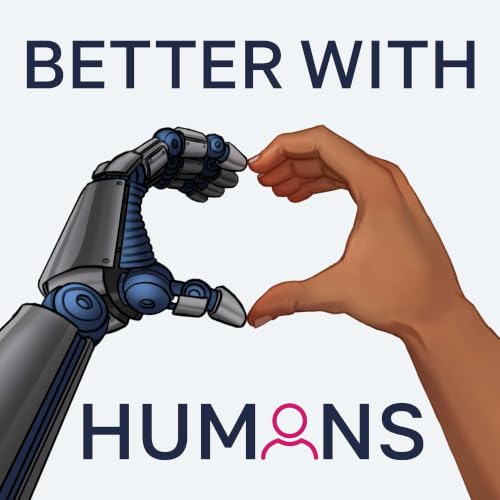
    Original logo illustration and in video podcast graphics by Jesse Rist - https://instagram.com/jesse_rist

    Follow us for episode clips https://www.instagram.com/betterwithhumans

    All episodes and news at https://www.betterwithhumans.com

    Want to watch episodes instead, check out https://www.youtube.com/@betterwithhumans?sub_confirmation=1

    Connect with Shaun on Linkedin - https://www.linkedin.com/in/shaunph/


    続きを読む 一部表示
    44 分
  • We Let Technology Replace Farm Workers. Offices Could Be Next.
    2026/06/23
    Better With Humans. Episode 2. Leslie Coelho.


    Leslie has 40 years in software engineering. He wrote safety-critical aviation code for the Airbus A321 with no internet, no code libraries, and no AI. And he still cannot stop exploring what comes next.

    That context matters. Because when Leslie talks about AI, he is not speculating. He has watched this story unfold in real time across four decades. That is a perspective you cannot fake.

    One thing that landed early was the parrot analogy. When you ask AI a question, it tokenises your input into numbers and predicts what tokens to send back. It has no concept of what the words mean. It is doing what the parrot in the pet shop does when the door opens. It says hello because it heard other people say hello. It does not know what hello means.

    That sounds simple. But sit with it for a moment. Because it changes how you think about the frustration you feel when AI gives you something that seems completely wrong. It is not being careless. It genuinely does not know what it is saying to you.

    The conversation about AI and art stayed with me too. If you use AI to create work in the style of Rembrandt and sell it as something of value, Leslie made the point plainly. If you were doing that with a paintbrush and an easel, we would call it forgery. So what is it when you do it with AI?

    But there is another side. Leslie cannot draw. If he wanted to create a children's book, previously he would have had to find and instruct an illustrator, which would have taken time and effort he did not have. AI changes that. It is not aping anyone's style. It is enabling something that simply would not have existed otherwise. The question is not just can we. It is what are we creating, and for whom.

    And then there is the bigger picture. Before mechanisation, most people in most countries worked on the land. That changed. Offices may be next. Leslie's view is that ultimately this comes down to consumer choice, not businesses. Businesses optimise for shareholder value. If it is cheaper to use AI, they will. What we choose to buy, and who from, is where the real lever sits.

    The raging river analogy was the one I keep thinking about. It is moving so fast and changing direction constantly. But as Leslie said, if you are in the boat, you have got a chance of travelling along the river.

    Get in the boat.

    This was made with humans.

    Your host - Shaun Phillips

    Editor: Glen Boswell
    https://astralforgefilm.com
    https://www.instagram.com/thebozzyman

    Original music composed and produced by Brokli - https://youtube.com/@iambrokli

    Original logo illustration and in video podcast graphics by Jesse Rist - https://instagram.com/jesse_rist

    Follow us for episode clips https://www.instagram.com/betterwithhumans

    All episodes and news at https://www.betterwithhumans.com

    Want to watch episodes instead, check out https://www.youtube.com/@betterwithhumans?sub_confirmation=1

    Connect with Shaun on Linkedin - https://www.linkedin.com/in/shaunph/


    続きを読む 一部表示
    38 分
  • We Waited Too Long To Question Smartphones. Don’t Repeat It With AI
    2026/06/16

    One of the most interesting conversations I have had recently was around something most of us carry every single day without really questioning it anymore.

    Our phones.

    Richard Lalchan joined me on Better With Humans and we explored what smartphones, social media, and now AI are actually doing to us, particularly our children. Not from a fear perspective. From a human perspective.

    One thing Richard said really stuck with me. Kids do not yet have the neurological hardware to make long-term decisions about technology designed by multi-billion dollar companies whose business model depends on attention.

    That lands differently when you stop and think about it.

    As parents, leaders, educators, and people working in technology, we cannot just ask: “What can this technology do?”

    We also need to ask: “What is this technology doing to us?”

    I resonated deeply with the conversation around endless scrolling.

    • Books have an ending.
    • Conversations have pauses.
    • Meals finish.

    But many apps are intentionally designed without an endpoint. That changes behaviour over time.

    The other part that really hit me was this idea that boredom is not the enemy.

    Some of our best thinking, creativity, reflection, and emotional processing happens in quiet moments. Moments that are increasingly being filled by notifications, scrolling, and constant stimulation.

    And this is not about blaming parents. Life is hard. Parenting is hard. Leadership is hard. Sometimes people just need five minutes of peace.

    What matters is that we are willing to step back and honestly examine the systems shaping our lives and our children’s lives.

    • Not just accepting technology because it exists.
    • Not assuming progress automatically equals good.
    • Not waiting twenty years before asking difficult questions.

    Technology should equip, empower, and encourage people.
    Not quietly replace human connection, critical thinking, and presence.

    Grateful to Richard for such an honest and thoughtful conversation.

    Come on people. Let’s do this.

    This was made with humans.

    Your host - Shaun Phillips

    Editor: Glen Boswell
    https://astralforgefilm.com
    https://www.instagram.com/thebozzyman

    Original music composed and produced by Brokli - https://youtube.com/@iambrokli

    Original logo illustration and in video podcast graphics by Jesse Rist - https://instagram.com/jesse_rist

    Follow us for episode clips https://www.instagram.com/betterwithhumans

    All episodes and news at https://www.betterwithhumans.com

    Want to watch episodes instead, check out https://www.youtube.com/@betterwithhumans?sub_confirmation=1

    Connect with Shaun on Linkedin - https://www.linkedin.com/in/shaunph/

    続きを読む 一部表示
    48 分
  • Let's uncover what it means to be Better with Humans - Podcast trailer
    2026/06/09

    The way we create. The way we think. The way we live.

    And most of us have not stopped to ask whether we actually chose this.
    I am Shaun Phillips. And I have been sitting down with the people right in the middle of it.
    Industry leaders. Creatives. Thinkers. People navigating the shift in real time.
    Not polished takes. Not press releases. Honest conversations.
    One idea keeps coming back.
    If we choose the speed of AI today, we are borrowing intelligence from the future.
    What does that actually mean for us?
    That is what this show is about. Not the technology for technology's sake. What it means to stay human through it.

    We borrowed something without asking.

    They were weak. Weedy. Because nothing pushed back..

    That is the question underneath all of this. Not just what AI can do for us. What happens to us if it quietly removes the very things that make us capable?

    Let's find out what is better with humans.


    This was made with humans.

    Your host - Shaun Phillips

    Editor: Glen Boswell
    https://astralforgefilm.com
    https://www.instagram.com/thebozzyman

    Original music composed and produced by Brokli - https://youtube.com/@iambrokli

    Original logo illustration and in video podcast graphics by Jesse Rist - https://instagram.com/jesse_rist

    Follow us for episode clips https://www.instagram.com/betterwithhumans

    All episodes and news at https://www.betterwithhumans.com

    Want to watch episodes instead, check out https://www.youtube.com/@betterwithhumans?sub_confirmation=1

    Connect with Shaun on Linkedin - https://www.linkedin.com/in/shaunph/


    続きを読む 一部表示
    1 分