『Chef Life Radio』のカバーアート

Chef Life Radio

Chef Life Radio

著者: Adam M Lamb
無料で聴く

Chef Life Radio is not about working harder, optimizing systems, or hustling your way out of exhaustion. It’s about restoring authorship. Hosted by Chef Adam Lamb, Chef Life Radio explores the invisible emotional and leadership load carried by people who love their work, and quietly let that love become obligation. Through reflective solo episodes and lived stories, the show names what most professionals feel but rarely articulate: When responsibility becomes erosion When endurance replaces choice When leadership turns into self‑sacrifice This isn’t motivation. It’s recommitment. Chef Life Radio is for people who want to remain excellent without disappearing from their own lives — and who are ready to lead from clarity instead of depletion. Register for the free monthly Culinary Leadership Lab: a live working space for chefs ready to lead without losing themselves @ https://link.cheflifecoaching.com/leadershiplabChef Life Media LLC アート クッキング 個人的成功 出世 就職活動 経済学 自己啓発 食品・ワイン
エピソード
  • 244 | The Weight You're Carrying
    2026/06/09
    The Weight You're Carrying — When the Exhaustion Isn't About the WorkThere's a kind of tired that sleep doesn't touch. You take the day off, sleep well, run a clean service — and still drive home feeling heavy. This episode is for the chef who keeps waiting for that weight to lift with one more vacation, one more good hire, one more season that doesn't crush them — and is starting to suspect it never will.Register for the free monthly Culinary Leadership Lab: a live working space for chefs ready to lead without losing themselves "This didn't start as obligation. It started as love."The Tired Sleep Doesn't TouchYou know the feeling. Solid service, food went out, team was locked in, guests were happy. You did everything right and you still feel heavy. Not frantic. Not chaotic. Just weighed down, and you can't quite name it.Here's the reframe that runs through the whole episode: what if that exhaustion isn't a sign you're weak or burned out or not cut out for this? What if it's information? Because the weight you're carrying usually isn't coming from the work. It's coming from something older than that.Emotional Labor Without AuthorshipThe chefs who show up most depleted almost never identify the right source of the weight. It's the hours. It's the team that won't step up. It's a business that never stops taking. All true. But underneath it, almost every time, there's something else — emotional labor without authorship.Managing the energy in a room, holding the container, absorbing the tension, keeping people steady — that's real work, and it costs something. In a kitchen it falls on the leader invisibly, without acknowledgement and without end. What makes it unbearable isn't the labor. It's doing it without ever consciously choosing it. It just accumulates. And what started as care becomes exhaustion. What started as love becomes weight you didn't even remember picking up. The Chef in the Black ForestYears ago, on a balcony in the Black Forest in Germany, Adam watched a chef step out a side door between lunch and dinner prep. No rush. He grabbed a basket and walked into the trees for 40 minutes — foraging, unhurried, present, like the work and the rest were part of the same thing instead of opposites.That image came home to a high-volume kitchen of ticket stacking and noise, and a belief that slowing down had to be earned. Adam kept telling himself the next job would feel right. Better kitchen, better team, better ownership. The next job came, and the one after that, and the feeling didn't — because the problem was never the kitchen. It was what he carried into every kitchen. He'd confused the weight with the love.------------------Stop chasing stars and start building a career that actually works. Join the National Champions at A-B Tech in Asheville for hands-on training that respects the hustle without losing the soul. Real tools for real chefs .------------------- How We Got ConditionedWe came into this with open hearts. We fell in love with the craft, with the choreography of a kitchen firing on all cylinders. But the industry we walked into had a very specific set of ideas about what dedication looked like, and we absorbed them before we had language to question them. Dedication looked like staying the longest. Commitment looked like absorbing the most. Caring looked like never setting anything down.So we learned to conflate sacrifice with love — to treat the weight as proof of our investment. Nobody handed us a contract to hold other people's motivation as our personal responsibility. It happened through the culture, through the chefs who modeled it, through an industry that rewarded endurance over presence and called it excellence. That's not a character flaw. That's conditioning. What's Actually in the BagThe first step out is naming what's actually in there. You carry other people's moods — you read the room before you read the board. You carry other people's motivation, feeling responsible when someone won't perform. You carry unspoken expectations you never agreed to. And you carry the gap between the chef you imagined you'd be and the chef the business requires you to be. Most of us carry it all silently, as if it's just part of the deal. It doesn't have to be.The Authorship ResetWhen did you stop choosing this? Not when did it get hard — when did you move from *I choose this* to *I don't have a choice?* Because choosing nothing is still a choice, and choices can be revisited. The refrain to take from this episode: this didn't start as obligation. It started as love. Love without authorship turns into obligation. Obligation without boundaries turns into resentment. And resentment is just love that's lost its way.The reset is three steps — on paper, not in your head. One: name what you're carrying that isn't yours. Two: name what you're choosing today. Three: release one expectation you never agreed to. Pick one. Just one. The reset isn't a reinvention. It's a reclamation...
    続きを読む 一部表示
    17 分
  • 243 | Hold the Line — When Love Means Saying Something
    2026/05/26
    Most kitchen cultures don't break in blow-ups. They erode in the things leaders chose not to name. This episode is for the chef who knows something is off in the room, has known for weeks, and keeps hoping it will fix itself."Love without boundaries becomes martyrdom. Standards without heart becomes control. Leadership is the integration of both."Register for the free monthly Culinary Leadership Lab: a live working space for chefs ready to lead without losing themselves @ https://thecheflifebrigade.com/thelab-------------------The Signal in the RoomYou've walked into a kitchen and felt it before you could name it. Service is running. Tickets are moving. Food is going out. But the energy is weird. The team is guarded. The rhythm feels broken in a way you can't put your finger on.That's not anxiety. That's not you being too sensitive. That's your leadership radar going off. And if you've been at this long enough, you know that feeling isn't random. The discomfort is information.The problem isn't that you don't feel it. The problem is what most of us do with it. We hope.We hope it fixes itself. We hope they get the message. We hope one more shift will smooth it out. But hope in that context isn't strategy. It's avoidance wearing a patient face. And what you tolerate, you teach.How We Got HereWe didn't get here because we stopped caring. We got here because we cared deeply. We fell in love with the craft, with feeding people, with precision, with the feeling of getting it exactly right.Then we ran into a business that rewarded the ones who could absorb the most, who could endure the most, who could give the most without asking for anything back. So we hardened. We armored up to survive. And slowly, quietly, the heart that made us powerful became something we learned to protect instead of lead from.Here's the fracture most chefs don't have language for yet. The craft asks for presence. The business rewards endurance. Those two things pull in opposite directions. If nobody teaches you how to hold both, you end up believing that sacrificing yourself is part of the job. It isn't. That's conditioning.Two CustomersIn every operation, there are two customers. The guest at table 12. And the internal customer — your team, the people standing next to you on the line, carrying the mission with you every shift.Both are owed something.But if you're wired as a people pleaser — if you're wired to smooth things over, to absorb the friction so nobody else has to feel it — you're probably over-indexing on one and under-serving the other. Most chefs are deeply committed to the guest experience. They'll flex the menu, jump on a station, take the hit. And in doing that, they sometimes quietly ask their team to absorb the chaos instead.That's not leadership. That's love without boundaries. And love without boundaries always lands somewhere — usually on the people closest to you.Stay Tall & Frosty. And Lead from the Heart. —Adam.----------------Chapters00:00 - Lead With Heart02:14 - Leadership Radar05:00 - Two Customers07:32 - Hold The Line08:48 - The Slip11:19 - Owe Each Other13:23 - Love With Boundaries14:19 - One Loop This Week15:31 - Episode Takeaways16:23 - Closing Thanks---------------Stop chasing stars and start building a career that actually works. Join the National Champions at AB Tech in Asheville for hands-on training that respects the hustle without losing the soul. Real tools for real chefsYou wouldn't run a kitchen with broken equipment, so why are you redlining your own body? Carolina Health & Wellness helps you find your peak with TRT and peptide therapy. Stop grinding through the fatigue.Research LinksThe Successful Chef Leadership BootcampAttribution & SubscriptionSubscribe to The Recipe for Your Success NewsletterLearn more at Chef Life CoachingLike, Follow & Subscribe to Chef Life RadioPodcast Copyright Chef Life Media LLC
    続きを読む 一部表示
    18 分
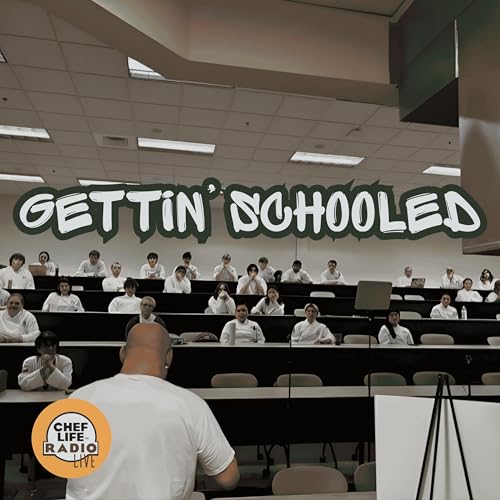
  • 242 | Chef Life Radio LIVE - Gettin' Schooled
    2026/05/18

    Chef Life Radio leaves the studio and enters the classroom at AB Tech In Ashveille NC for a conversation with culinary students about leadership, burnout, boundaries, and success.

    The discussion focuses less on technique and more on how culinary school shapes identity, discipline, and the way students see their future in the industry. The conversation stresses the demands of the program and the need for organization, preparation, and persistence.

    The students are mentored by program director Chef Cathryn Horton abd warned hat the work can be overwhelming, but by taking on less and doing it well is better than trying to do too much and quitting. The discussion also touches on the importance of sleep, time management, and being honest about how work, family, and school affect daily life.

    One student, Allie Marie Councel shares that she is a mother, works, and is studying culinary arts after years in event and wedding coordination. She explains that cooking became important to her through family life and that she wants to learn the craft well so she can teach others. Her comments lead into a wider conversation about why people enter the industry and how personal goals can change over time.

    Chef Stephen Hertz joins the discussion and speaks about how his own idea of success changed. He says he once believed success meant running an independent restaurant, but later began to value teaching, family time, and a broader definition of achievement. He also talks about the transition from kitchen work to teaching, the challenge of paperwork and grading, and the need to understand leadership as part of the chef’s role.

    The conversation closes with questions about being jaded, staying present, and avoiding the habit of always looking ahead to the next job. The main message is that chefs should define their own success, stay connected to the people around them, and remember that hospitality is about relationship, not just food.

    続きを読む 一部表示
    34 分
adbl_web_anon_alc_button_suppression_t1
まだレビューはありません