

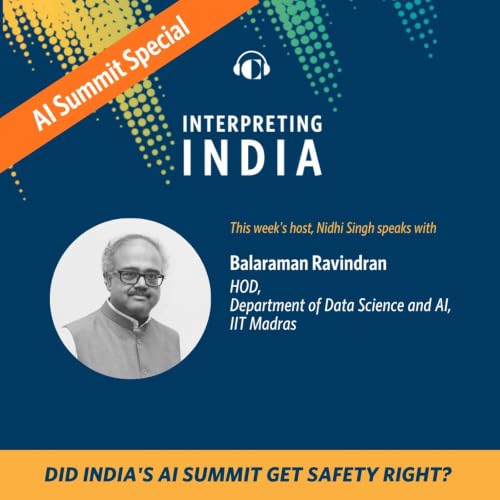
Did India's AI Summit Get Safety Right?
カートのアイテムが多すぎます
カートに追加できませんでした。
ウィッシュリストに追加できませんでした。
ほしい物リストの削除に失敗しました。
ポッドキャストのフォローに失敗しました
ポッドキャストのフォロー解除に失敗しました

Did India's AI Summit Get Safety Right?
-
ナレーター:
-
著者:
This episode is part of our special series on the India AI Impact Summit, examining the conversations, decisions, and debates that are shaping global AI governance.
Professor Ravindran addresses early on the perception that the India summit sidelined safety. More than 60% of the summit's events and discussions were focused on safety, trust, and cross-border collaboration. The framing shifted, and deliberately so. When the summit came to the Global South, leading with existential risk, rather than the very real opportunity AI presents to improve healthcare, education, and public services for hundreds of millions of people, would have been the wrong entry point. The two key deliverables from his working group reflect that balance: the Trusted AI Commons, a repository of benchmarks, testing protocols, and best practices designed for AI deployment in resource-constrained settings, and a high-level governance guidance note endorsed by 22 countries, that calls out the issues every national AI policy should address without being prescriptive enough to limit how different countries approach it.
On frontier risks, Professor Ravindran notes that the landscape has shifted in ways that would have seemed speculative even a year ago, and that the frameworks being built to manage these risks will need to keep pace with that change. He also reflects on what the growing concentration of the most capable AI models means for countries like India, and why that conversation may need to move from being a company-to-country dialogue to a country-to-country one. His overall view is one of cautious optimism: there will be disruption in the short term, but there will also be a new equilibrium, and the work is to make sure the transition is managed well.
Episode Contributors
Professor Balaraman Ravindran heads the Department of Data Science and AI at IIT Madras. He is also the Founding Head of the Wadhwani School of Data Science and AI (WSAI), Robert Bosch Centre for Data Science and AI (RBCDSAI), and Centre for Responsible AI (CeRAI) at IIT Madras. He has more than three decades of experience working in reinforcement learning, and his research interest spans responsible AI and deep RL.
Nidhi Singh is an associate fellow at Carnegie India. Her current research interests include data governance, artificial intelligence and emerging technologies. Her work focuses on the implications of information technology law and policy from a Global Majority and Asian perspective. She has previously contributed to the Indian Express, The Secretariat, Medianama and HinduBusiness Line.
Every two weeks, Interpreting India brings you diverse voices from India and around the world to explore the critical questions shaping the nation's future. We delve into how technology, the economy, and foreign policy intertwine to influence India's relationship with the global stage.
As a Carnegie India production, hosted by Carnegie scholars, Interpreting India, a Carnegie India production, provides insightful perspectives and cutting-edge by tackling the defining questions that chart India's course through the next decade.
Stay tuned for thought-provoking discussions, expert insights, and a deeper understanding of India's place in the world.
Don't forget to subscribe, share, and leave a review to join the conversation and be part of Interpreting India's journey.