

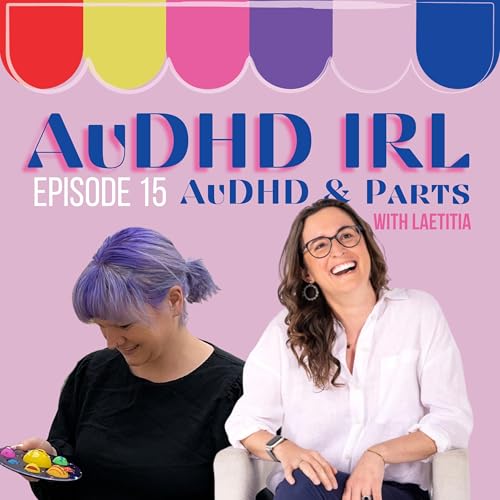
Ep15. AuDHD and Parts with Laetitia
カートのアイテムが多すぎます
カートに追加できませんでした。
ウィッシュリストに追加できませんでした。
ほしい物リストの削除に失敗しました。
ポッドキャストのフォローに失敗しました
ポッドキャストのフォロー解除に失敗しました

Ep15. AuDHD and Parts with Laetitia
-
ナレーター:
-
著者:
概要
Content Warning:
- Burnout and shutdown
- Masking and identity confusion
- People-pleasing and self-sacrifice
- Discussion of childhood experiences and labels
- Social pressure, fitting in, and internalised expectations
Go gently if these topics are dysregulating for you.
Summary:
In this episode, Bri sits down with Laetitia Andrac to explore AuDHD through the lens of parts, identity, and the roles we develop to survive and succeed.
Laetitia shares her journey from high-achieving strategy consultant to burnout, and how discovering her daughter’s neurodivergence led to her own late diagnosis. Together, they unpack how growing up without the “right” label often leads to collecting harmful ones instead: shaping identity through external expectations rather than self-understanding.
The conversation dives deeply into parts work, from Internal Family Systems to psychodrama, exploring how certain parts (like the “get shit done” achiever or the selfless leader) are highly rewarded, while others (like the need for silence, rest, or deep interests) are pushed to the back of the bus.
Laetitia introduces a powerful analogy:👉 AuDHD as your operating system, and your parts as apps.
The episode ultimately invites listeners to move away from “fixing” themselves and toward building relationships with all parts, even (and especially) the ones that have been hidden, dismissed, or shamed.
Takeaways:
- If you don’t get the right label, you collect the wrong ones. Growing up without understanding your neurotype can lead to harmful identity narratives and reduced self-worth.
- Some parts are rewarded, others are rejected. Productivity, selflessness, and high achievement are often praised, while rest, quiet, and deep internal worlds are dismissed.
- The “get shit done” part can come at a cost. Capable parts often dominate until burnout forces other needs to the surface.
- People-pleasing is often relational intelligence, not a flaw. Being attuned to others can be valued socially, but can lead to self-abandonment when it becomes the dominant role.
- Masking can disconnect you from who you are. Many AuDHDers develop a strong “masking part” that performs externally while internal distress goes unseen.
- Burnout can reconnect you with lost parts. Experiences like shutdown or burnout can bring forward parts that were previously ignored, like the need for stillness, silence, or non-productivity.
- Special interests are often dismissed, but deeply protective. They bring joy, meaning, and regulation, yet are frequently minimised because they don’t align with social norms.
- AuDHD is the operating system, and parts are the apps. Your neurotype is your wiring, but your parts (roles, adaptations, identities) are layered on top and can be understood and reshaped.
- You don’t need to delete parts; you need relationships with them. Trying to “get rid of” parts doesn’t create change; it creates disconnection. Healing comes from understanding their role and intention.
- Befriending your parts is an act of rebellion. In a world that prioritises performance and conformity, choosing authenticity and internal connection is powerful and countercultural.
You can find Laetitia on Instagram at @understanding.zoe and on the web at www.understandingzoe.com.