『Evidence Based Birth®』のカバーアート

Evidence Based Birth®

Evidence Based Birth®

著者: Rebecca Dekker PhD RN
無料で聴く

今ならプレミアムプランが3カ月 月額99円

2026年5月12日まで。4か月目以降は月額1,500円で自動更新します。

概要

In the Evidence Based Birth® podcast, we cover the research evidence on hot topics about pregnancy and childbirth! Our mission is to help birth workers build the evidence based knowledge, skills, and power they need to protect families' ability to give birth with empowerment. The work we do has a huge impact on parents who are searching for accurate information to empower their prenatal, birth, and postpartum experiences!Evidence Based Birth® 人間関係 子育て 衛生・健康的な生活 身体的病い・疾患
エピソード
  • REPLAY: EBB 357 - Making Decisions about Elective Induction of Labor with Dr. Ann Peralta & Kari Radoff, CNM, from Partner to Decide
    2026/04/15
    Every pregnant person deserves the information and support they need to make truly informed decisions about labor induction. In this encore episode, Dr. Rebecca Dekker talks with Dr. Ann Peralta and Kari Radoff, CNM, the co-creators of Partner to Decide, a nonprofit improving decision-making in perinatal care. They discuss their free, multilingual decision aid that helps families understand their options around routine induction of labor and empowers them to advocate for their own values, preferences, and autonomy. Ann shares how her own birth experience, shaped by access to education and privilege, sparked the creation of the tool. Kari offers insight into how the decision aid has changed conversations in clinical settings, bringing clarity, reducing bias, and fostering truly shared decision-making. Together, they illuminate how access to balanced information can reduce anxiety, improve trust, and shift the culture of perinatal care. (03:02) What Is a Decision Aid and Why It Matters (07:12) Ann's Birth Story and the Origins of Partner to Decide (11:09) Gaps in Shared Decision-Making from a Provider's Perspective (14:24) Personal Values, Intuition, and Cultural Differences (18:19) Designing the Decision Aid with Equity and Accessibility (23:49) The Power of Absolute vs. Relative Risk in Birth Conversations (25:01) Surprising Patient Feedback: From Access to Empowerment (30:31) Provider Reflections and Challenging Bias (36:11) Why "Routine" Induction Language Matters (43:59) How to Respond to Pressure or Coercion Around Induction (46:16) How to Access the Free Decision Aid and Support New Tools Resources Access the free Induction of Labor Decision Aid in seven languages: www.inductiondecisionaid.org Learn more about the nonprofit: www.partnertodecide.org For more information about Evidence Based Birth® and a crash course on evidence based care, visit www.ebbirth.com. Follow us on Instagram and YouTube! Want more resources? Check out our Signature Articles or read Dr. Dekker's book, "Babies Are Not Pizzas: They're Born, Not Delivered!" If you want to get involved at EBB, join our Professional membership (scholarship options available) and get on the wait list for our EBB Instructor program. Find an EBB Instructor here, and click here to learn more about the EBB Childbirth Class.
    続きを読む 一部表示
    49 分
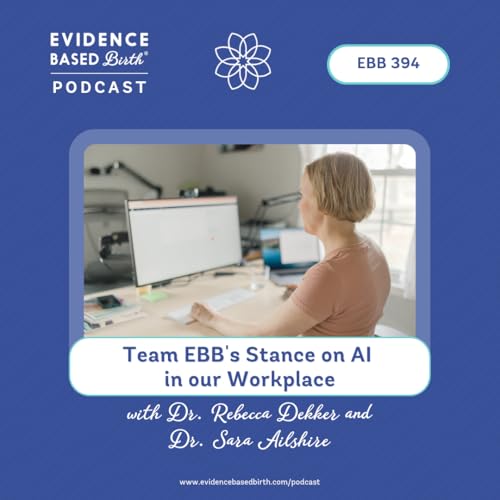
  • EBB 394 - Team EBB's Stance on AI in our Workplace
    2026/04/08
    Artificial intelligence is rapidly changing how people search for information, including how families learn about pregnancy and birth. As this technology grows, it raises important questions about accuracy, ethics, and the role of human expertise in healthcare information. In this episode, Dr. Rebecca Dekker and Dr. Sara Ailshire share a behind-the-scenes look at how Evidence Based Birth® developed its own AI policies. They discuss concerns about misinformation, bias, privacy, and environmental impact, as well as the potential effects on critical thinking and human connection. Learn why EBB has chosen to avoid the use of AI in our research, and what that means both for our team and for you. (03:22) Why EBB began developing an AI policy (10:39) Defining AI, generative AI, LLMs, and hallucinations (17:03) Ethical concerns: Accuracy, bias, and risks to evidence-based information (20:14) Environmental impact of AI and data centers (21:47) Privacy concerns and data security risks (26:21) Intellectual property, sustainability, and loss of research context (27:03) Humanitarian concerns and the impact of AI on jobs and communities (31:24) AI's potential effects on cognition and critical thinking (37:30) Why EBB takes a cautious, evidence-based approach to AI (38:20) Research team policy (42:06) Content team policy (45:01) Programs team policy and guidance for applicants (47:32) Hiring practices and commitment to human review (52:29) Final takeaways: EBB's overall stance on AI References Read EBB's Statement on Artificial Intelligence: ebbirth.com/artificial-intelligence-statement/For a Student Who Used AI to Write a Paper, by Joseph Fasano: https://poets.org/poem/student-who-used-ai-write-paperBarrington, F. (2025). "Thirsty for power and water, AI-crunching data centers sprout across the West." & The West Magazine, Stanford University. April 8, 2025. https://andthewest.stanford.edu/2025/thirsty-for-power-and-water-ai-crunching-data-centers-sprout-across-the-west/Gecker, J. (2025). "Big Tech is paying millions to train teachers on AI, in a push to bring chatbots into classrooms." Associated Press. October 20, 2025. https://apnews.com/article/artificial-intelligence-teacher-union-microsoft-f7554b6550fb90519dd8129acac8e291Han, Y., Wu, Z., Li, P., et al. (2024). "The Unpaid Toll: Quantifying and Addressing the Public Health Impact of Data Centers." arXiv preprint arXiv: 2412.06288. https://arxiv.org/pdf/2412.06288Hou, H., Leach, K., & Huang, Y. (2024). "ChatGPT Giving Relationship Advice - How Reliable Is It?" Proceedings of the Eighteenth International AAI Conference on Web and Social Media: 610–623. https://ojs.aaai.org/index.php/ICWSM/article/view/31338Kosmyna, N., Hauptmann, E., Yuan, Y. T., et al. (2025). "Your Brain on ChatGPT: Accumulation of Cognitive Debt when Using an AI Assistant for Essay Writing Task." arXiv preprint arXiv:2506.08872. https://arxiv.org/abs/2506.08872Marrinan, C. (2025). "Data Center Boom Risks Health of Already Vulnerable Communities." Tech Policy Press.com. June 12, 2025. https://www.techpolicy.press/data-center-boom-risks-health-of-already-vulnerable-communities/NASA. (2024). "Defining Artificial Intelligence." Accessed November 17, 2025. https://www.nasa.gov/what-is-artificial-intelligence/Notre Dame Learning. (2025). "AI Overview and Definitions." Accessed November 17, 2025. http://learning.nd.edu/resource-library/ai-overview-and-definitions/Pataranutaporn, P., Karny, S., Archiwaranguprok, C., et al. (2025). "My Boyfriend is AI: A Computational Analysis of Human-AI Companionship in Reddit's AI Community." arXiv preprint arXiv:2509.11391.https://arxiv.org/pdf/2509.11391Sonka, J. (2025). "The AI data center boom is coming for Kentucky. What will lawmakers do about it?" Kentucky Public Radio. December 9, 2025. https://www.lpm.org/news/2025-12-09/the-ai-data-center-boom-is-coming-for-kentucky-what-will-lawmakers-do-about-itStryker, C. (n.d.) "What are LLMs?" IBM.com. Accessed November 17, 2025. https://www.ibm.com/think/topics/large-language-modelsTabuchi, H. (2025). "Elon Musk's A.I. Company Faces Lawsuit Over Gas-Burning Turbines." New York Times. June 17, 2025. www.nytimes.com/2025/06/17/climate/naacp-musk-xai-supercomputer-lawsuit.html/United Nations (UN). (2025). "AI has an environmental problem. Here's what the world can do about that." UN Environmental Programme. November 13, 2025. https://www.unep.org/news-and-stories/story/ai-has-environmental-problem-heres-what-world-can-do-about For more information about Evidence Based Birth® and a crash course on evidence based care, visit www.ebbirth.com. Follow us on Instagram and YouTube! Ready to learn more? Grab an EBB Podcast Listening Guide or read Dr. Dekker's book, "Babies Are Not Pizzas: They're Born, Not Delivered!" If you want to get involved at EBB, join our Professional membership (scholarship options available) and get on the wait list for our EBB Instructor program. Find ...
    続きを読む 一部表示
    56 分
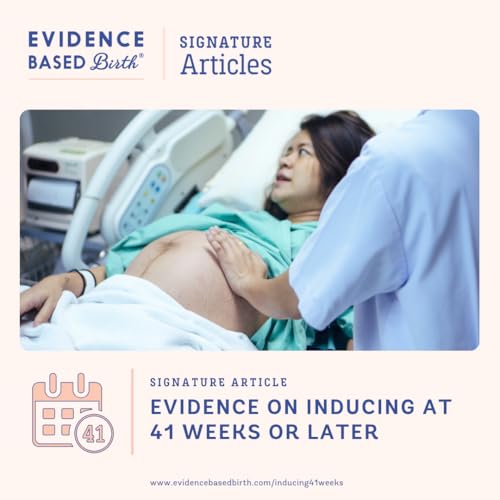
  • EBB 393 - Evidence on Inducing at 41 Weeks or Later
    2026/04/01
    At the 41-week mark in pregnancy, conversations and decisions about induction can start to feel more urgent and complex. In this episode, Dr. Rebecca Dekker and Dr. Sara Ailshire share why the 41st week has become such a focus in maternity care and what the evidence actually says about induction at this milestone. They discuss elective induction versus expectant management and key findings from major studies like the INDEX and SWEPIS trials. They also talk through potential benefits and risks, including changes in stillbirth risk, newborn outcomes, and maternal experiences. Content Warning: This episode contains discussion of stillbirth. Please take care while listening. (00:05:58) How common is labor induction? U.S. rates and challenges with data accuracy (00:09:25) Medically indicated vs. elective induction (00:15:24) The limits of research on induction vs. expectant management (00:20:18) The INDEX trial (00:28:36) Follow-up observational study to INDEX: preferences, Cesarean rates, and outcomes (00:32:51) The SWEPIS trial (00:41:59) Impact of SWEPIS on guidelines and outcomes in Sweden (00:44:40) Benefits of elective induction at 41 weeks (00:46:34) Risks and potential downsides of induction (00:49:18) FAQ: Induction and VBAC considerations For a full list of resources and references, visit ebbirth.com/inducingduedates. For more information about Evidence Based Birth® and a crash course on evidence based care, visit www.ebbirth.com. Follow us on Instagram and YouTube! Ready to learn more? Grab an EBB Podcast Listening Guide or read Dr. Dekker's book, "Babies Are Not Pizzas: They're Born, Not Delivered!" If you want to get involved at EBB, join our Professional membership (scholarship options available) and get on the wait list for our EBB Instructor program. Find an EBB Instructor here, and click here to learn more about the EBB Childbirth Class.
    続きを読む 一部表示
    1 時間
まだレビューはありません