• E19: 1991 Twins vs Braves World Series. Greatest Ever?
    2026/04/27

    Send us Fan Mail

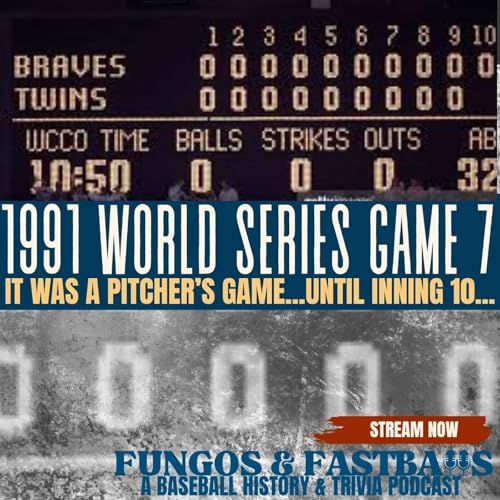
    A runner gets lifted off first base. A ball disappears into the Metrodome plexiglass. A Game 7 stays scoreless so long you can feel every breath in the stadium. The 1991 World Series isn’t just a classic, it’s a blueprint for why people fall in love with October baseball in the first place. We’re talking Minnesota Twins vs Atlanta Braves, seven games, constant tension, and the kind of moments that still look unreal on replay.

    Guest Jordan Dove & I start with the context that makes the story pop: both teams were in last place the year before, then stormed back to win their divisions. That “worst to first” twist isn’t hype, it’s the foundation for everything that follows, from Minnesota’s key additions like Chuck Knoblauch and Jack Morris to Atlanta’s rise under Bobby Cox and a pitching core led by Tom Glavine, John Smoltz, and Steve Avery. Along the way we hit the famous Kent Hrbek and Ron Gant play, the walk-off swings in Atlanta, and the little details that show how thin the margin is in playoff baseball.

    Then we get to the heart of the legend: Kirby Puckett’s Game 6 masterpiece and Jack Morris’s all-time Game 7 performance. If you search baseball history for “Kirby Puckett walk off” or “Jack Morris 10 innings,” this is the series you land on, and we break down why it still holds up for fans who love pitching duels, defense, and pressure-packed at-bats.

    If you’ve got a favorite 1991 World Series moment, share it with us, and if you want more baseball history and trivia, subscribe, leave a review, and send this to a friend who still argues about the greatest World Series of all time.

    Email us at fungosandfastballs@gmail.com

    続きを読む 一部表示
    35 分
  • E18: The Legacy of Thurman Munson & Billy Joel Baseball Trivia
    2026/04/22

    Send us Fan Mail

    You can learn a lot about a team by the player it chooses to follow when things get loud. For my birthday special, I bring on my son Griffin Dynes (calling in from Denver) to talk about the toughest kind of baseball greatness: the quiet, gruff, unglamorous leadership of Yankees catcher and captain Thurman Munson.

    We start with a quick New York detour through Billy Joel and a trivia question from “We Didn’t Start The Fire,” then we get to the heart of the story. Munson is the spine of the 1970s New York Yankees, a catcher who wins AL Rookie of the Year, takes home the 1976 AL MVP, earns Gold Gloves, and delivers huge postseason numbers on the way to the 1977 and 1978 World Series titles. We dig into what made him different from the flashier stars of the era, and why his style still feels like the definition of “captain.”

    Griffin and Jerry also get into the rivalries that shaped Munson’s reputation: the Johnny Bench comparisons, the brutal Carlton Fisk clashes from an era when collisions at home plate were part of the sport’s identity, and the famous Reggie Jackson “straw that stirs the drink” quote that sparked real clubhouse tension. Then we tackle the question Yankees fans keep asking: with his accolades and impact, why is Thurman Munson still not in the Baseball Hall of Fame, and what do modern comps like Buster Posey mean for that debate?

    We close with the hardest part of his story, the 1979 tragedy, and the powerful ways the Yankees honored him, from retiring number 15 to preserving his locker. If you care about baseball history, Yankees legends, and what real leadership looks like behind the plate, this one is for you. Subscribe, share the episode with a baseball fan, and leave us a review telling us where you land on Munson’s Hall of Fame case.

    Email us at fungosandfastballs@gmail.com

    続きを読む 一部表示
    33 分
  • E17: The Polo Grounds Shaped History & Rally Monkey!!
    2026/04/16

    Send us Fan Mail

    A rally monkey that only appears under strict rules, a capuchin celebrity from Friends, and fans waving stuffed primates like it’s a sacred rite. That’s where we start, because baseball’s superstitions aren’t just funny, they reveal how the sport builds meaning out of moments. Then we jump to a place where the weirdness isn’t a gimmick at all: the Polo Grounds, one of the most important and most bizarre stadiums in MLB history.

    We walk through the full Polo Grounds timeline, from its origins as a polo venue to its forced moves across Manhattan and its long run as the New York Giants’ home before the franchise heads to San Francisco. Along the way we keep the baseball history and trivia coming: how the Metropolitans connect to the later Mets, why the deadball era changes how you should imagine the game, and how one ballpark ends up hosting an absurd mix of baseball, football, and major New York rivalries under the same roof.

    The heart of the story is the field itself. The Polo Grounds is famous for extreme stadium dimensions, short foul lines, a cavernous center field, playable bullpens, and corners that turn routine hits into chaos. We also hit the unforgettable and sometimes unsettling milestones tied to this park, from Willie Mays’ The Catch and the Shot Heard Round the World to tragedies that pushed safety and rule changes. If you love classic ballparks, New York Giants history, and the strange details that make baseball feel alive, this one’s for you.

    Subscribe on your favorite podcast app, share the show with a baseball friend, and leave a quick review if you’re enjoying the ride. What’s your favorite weird ballpark fact or superstition?

    Email us at fungosandfastballs@gmail.com

    続きを読む 一部表示
    28 分
  • E16: MLB Mascots & The 2026 Season So Far
    2026/04/13

    Send us Fan Mail

    Jerry’s new Mariner Moose plush turns into a full blown tour through the strangest and most lovable corner of baseball culture: MLB mascots. We dig into why mascots work, why a few teams still refuse to have one, and what separates “cute” from cringy (“why does that thing have a human body”). Along the way, we hit the origins of the word mascot, the design choices that push characters into uncanny territory, and the fan psychology that makes a costumed creature feel like part of the team’s identity.

    The history gets especially fun when we trace the rise of the San Diego Chicken and how one promotional stunt helped reshape ballpark entertainment and baseball marketing. We also talk official versus unofficial mascots, from early animals used as crowd pleasers to Mr. Met’s claim as the first official MLB costumed mascot. And of course we can’t skip the Philly Phanatic: the lore, the antics, the business side of licensing, and the way mascots can trigger very real reactions from very serious baseball people.

    Then we interrupt our mascot nerding with a “breaking news” style segment featuring our friend Edwin Nolan. We talk automated ball strike challenges (ABS), what we like about it, what could get weird late in games, and how players, catchers, and umpires are adjusting in real time. We also go around the league with early season surprises, young star contracts, City Connect uniforms, odd baseball headlines, and the kind of fights that remind you the game can still get old school.

    If you like baseball history, MLB trivia, and smart takes that still laugh at the absurd parts of the sport, hit subscribe, share the episode with a baseball friend, and leave us a quick review so more fans can find the show.

    Email us at fungosandfastballs@gmail.com

    続きを読む 一部表示
    34 分
  • E15: Mr. Padre Tony Gwynn & No Pepper Explained
    2026/04/08

    Send us Fan Mail

    Email us at fungosandfastballs@gmail.com

    続きを読む 一部表示
    25 分
  • E14: Ball Four Book Review And The Seattle Pilots, The One-Year Team
    2026/04/02

    Send us Fan Mail

    The fastest way to puncture a sports myth is to show the day-to-day life behind it and Jim Bouton did exactly that with Ball Four. We start with a quick detour into Jerry’s battered tennis hand, then get serious about why this 1970 baseball book still sparks arguments: it broke the clubhouse “what you say here stays here” rule and made MLB confront what it wanted fans, kids, and the media to believe about players.

    We talk through what Bouton actually put on the page: greenies (amphetamines), drinking, crude behavior, and the kind of juvenile pranks that feel unbelievable until you remember how insulated team life can be. That leads to a bigger question Brooke presses: do we expect baseball players to be better than everyone else, or do we just romanticize baseball history more than other sports?

    Then we follow the thread that makes Ball Four truly unique, the 1969 Seattle Pilots. We break down MLB expansion in 1969, the rushed stadium upgrades at Sick Stadium, the losing season, and the financial spiral that ends in bankruptcy days before Opening Day. From Bud Selig’s behind-the-scenes push to bring a team to Milwaukee to the Pilots becoming the Brewers so late that Topps cards still said “Pilots,” it’s a baseball business story that still echoes in Seattle’s Mariners legacy.

    If you like baseball history, sports scandals, and the weird details that connect books, teams, and culture (yes, including Big League Chew), subscribe, share the show with a friend, and leave a quick review so more fans can find us.

    Email us at fungosandfastballs@gmail.com
    続きを読む 一部表示
    28 分
  • E13: Disco Demolition Night at Comiskey & Mendoza Line Explained
    2026/03/30

    Send us Fan Mail

    One bad idea can become baseball history, and sometimes it takes the form of a crate full of disco records wired to explode in center field. We go from a quick, colorful detour on the Mendoza Line (baseball’s infamous .200 batting average benchmark) to one of the most chaotic nights ever staged at a ballpark: Disco Demolition Night at Comiskey Park in Chicago. Along the way, we connect the dots between language, fandom, and the kind of promotions that can flip a regular season game into a headline.

    We walk through how disco took over late-1970s pop culture, why the backlash got so loud, and how Chicago DJ Steve Dahl turned that anger into a stunt. Then we dig into the White Sox promotional machine powered by Bill Veeck’s anything-for-a-crowd reputation, and the plan that sounded funny on paper: bring a disco record, pay 98 cents, and watch the pile get blown up between games of a doubleheader. The crowd size, the debris on the field, and the rush that followed turned a marketing gimmick into a safety nightmare and, ultimately, an American League forfeit.

    To put that forfeit in context, we also revisit MLB’s last forfeit overall: the 1995 St. Louis Cardinals vs Los Angeles Dodgers game where a souvenir baseball giveaway helped trigger a rain of hardballs onto the field after disputed calls. If you love baseball history, weird trivia, and the intersection of sports and culture, this story delivers. Subscribe, share the show with a fellow fan, and leave a review. Which promotion do you think was more reckless: exploding records or handing out baseballs?

    Email us at fungosandfastballs@gmail.com

    続きを読む 一部表示
    22 分
  • E12: Origins of The National League, Fantasy Draft WS26 Predictions & Linda Ronstadt Explained
    2026/03/25

    Send us Fan Mail

    A fastball that “blue bayou” sounds like something you’d hear in a music documentary, not a baseball broadcast, but that’s exactly why we love the game. We kick things off with one of our favorite bits of baseball terminology: Tim McCarver’s “Linda Ronstadt,” his nickname for a pitch so nasty it just whizzes past the hitter. It’s a perfect reminder that baseball history and baseball trivia aren’t side quests. They’re how the sport keeps its personality.

    From there, we hop in the Wayback Machine to 1876 and dig into the origins of the National League, the foundation of modern Major League Baseball. We walk through why owners wanted a new league in the first place, including the National Association’s chaos: unstable franchises, teams skipping road games, players breaking contracts, and the early mix of alcohol and gambling around the park. We also spotlight the power players who shaped the league, especially Chicago’s William A. Hulbert, and we talk through the NL’s early attempts at real structure with rules about markets, scheduling, and ticket prices.

    We also play a quick guessing game with the eight original National League teams and reveal the two that still exist today, even if you know them by different names now. Along the way, we hit classic old-school details like Albert Goodwill Spalding’s role in the business of baseball and the forgotten slang where shutouts were once called “Chicago games,” and getting blanked meant you got “Chicagoed.” Then we wrap with a fun sprint of 2026 World Series predictions from our fantasy league at Rally Cap.

    If you’re into MLB history, the National League, and the strange little stories that make baseball feel alive, hit subscribe, share this with a baseball friend, and leave a review. What’s your bold 2026 World Series pick?

    Email us at fungosandfastballs@gmail.com

    続きを読む 一部表示
    24 分