エピソード

  • Why Reversing the Haber-Bosch Process Requires a New Catalyst
    2026/03/17
    In this episode of Innovate and React, I met with Malte Behrens, a professor of inorganic solid-state chemistry at the University of Kiel, to discuss ammonia as a vital carrier for the hydrogen economy. We explore the challenges of transporting pure hydrogen and how converting it into ammonia offers a more practical, carbon-free solution due to its ease of liquefaction and higher volumetric energy density. Malte shares his journey from solid-state chemistry to heterogeneous catalysis. The conversation dives deep into the necessity of discovering effective and scalable catalysts to decompose, or "crack" ammonia back into hydrogen gas for energy use and nitrogen. The discussion highlights the limitations of using traditional iron catalysts, as well as the economic barriers of using highly active but expensive ruthenium. To solve this, Malte’s research focuses on alloying iron with cobalt to prevent bulk nitridation, effectively finding the optimal balance of binding energy on the Sabatier volcano curve. The episode concludes with a look at the future of green ammonia, emphasizing the need for renewable energy-driven electrolysis to power a sustainable global energy trade.
    続きを読む 一部表示
    53 分
  • Safe Hydrogen Storage with Salts: Alternative to Pressure Tanks and Ammonia
    2026/03/04
    In this episode of Innovate and React, host I sit down with Jonas Massa, co-founder of AKROS Energy, to tackle the pressing challenges of hydrogen storage and transportation. While green hydrogen is a promising energy carrier for fluctuating renewables, its highly flammable nature poses significant safety and regulatory hurdles, especially for decentralized applications involving non-specialist personnel. Jonas breaks down why conventional storage methods, like highly pressurized vessels or toxic ammonia, fall short for widespread, small-scale use. To solve this, AKROS Energy is developing a revolutionary method that stores hydrogen in everyday, non-toxic salts, namely potassium bicarbonate and potassium formate. Jonas explains their streamlined, low-temperature catalytic process and they want to scale it up. A great alternative to Ammonia and LOHC.
    続きを読む 一部表示
    48 分
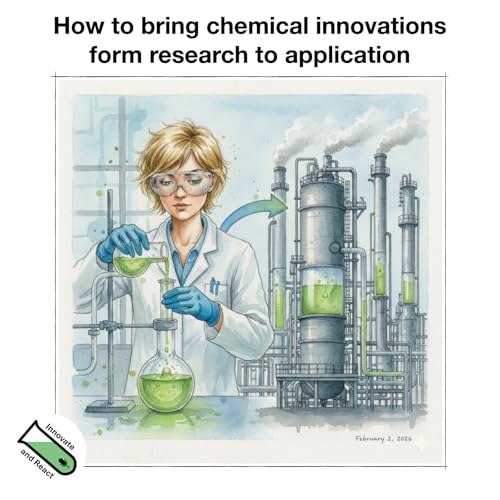
  • How to bring chemical innovations from research to application
    2026/02/03
    In this episode of Innovate and React, i am talking with Dr. Petra Ryl, innovation and talent lead at greenCHEM Berlin. We explore how innovation is transforming the chemical industry and how research from universities can be applied practically. Petra shares her journey from academic biochemical research to working at greenCHEM, explaining the importance of sustainable materials and the transition from fossil-based to regenerative resources. They discuss the role of disruptive innovation, the advantages of startups in driving change, and how greenCHEM supports entrepreneurs through various programs, including technology transfer, academic partnerships, and a robust network. Highlights include specific examples of pioneering startups within the greenCHEM network and advice for researchers considering entrepreneurial pathways.
    続きを読む 一部表示
    54 分
  • The beginning and challenges of Natural Products in cancer treatments
    2025/12/30
    This episode of Innovate and React explores the fascinating history of natural product research and its pivotal role in developing life-saving cancer treatments. The journey begins in the 1950s and 60s with the National Cancer Institute's efforts to screen thousands of plant extracts for biological activity. Through the stories of landmark compounds like camptothecin and Taxol, Kevin illustrates the complex collaboration required between botanists and chemists to isolate active ingredients from nature and transform them into viable medical therapies. The episode delves into the origins of Taxol, originally discovered in the bark of the Pacific Yew tree. You will learn about the significant hurdles researchers faced. From the tedious workup to supply chain restrictions caused by harvesting bark from slow-growing trees. Find out how chemists made Taxol a marketable drug and overcame these problems.
    続きを読む 一部表示
    26 分
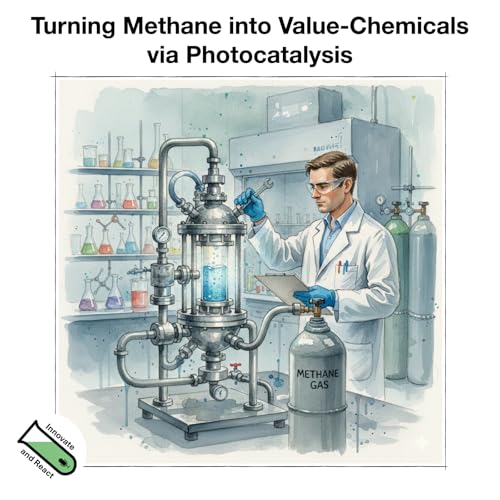
  • Turning Methane into Value-Chemicals via Photocatalysis
    2025/11/26
    In this episode we discuss a novel and sustainable approach to converting methane into valuable chemicals. Currently light hydrocarbons like methane are often simply burned for energy, despite their potential as a carbon source for the chemical industry. Traditional conversion methods like natural gas cracking are energy-intensive, and other functionalization routes require harsh conditions and often toxic chemicals. Dr. Andrés Constantino sharess his research focusing on photocatalysis to achieve the direct functionalization of methane under milder conditions. The key to this method is a supramolecular catalytic system using FeCl3•6H2O and collidine. When irradiated, the catalyst generates a highly active chlorine radical that efficiently abstracts hydrogen from the inert alkane (methane) to form an alkyl radical. The collidine plays a crucial dual role, acting as a base to quench the resulting HCl and as a ligand that stabilizes the iron tetrachloride core. The radicals were used for allylation chemistry, which retains a useful olefin group in the product.
    続きを読む 一部表示
    40 分
  • Sustainable Chemistry and Advances in Catalysis
    2025/11/09
    In this episode we discuss sustainable chemistry and the replacement of critical materials like platinum group elements with guest Dr. Soumyadeep Chakrabortty from the Max-Planck-Institute for Kohlenforschung. We delve into the importance of sustainability in chemical reactions, the role of catalysis, and the development of more benign and cost-effective catalysts. Soumyadeep shares his experiences with asymmetric hydrogenation and the creation of a new ligands for pharmaceutical applications. The conversation also touches on collaboration between academia and industry and the impact of high-throughput screening and AI on future catalysis research.
    続きを読む 一部表示
    37 分
  • One chemical reaction to feed them all: The synthesis of ammonia
    2025/10/07
    In this episode of Innovate and React, I delve into the groundbreaking discovery of the Haber-Bosch process, which revolutionized agriculture and the chemical industry by synthesizing ammonia from atmospheric nitrogen and hydrogen. Starting with a historical perspective from the 19th, the episode explores the pivotal contributions of Fritz Haber and Carl Bosch to the invention of the Haber-Bosch process. It covers the scientific challenges, innovations, and controversies surrounding Haber’s research, and how Bosch made the reaction viable for industrial scale. The episode also discusses the modern impact and future applications of ammonia in renewable energy systems.
    続きを読む 一部表示
    15 分
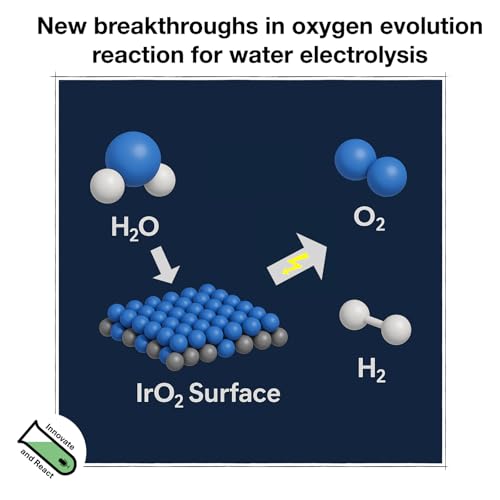
  • New breakthroughs in oxygen evolution reaction for water electrolysis
    2025/09/04
    In this episode of Innovate and React, we dive into the world of water electrolysis and how theoretical chemistry can help design better catalysts for clean hydrogen production. Mohammad Usama, a PhD researcher at the University of Duisburg-Essen, shares his unconventional journey from mechatronics and automotive engineering to electrochemistry and catalysis. We discuss his work on iridium dioxide surfaces for the oxygen evolution reaction (OER)—the bottleneck in water electrolysis—and the discovery of a novel Walden-type pathway. This finding helps us to better understand the reaction mechanism and could lead to the discovery of enhanced catalysts. We also touch on how AI and data-driven approaches are transforming catalyst discovery, from nitrogen oxidation research to the future of digital twins and automated labs.
    続きを読む 一部表示
    41 分