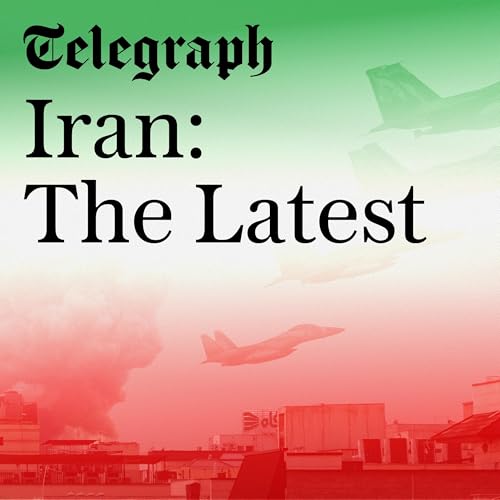
『Iran: The Latest』のカバーアート

Iran: The Latest

Iran: The Latest

著者: The Telegraph
無料で聴く

概要

Iran: The Latest is The Telegraph’s defence, security and foreign affairs news podcast providing deep-dive analysis on the ongoing conflict between the US, Israel and Iran.


Veteran foreign correspondents Roland Oliphant and Venetia Rainey bring you the latest updates from The Telegraph’s award-winning journalists, plus exclusive interviews with world-class experts in military strategy, international relations, and Middle East policy.


From attacks on the Gulf to Hezbollah in Lebanon to the Houthis in Yemen to the threat of nuclear escalation, stay informed with the best of The Telegraph’s Middle East coverage in one place. As the geopolitical landscape shifts, subscribe for essential updates on the security shifts defining our global future.


Every Wednesday on Battle Lines: Global Health Security they’re joined by Arthur Scott-Geddes to look at the intersection between health and security, from bioweapons to warzone diseases to frontline medicine. You can watch these episodes here.


Battle Lines, a defence podcast with a wider scope and created by David Knowles, previously lived on this feed.


Don’t forget to follow and leave a review to stay updated on the latest in global conflict and foreign affairs.

Battle Lines: Global Health Security is supported by the Bill and Melinda Gates Foundation.

Hosted on Acast. See acast.com/privacy for more information.

© Copyright 2026. All rights reserved.
政治・政府
エピソード
  • One month of Iran-US war: Assassinations, missiles and the Strait of Hormuz
    2026/03/31

    After one month of the US-Iran war, who is winning and who is losing?


    Roland Oliphant and Venetia Rainey step back to examine how much of US President Donald Trump’s original war goals have been achieved, from destroying Iran’s missiles, navy and regional proxies to regime change and preventing the development of nuclear weapons.


    They also look at the role of Israel, the impact of attacks on the Gulf and the global economic shock caused by Iran’s closure of the vital waterway, the Strait of Hormuz.


    Plus, they discuss the depletion of global munition stocks after a month of air strikes, how the conflict has further frayed the Western alliance and what all that means for Ukraine and Russia.


    If you’ve been struggling to keep up with the latest news from the Middle East conflict, this is an update and analysis of everything you need to know from March 2026.


    CONTRIBUTORS:


    Roland Oliphant, co-host and chief foreign affairs analyst @RolandOliphant

    Venetia Rainey, co-host @venetiarainey


    CONTENT REFERENCED:


    Why tens of millions face hunger and poverty in wake of Trump’s Iran war

    American troops forced to withdraw from Middle East bases

    RUSI: Over 11,000 munitions in 16 Days of the Iran War: ‘Command of the Reload’ Governs Endurance


    Producer: Peter Shevlin

    Executive Producer: Louisa Wells


    ► Sign up to our most popular newsletter, From the Editor. Look forward to receiving free-thinking comment and the day's biggest stories, every morning. telegraph.co.uk/fromtheeditor


    ► EMAIL US: Contact the team on battlelines@telegraph.co.uk


    ► GET THE LATEST HEADLINES: Find all our latest Iran coverage here: https://www.telegraph.co.uk/iran-war/

    Hosted on Acast. See acast.com/privacy for more information.

    続きを読む 一部表示
    41 分
  • Iran vows to ‘rain fire’ on US troops, the Houthi ‘nightmare’ & on the ground in Tehran
    2026/03/30

    Is the US about to invade Iran?


    Warship USS Tripoli has arrived in the Middle East with thousands of fresh troops, and the USS Boxer is not far behind - but Iran has vowed to “rain fire” on any American troops who set foot on its territory. Meanwhile, Trump is said to be considering taking Kharg Island and has been claiming regime change has already happened.


    Venetia Rainey and Roland Oliphant discuss all the latest updates, along with the impact on the price of oil and Israel expanding its offensive in southern Lebanon.


    Yemen expert and University of Cambridge mistress Elisabeth Kendall explains why the Houthis joining the war is so significant and how they could turn things into a “nightmare”.


    Plus, a glimpse into daily life on the ground in Tehran. Norwegian Refugee Council’s Iran director, Martje van Raamsdonk, joins from the Iranian capital to talk about how bombing has intensified in recent days, prompting residents to tape up their windows, and growing fears and uncertainty amid talks of a US invasion.


    CONTRIBUTORS:


    Roland Oliphant, co-host and chief foreign affairs analyst @RolandOliphant

    Venetia Rainey, co-host @venetiarainey

    Elisabeth Kendall, president of Girton College, @Dr_E_Kendall

    Martje van Raamsdonk, Norwegian Refugee Council’s Iran director


    CONTENT REFERENCED:


    Trump needs troops to seize the Strait of Hormuz. These are his options


    ‘Gate of Tears’ could be a strait too far for Trump’s military


    Producer: Peter Shevlin

    Executive Producer: Louisa Wells


    ► Sign up to our most popular newsletter, From the Editor. Look forward to receiving free-thinking comment and the day's biggest stories, every morning. telegraph.co.uk/fromtheeditor


    ► EMAIL US: Contact the team on battlelines@telegraph.co.uk


    ► GET THE LATEST HEADLINES: Find all our latest Iran coverage here: https://www.telegraph.co.uk/iran-war/

    Hosted on Acast. See acast.com/privacy for more information.

    続きを読む 一部表示
    37 分
  • ‘A full spectrum crisis’: how the Iran war went global
    2026/03/27

    Iran’s blockade of the Strait of Hormuz has already pushed up oil prices. But is a bigger global economic disruption yet to come? And how long will it last?


    The Telegraph’s World Economy Editor Ambrose Evans-Pritchard joins Roland Oliphant to explain why the Iran conflict is sending shock waves around the world - and not just in the oil market.


    From fertiliser to helium to sulphur, the block on shipping through the Strait carries other key commodities used by the tech industry, hospitals and farmers. Ambrose explains how the war will almost certainly cause a global food shock in 2027.


    They also discuss how Russia and China are benefitting from the Iran war and why the Houthis in Yemen remain the dog that hasn’t barked - but could make things even worse than they are now.


    Plus, Roland Oliphant and senior foreign correspondent Sohia Yan analyse the latest news from the Iran war, including Donald Trump’s ongoing attempts at peace talks with Tehran, the US Navy’s first ever use of unmanned surface boats and why AP is now calling Israel’s attack on Lebanon an invasion.


    CONTRIBUTORS:


    Roland Oliphant, co-host and chief foreign affairs analyst @RolandOliphant

    Sophia Yan, senior foreign correspondent @sophia_yan

    Ambrose Evans-Pritchard, world economy editor


    CONTENT REFERENCED:


    Roland Oliphant: Trump needs troops to seize the Strait of Hormuz. These are his options


    Ambrose Evans-Pritchard: China has already won the Gulf War


    Ambrose Evans-Pritchard: The longer Trump’s war drags on, the worse the coming global food crisis


    Producer: Peter Shevlin

    Executive Producer: Louisa Wells


    ► Sign up to our most popular newsletter, From the Editor. Look forward to receiving free-thinking comment and the day's biggest stories, every morning. telegraph.co.uk/fromtheeditor


    ► EMAIL US: Contact the team on battlelines@telegraph.co.uk


    ► GET THE LATEST HEADLINES: Find all our latest Iran coverage here: https://www.telegraph.co.uk/iran-war/

    Hosted on Acast. See acast.com/privacy for more information.

    続きを読む 一部表示
    34 分
まだレビューはありません