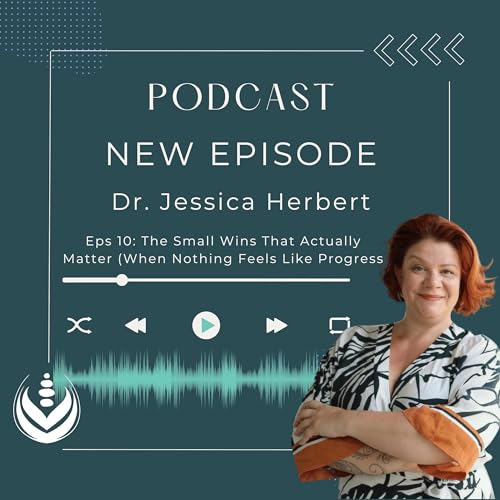
『Leading in Balance』のカバーアート

Leading in Balance

Leading in Balance

著者: jessica herbert
無料で聴く

今ならプレミアムプランが3カ月 月額99円

2026年5月12日まで。4か月目以降は月額1,500円で自動更新します。

概要

You've built a career. You've proven yourself. And now everything is changing—your role, your company, maybe your entire sense of what's next. Leading in Balance is the podcast for experienced leaders who refuse to let transition define them, but are ready to redefine themselves. Host Dr. Jessica Herbert, an ICF Professional Certified Coach who has spent 27+ years working with high-impact leaders in high-stress environments, knows the territory. She's lived the burnout, learned the patterns, and now guides leaders through the ambiguity with both analytical precision and human understanding. Each episode tackles the real issues: setting boundaries that actually hold, navigating difficult conversations with clarity, and creating space for the creativity and connection that transactional leadership steals. You'll walk away with reflection activities and practical tools to shift from surviving change to designing what comes next. Because balance isn't about doing it all—it's about choosing what matters.Copyright 2026 jessica herbert 個人的成功 出世 就職活動 社会科学 経済学 自己啓発
エピソード
  • The Small Wins That Actually Matter (When Nothing Feels Like Progress)
    2026/03/12

    EPISODE SUMMARY

    You're in the messy middle of transition. You've applied to 50 jobs with no offers. You've tried multiple activities and nothing has clicked yet. You're learning a new role but still feel behind. And it feels like nothing is happening.

    But here's the truth: Progress isn't always visible. That doesn't mean it's not happening.

    This episode is about recognizing the small wins you've been dismissing. Because small wins aren't consolation prizes—they're how real progress happens. They rebuild confidence. They create momentum. They sustain you when the big win hasn't come yet.

    Jessica shares her story of cleaning out a garage in 115-degree Phoenix heat—where some days, getting one bin sorted was a win. After the tenth trip to donation, she finally saw the progress. But if she'd waited for the "after" to feel good about it, she would have missed the small wins that kept her going.

    You've been building capacity this whole time. You've navigated extended transitions, rebuilt routine, addressed financial anxiety, broken the comparison noise, and shown up day after day even when nothing felt like it was working. That's not nothing. That's everything.

    And now you're ready for Phase 3: Designing What's Next.

    RESEARCH & RESOURCES MENTIONED

    1. Teresa Amabile (Harvard Business School): The Progress Principle - Single most powerful motivator is progress (even small, incremental). When people feel they're making progress (even small ways), motivation/creativity/engagement increase. When stuck, everything declines. To sustain motivation during difficult uncertain work, make progress visible—notice it, name it, celebrate it.
    2. BJ Fogg: Tiny Habits - Small actions compound over time. Success breeds success. Small wins create momentum. Make it easy to win early and often—every small win builds belief (self-efficacy) that you CAN do this. That belief carries you through hard middle.
    3. Albert Bandura: Self-Efficacy Research - Self-efficacy = belief in your ability to succeed. Most powerful way to build it: mastery experiences (small successes proving you're capable). In transition, self-efficacy takes hit. Only way to rebuild: small wins—noticing small actions where you showed up, tried, learned, did something hard.
    4. The Momentum Principle (Physics) - Objects in motion stay in motion. When stuck, even small movement matters. Small actions break paralysis. Once in motion, staying in motion easier than starting from stillness. Small wins create momentum that carries you forward when motivation fails.

    THIS WEEK'S REFLECTION ACTIVITY

    Download the Small Wins Tracker & Progress Recognition worksheet

    CONNECT WITH JESSICA

    If you're navigating an extended transition and need support redefining what progress actually looks like, visit Asbatra.com to learn about one-on-one coaching. We don't just talk about patience—we set micro-milestones, experiment, and build tolerance for the timeline without the guilt.

    Website: https://www.asbatra.com/

    Substack: https://asbatracoaching.substack.com/- Join the community for deeper discussions and downloadable worksheets

    Leave feedback: Use the thumbs up/down button in your podcast app or comment on Substack

    EPISODE CREDITS

    Host & Producer: Asbatra Coaching

    Episode Length: 26 minutes

    続きを読む 一部表示
    27 分
  • When Everyone Else Has Moved On (But You're Still Here)
    2026/03/05

    EPISODE SUMMARY

    You're in transition. And everyone else keeps moving. Former colleagues get promoted. Peers land new roles. LinkedIn is full of announcements—new jobs, six-figure consulting businesses, speaking engagements, awards. And you're still here. Still looking. Still figuring it out. Still in the middle.

    Every time you see someone else's win, a voice in your head asks: "What's wrong with me? Why is everyone else figuring this out except me?"

    Here's the truth you need to hear: Their timeline isn't your timeline. You're comparing your messy middle to their curated highlight reel. And that comparison is stealing energy you need to actually move forward.

    This episode is about breaking the noise. The LinkedIn comparison spiral. The family and friends who mean well but contribute to comparison. The constant pressure to perform like everyone else is thriving while you're struggling. It's about knowing when to engage and when to step back. And it's about focusing on YOUR circle of control instead of everyone else's highlight reel.

    Because comparison during transition is toxic. And you can't move forward while you're constantly looking sideways at everyone else's path.

    RESEARCH & RESOURCES MENTIONED

    1. Leon Festinger: Social Comparison Theory - Humans have inherent drive to evaluate ourselves; when we lack objective measures, we compare to others. Upward comparison (to people "ahead") can motivate or destroy depending on whether you believe you can reach their level. Downward comparison (to people "behind") temporarily boosts self-esteem but doesn't help you move forward.
    2. Temporal Comparison Research - Comparing current self to past self (rather than to others) is associated with higher wellbeing, lower anxiety, and more sustainable motivation. Keeps you focused on your own trajectory instead of everyone else's timeline.
    3. Reference Group Theory - Who you compare to matters enormously. Comparing to immediate circle (former colleagues, peers) feels personal. Comparing to strangers broadcasting wins on LinkedIn—you're comparing to a curated performance designed to impress.
    4. Social Media and Wellbeing Research - More time on social media during transition = worse feelings. Constant exposure to others' highlight reels while living in your messy middle creates toxic comparison cycle.

    THIS WEEK'S REFLECTION ACTIVITY

    Download the Comparison Audit & Circle of Control worksheet

    CONNECT WITH JESSICA

    If you're navigating an extended transition and need support redefining what progress actually looks like, visit Asbatra.com to learn about one-on-one coaching. We don't just talk about patience—we set micro-milestones, experiment, and build tolerance for the timeline without the guilt.

    Website: https://www.asbatra.com/

    Substack: https://asbatracoaching.substack.com/- Join the community for deeper discussions and downloadable worksheets

    Leave feedback: Use the thumbs up/down button in your podcast app or comment on Substack

    EPISODE CREDITS

    Host & Producer: Asbatra Coaching

    Episode Length: 33 minutes

    続きを読む 一部表示
    34 分
  • The Financial Anxiety That's Keeping You Up at Night
    2026/02/26

    EPISODE SUMMARY

    Financial anxiety during transition is real. When your income changes—whether you planned for it or not—everything shifts. For a majority of Americans, basic needs suddenly feel unaffordable. Housing. Food. Healthcare. The things you used to take for granted now keep you up at night.

    And here's what nobody tells you: There are plenty of resources out there about how to save money, create budgets, and plan financially. But almost no one tells you how to deal with the emotions during the transition—the fear, the shame, the constant mental calculation of "Can I afford this?" The anxiety that wakes you up at 3am doing math in your head.

    This episode isn't about teaching you to budget. It's about identifying what makes YOU feel financially secure so you can focus on those things during transition. It's about asking what you're actually willing to do. It's about separating scarcity thinking from strategic thinking. And it's about making financial decisions from strategy—not panic.

    Because financial anxiety and financial reality aren't always the same thing. And when you can separate fear from facts, you can think clearly instead of just reacting.

    RESEARCH & RESOURCES MENTIONED

    1. Morgan Housel: "The Psychology of Money" - Financial decisions are based on psychology, not spreadsheets. Your relationship with money is shaped by background, experiences, and fears. What feels secure varies by person—you must understand YOUR psychology to make strategic decisions.
    2. Sendhil Mullainathan & Eldar Shafir: "Scarcity: Why Having Too Little Means So Much" - Scarcity limits mental bandwidth through "scarcity capture"—constant worry creates cognitive load that prevents strategic thinking. Financial anxiety depletes your ability to make good decisions.
    3. Mike Michalowicz: "Profit First" - Business financial strategy adapted for personal use: create separate accounts for different purposes (rent, basic needs, flexible spending). Physical separation reduces anxiety and prevents constant mental math.
    4. Wallace Wattles: "The Science of Getting Rich" - Abundance thinking vs. scarcity thinking. Shift from "There's not enough" to "What resources can I create or reallocate?" Not toxic positivity—strategic questioning.
    5. Annie Duke: "Quit: The Power of Knowing When to Walk Away" - Strategic resource reallocation. Calculate expected value going forward, not backward. Moving to cheaper location, taking interim work, or changing lifestyle isn't failure—it's smart strategy.

    THIS WEEK'S REFLECTION ACTIVITY

    Download the Financial Security Inventory worksheet

    CONNECT WITH JESSICA

    If you need support navigating financial anxiety and making strategic decisions under pressure, visit Asbatra.comto explore one-on-one coaching. We separate fear from facts, identify what actually creates security for you, and build strategic plans that give you runway without compromising what matters. It's for people who want to make financial decisions from strategy, not panic.

    Website: www.asbatra.com

    Substack: https://asbatracoaching.substack.com/ - Join the community for deeper discussions and downloadable worksheets

    Leave feedback: Use the thumbs up/down button in your podcast app or comment on Substack

    EPISODE CREDITS

    Host & Producer: Asbatra Coaching

    Episode Length: 33 minutes

    続きを読む 一部表示
    42 分
まだレビューはありません