エピソード

  • Why There's No CEE Market — And No Amazon of the East #LTM155
    2026/06/25

    Amazon lost 50% of its Czech e-commerce revenue. Not once — twice, in two consecutive years. That's the data point that triggered this conversation. But the more interesting story isn't Amazon's decline. It's what that decline reveals about a region that Western e-commerce still fundamentally misreads.

    David Cikanek is a Prague-based marketplace expert who has spent years helping brands navigate Amazon and the broader CEE landscape. In this episode, he pushes back hard on one of the most persistent myths in European e-commerce: that Central and Eastern Europe is one market with one strategy. It isn't. The Czech Republic spends per capita are comparable to the Netherlands. Poland has Allegro — a genuine platform giant with 30%+ market share. Romania had eMAG, once called the Amazon of the East, now quietly retreating while a Turkish challenger backed by Chinese money closes in. Hungary is behind the rest of the region in terms of online penetration. These are not variations on a theme. They are different markets.

    We also get into why Temu is winning the region while Shein is losing, why Kaufland's marketplace expansion raises more questions than it answers amongst the locals, and why TikTok Shop is more likely to be an upper-funnel discovery tool than a structural threat.

    This episode is for anyone who has ever looked at CEE on a map and thought: same region, same playbook. Spoiler: it isn't.

    📊 The CZ marketplace data chart referenced in this episode: https://www.linkedin.com/feed/update/urn:li:activity:7470062455113691137/

    続きを読む 一部表示
    37 分
  • The EU Is Coming for Shemu – Plus More Marketplace News LTM #154
    2026/06/11

    The EU fined Temu €200M, France hit Shein with another penalty. Is this the turning point many in European e-commerce have been waiting for? In this episode, Ingrid and Valerie go through the most important marketplace news of the last few weeks. Their take on regulation: it works – slowly, but for real. The first genuine DSA enforcement actions against Temu and Shein are a clear signal. Amazon dominates two news blocks: Prime Day this year runs from 23 to 26 June – earlier and longer than ever before. And with Amazon Supply Chain Services, Amazon is opening its entire logistics network to every industry for the first time. Meanwhile, the AI shopping race is already running: structured product data is your advantage now – for AI agents and human customers alike. Also: JD.com is eyeing the UK's Very Group after the Ceconomy deal was put on hold, Otto is opening to Polish sellers, and eBay is making a clear recommerce statement in its fee structure.

    Note to Agentic Commerce:

    AI shopping is moving so fast that even a dedicated news block barely scratches the surface. For the fuller picture, we published a deep-dive analysis on marketplace-universe.com. https://marketplace-universe.com/when-buyer-is-algorithm-what-brands-need-to-know-about-agentic-commerce/

    続きを読む 一部表示
    32 分
  • Just Being on TikTok Shop Is Not Enough": Philips' 2-Year Playbook for Europe #LTM153
    2026/06/05

    A 130-year-old brand on a channel that didn't exist five years ago - and one of the most honest assessments of TikTok Shop you're likely to hear. Stephanie Vanderplank-Jones built Philips' TikTok Shop business in the UK from scratch and is currently expanding into Germany, France and Spain. In this episode, she explains why 80% of Philips customers spend more than two and a half hours on TikTok every day - and why that was the decisive reason for Philips to enter TikTok Shop. She talks about why the first six to nine months on the platform are essentially a paid experiment, and how to bring stakeholders through that phase without losing their trust. Stephanie also explains why affiliates require far more work than most brands expect - and why that's especially true in newer markets like Germany. And she makes clear why TikTok Shop isn't just for low-priced products: Philips now sells devices up to €400 on the platform.

    Note from the sponsor ChannelEngine:

    20,000 SKUs across seven Kaufland markets - without starting from scratch seven times. The Handyhuellen.de case shows how an existing Kaufland Germany setup was rolled out to six additional countries with the help of ChannelEngine - and why that is exactly what makes the difference in cross-border expansion. Individual markets were technically activated in around two hours, the new countries reached around 50% of Germany's sales volume after one year, and Italy is already number two after Germany. The full case with all the details is available at Marketplace Universe. https://marketplace-universe.com/best-practice-how-handyhuellen-de-scaled-into-seven-kaufland-markets/

    続きを読む 一部表示
    37 分
  • From Headache to Scale: How AI Is Changing Fashion Content Production #LTM152
    2026/05/28

    AI can generate an impressive product image – but can it deliver that same image, correctly named, in the right format, and on time to Zalando, About You, and Amazon simultaneously? That, says Fabio Loparco, CEO of Pixel Moda, is where the real problem lies. In this episode, Valerie speaks with Fabio about what has changed in AI-powered content production for fashion brands since September 2025. They discuss why AI-assisted and Generative AI are two fundamentally different business models. Why scalability doesn't come from the tool itself, but from its integration into the production infrastructure. And why Zalando produces 70% more content at the same cost – not because they have better AI, but because they rebuilt their operating model around it.

    Note from the sponsor ChannelEngine:

    TikTok Shop is worth it – but only if you get the fundamentals right. Because TikTok Shop rewards content performance, runs on creator trust, and punishes weak operational processes. The brands winning right now have the infrastructure to back up their content strategy. That's exactly where ChannelEngine comes in: the platform connects your backend directly to TikTok Shop, handling real-time stock sync, listing compliance, and order routing – so your operations don't fall apart when your content takes off. The full deep dive on how to win on TikTok Shop is right here on Marketplace Universe. https://marketplace-universe.com/how-to-succeed-on-tiktok_shop/

    Note from the sponsor eDesk:

    Every unanswered pre-sale question can mean a lost purchase. Every slow response can hurt seller performance. And every poorly handled complaint can turn into a negative review that affects visibility for weeks. Many sellers spend months optimising ads, listings and prices – but a significant share of revenue is won or lost in a place many still underestimate: the inbox. That's exactly what we'll be discussing in a free webinar on 2 June at 11 AM CET with Gareth Cummings, CEO of eDesk, and Irene Epp from Pertemba – who sell on more than 100 global marketplaces and handle over 1,000 customer inquiries per day. Register right now here: https://zoom.us/webinar/register/6717775614141/WN_45_8U9P_TKWx-WzmbZnGFQ#/registration

    続きを読む 一部表示
    44 分
  • What's up eBay Live? Taking stock six months after the launch #LTM151"
    2026/05/21

    Live commerce in Europe is still too often viewed through an Asian lens - and that's exactly the problem. In this episode, Ingrid sits down with Lara Day, who has been building eBay Live in Germany for the past year, six months after the official launch. They explore why the European model needs its own logic and can't simply be a watered-down version of the Asian one.

    They discuss why re-commerce, secondhand and fashion are the natural entry points for live commerce in Europe - not because of entertainment value, but because live commerce solves a trust problem that static product images never could. And why returns play a bigger role in this equation than most people assume.

    The episode also features two sellers who are already active on eBay Live: Benjamin Gabriel, who sells refurbished electronics, and Meroda, who sells vintage fashion. Both describe how the personal connection to the buyer in a live stream changes purchase decisions - and reduces returns.

    Plus: how much technology and production does a successful live stream actually require? The answer might surprise you.

    Note to the eBay webinar:

    Want to go deeper? On June 16, 11. a.m. we're hosting a free webinar What It Really Takes to Succeed in Live Commerce together where Mason Howell from eBay and Ingrid Lommer will walk you through exactly how eBay Live works, what you need to get started, and how brands and retailers can make the most of it. Here's the Registration Link: https://zoom.us/webinar/register/5017786708012/WN_2aFhsYAMSIa8ZIgyy0TJ2g

    続きを読む 一部表示
    36 分
  • Welcome back, Valerie: What a baby does to business. #LTM150
    2026/05/07

    Welcome back, Valerie: What a baby does to business. #LTM150

    Episode 150 is a special one – and a very personal one. Valerie is back after four months of maternity leave, and to mark the anniversary, the two take a moment for an honest look behind the scenes.

    They talk about what it was like to steer a business through a time like this - for Ingrid, who held the wheel on her own, and for Valerie, who learned that being pregnant and being a founder in Germany comes with almost no systemic support. The fact that it worked anyway comes down to a strong partner, a team of ten women working behind the scenes - and a business structure that can withstand phases like this. They speak openly about why they kept the pregnancy quiet for so long, what they learned about trust in business, and how motherhood changes the way you work.

    An episode about partnership, reliability - and what really keeps a business standing when it matters most.

    続きを読む 一部表示
    30 分
  • 11 Giants, 83% Share: A Data-Driven Map of Marketplace Concentration #LTM149
    2026/04/30

    In this episode the focus is on data: Ingrid speaks with Friedrich Schwandt, co-founder of ECDB, about current developments in the global marketplace landscape. At the centre are new insights into market concentration, the growth of 3P models, and shifting dynamics among leading platforms.

    They discuss why 84% of global e-commerce revenue now flows through marketplaces and how power structures within the top players are evolving – driven by the rapid growth of platforms like Temu, Shein or TikTok Shop.

    At the same time, they take a closer look at regional champions and category specialists, analysing how to identify whether a marketplace model is being built strategically or merely “running on the side.” The conversation also covers new transparency around 1P and 3P shares, the role of data modelling and estimation, and why 3P has become the central growth driver in e-commerce.

    続きを読む 一部表示
    39 分
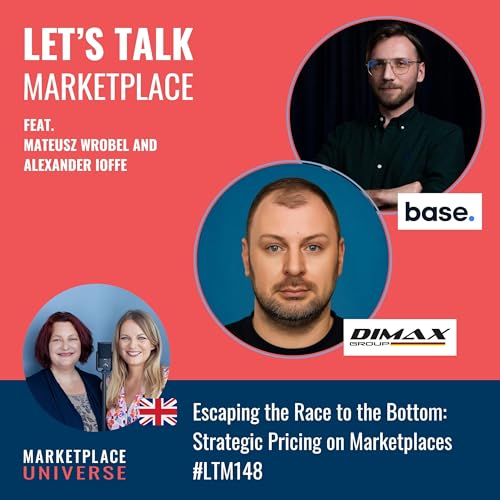
  • Escaping the Race to the Bottom: Strategic Pricing on Marketplaces #LTM148
    2026/04/23

    Pricing on marketplaces is no longer just an operational lever. In this episode, Ingrid talks to Alexander Ioffe (Dimax Group) and Mateusz Wrobel (base) about the reality behind repricing and automation.

    It becomes clear that prices are shaped by a combination of factors: competition, platform logic, availability, margins and strategic goals - and often also by dynamics within a brand’s own distribution network. When multiple partners sell the same brand, different calculations collide and can trigger self-reinforcing price spirals.

    They explain why automation is necessary, but does not replace strategy. Repricing tools react faster, but they don’t decide why prices should be adjusted. This is where the work shifts: away from operational maintenance towards clearly defined price boundaries and strategic control.

    An episode about control, responsibility and the question of how much you should really leave to automation.

    Note from the sponsor Channable:

    Incomplete or inaccurate product data quickly costs visibility and margin in the marketplace business. This is especially true in the DIY segment, where a single centimetre can make a huge difference. Because here, it’s not about “Do I like it?”, but whether a product actually fits, works, and is correctly classified. Channable sees this every day. The integrator works with product feeds across multiple categories and marketplaces – and has a clear view of where data does not align with platform logic. What’s interesting is that the issues are often not that complex. More on how to improve product data can be found in this LinkedIn post: https://www.linkedin.com/posts/valerie-dichtl_2-m-instead-of-200-cm-and-your-product-share-7448286365009666049-hxVb?utm_source=share&utm_medium=member_desktop&rcm=ACoAAAdsMEUB4XWtREmwGDN_WBf1ZK4QGlwZlME

    Note from the sponsor Front Row

    If you work with marketplaces, you probably know this situation: your Amazon team optimizes retail media, your D2C team looks at CRM and lifetime value, and your performance team focuses on ROAS. But the customer doesn’t experience your brand in separate channels. From the customer’s perspective, it’s all one journey - from discovery on social media to research on marketplaces and finally to purchase. And that’s exactly what the new Connected Commerce Guide by Front Row is about. The guide explains how brands can connect Amazon, D2C, retail media and CRM into one system instead of optimizing each channel individually. It shows why focusing only on short-term metrics like ROAS often hides the real impact marketplaces have on the overall customer lifetime value. You can download the Connected Commerce Guide by Front Row for free here: https://www.frontrowgroup.de/insight/connected-commerce-guide/

    続きを読む 一部表示
    30 分