エピソード

  • #22A Who Keeps the Power Grid Stable? (AI dubbed via elevenlabs)
    2026/04/13
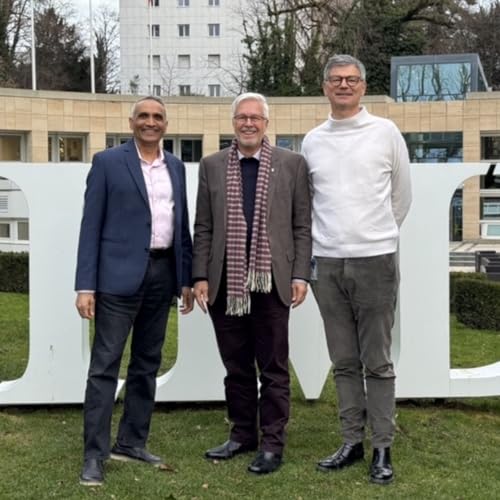
    How does a power grid stay stable when thousands of producers feed electricity into it at the same time? A conversation with Tobias Andrist, CEO of EBL. Recorded at EBL headquarters in Liestal.
    続きを読む 一部表示
    25 分
  • #22B Wer hält das Stromnetz stabil?
    2026/04/12
    Wie bleibt ein Stromnetz stabil, wenn tausende Produzenten gleichzeitig einspeisen? Ein Gespräch mit Tobias Andrist, CEO der EBL. Aufgenommen am Hauptsitz in Liestal.
    続きを読む 一部表示
    25 分
  • #21B - Kein Green Premium – Wie Innovation Nachhaltigkeit marktfähig macht (Teil 2) {KI gedubbt}
    2026/02/17
    {TEIL 2} Ein Gespräch mit den IMD-Professoren Fréderic Dalsace und Goutam Challagalla über „No Green Premium“ und den Wandel von Nachhaltigkeit als Right to Play hin zu Innovation als Right to Win. Mit realen Unternehmensbeispielen und Einblicken in ihr im Harvard Business Review vorgestelltes Buch Clean Winners, das während der WEF-Woche 2026 in Davos lanciert wurde. Teil 1 beleuchtete die Compliance-getriebenen Vorteile. Teil 2 steht für Sustainability 2.0. Die zentrale Idee von Clean Winners ist: Nachhaltigkeit wird erst dann zum Wettbewerbsvorteil, wenn sie Innovation antreibt, die Ressourcenallokation steuert und neuen Kundennutzen schafft. Solange sie primär als Reporting- und Compliance-Aufgabe verstanden wird, bleibt sie ein notwendiger Kostenfaktor – aber kein Differenzierungsmerkmal. Die meisten Unternehmen beginnen beim „Right to Play“: Reporting, Risikoreduktion und Reputation. Der nächste Schritt ist Effizienz – Energie sparen, Materialien reduzieren, Prozesse optimieren. Der eigentliche strategische Hebel entsteht jedoch erst, wenn Nachhaltigkeit zur Wachstumsplattform wird. In dem Moment, in dem Unternehmen verstehen, wie sich die Bedürfnisse ihrer Kunden verändern, und darauf mit neuen Lösungen und Geschäftsmodellen reagieren. Damit verschiebt sich auch die zentrale Managementfrage. Nicht mehr: „Wie werden wir compliant?“ Sondern: „Wo investieren wir unsere knappen Ressourcen so, dass durch Nachhaltigkeit zukünftiges Wachstum entsteht?“ Die grösste Chance liegt nahe beim Kunden – im Verständnis dafür, wie sich dessen Prozesse verändern und welche neuen Fähigkeiten und Lösungen künftig gebraucht werden. Deshalb gilt das Prinzip: beim Kunden beginnen, nicht beim Fussabdruck. Intern zu messen und zu optimieren ist notwendig – Differenzierung entsteht aber erst, wenn man den Kunden hilft, ihre eigene Transformation erfolgreich zu gestalten. Für Unternehmen im CSRD-Kontext ist die Konsequenz klar: Nachhaltigkeit schafft nur dann echten Wert, wenn sie in die Kernprozesse integriert wird – in Strategie, Innovation, Marketing und Vertrieb, Einkauf, Produktion und Lieferung, das After-Market-Geschäft und die Kapitalallokation. Wird sie als paralleler Reporting-Strang geführt, bleibt sie Compliance. Wird sie integriert, wird sie zum Treiber von Innovation, Wachstum und Resilienz. Die eigentliche Gefahr besteht darin, Nachhaltigkeit vollständig in einer Compliance-Logik zu verbrauchen. Das erzeugt viel Aktivität und viele Daten, aber wenig strategische Wirkung. Die Führungsaufgabe besteht darin, die regulatorischen Anforderungen zu erfüllen und gleichzeitig genügend Ressourcen und Fokus zu sichern, um Nachhaltigkeit in zukünftige Wertschöpfung zu übersetzen.
    続きを読む 一部表示
    1 時間 11 分
  • #21A - No Green Premium – Sustainability Needs Innovation to Win Customers (Part 2)
    2026/02/17
    {PART 2} A conversation with IMD professors Frédéric Dalsace and Goutam Challagalla on “no green premium” and the shift from sustainability compliance as a right to play toward innovation as a right to win. Real-world business cases and insights from their HBR-published book Clean Winners, launched in Davos during 2026 World Economic Forum week. Part 1 focussed on compliance related benefits, Part 2 talks about Sustainability 2.0. The central idea behind Clean Winners is that sustainability becomes a competitive advantage only when it drives innovation, guides resource allocation, and creates new value for the customer. As long as it is treated mainly as a compliance and reporting exercise, it remains a cost of doing business — necessary, but not differentiating. Most companies begin with “right to play”: reporting, risk reduction, and reputation. The next step is efficiency — saving energy, reducing materials, improving processes. But real strategic impact starts when sustainability becomes a growth platform. That is the moment when companies understand how customer needs are changing and develop new solutions and business models in response. This shifts the key management question. It is no longer “How do we become compliant?” but “Where do we invest our scarce resources so that sustainability creates future growth?” The real opportunity is close to the customer: understanding how their processes are transforming and what new capabilities they will need. That is why the principle is to start from the customer, not from the footprint. Measuring and optimising internally is essential, but differentiation comes from helping customers succeed in their own transformation. For companies working with CSRD, the implication is clear. Sustainability creates value only when it is embedded in the core processes of the business — in strategy, innovation, marketing and sales, purchasing, manufacturing and delivery, the after-market, and capital allocation. If it is managed as a parallel reporting stream, it stays compliance. If it is integrated, it becomes a driver of innovation, growth, and resilience. The real risk is to consume sustainability in a purely compliance logic. That generates a lot of activity, but little strategic effect. The leadership challenge is to meet the regulatory requirements while preserving the resources and the focus needed to turn sustainability into future value creation.
    続きを読む 一部表示
    1 時間 11 分
  • #20B - Kein Green Premium – Wie Innovation Nachhaltigkeit marktfähig macht (Teil 1) {KI gedubbt}
    2026/02/11
    Ein Gespräch mit den IMD-Professoren Frédéric Dalsace und Goutam Challagalla über „no green premium“ und den Wandel von Nachhaltigkeits-Compliance als 'right to play' hin zu Innovation als 'right to win'. Praxisnahe Business-Beispiele und Einblicke aus ihrem im Harvard Business Review veröffentlichten Buch Clean Winners, das während der World-Economic-Forum-Woche in Davos vorgestellt wurde. Die deutsche Version dieses englischen Podcast wurde mittels Dubbing auf ElevenLabs durchgeführt und nach bearbeitet.
    続きを読む 一部表示
    50 分
  • #20A - No Green Premium – Sustainability Needs Innovation to Win Customers (Part 1)
    2026/02/09
    A conversation with IMD professors Frédéric Dalsace and Goutam Challagalla on “no green premium” and the shift from sustainability compliance as a right to play toward innovation as a right to win. Real-world business cases and insights from their HBR-published book Clean Winners, launched in Davos during 2026 World Economic Forum week.
    続きを読む 一部表示
    50 分
  • #19A - A New Approach to Electrification – Removing Barriers, Engaging Communities (Dubbed)
    2025/12/31
    Electrification is the backbone of the energy transition – from heat pumps and e-mobility to industrial processes, storage, and smart grids. But very few people grasp what our power systems will actually need to deliver by 2050 if Europe is serious about decarbonization. Professor Deetmar Gräber from TH Ulm explains how many of today’s roadblocks are self-inflicted – and how we can overcome them. An agile approach is key, along with active involvement of the entire community: researchers, policymakers, utilities, and of course, end users.
    続きを読む 一部表示
    40 分
  • #19B – Ein neuer Weg zur Elektrifizierung – Hürden abbauen, Vertrauen schaffen
    2025/11/24
    Elektrifizierung gilt als Rückgrat der Energiewende – Wärmepumpen, E-Mobilität, Industrieprozesse, Speicher, Smart Grids. Doch kaum jemand macht sich klar, was unser Stromsystem bis 2050 tatsächlich leisten muss, wenn Europa ernsthaft dekarbonisieren will. Professor Dietmar Gräber von der TH Ulm zeigt auf, welche Hürden wir uns selbst schaffen und wie wir sie vermeiden können. Dabei ist ein agiles Vorgehen wichtig, und die Einbindung der Community: Forscher, Politiker, Energieversorger und natürlich auch Endkunden.
    続きを読む 一部表示
    40 分