エピソード

  • LaGuardia Runway Collision, Challenger 600 Dual Engine Flameout, and More NTSB Accident Reports
    2026/05/06

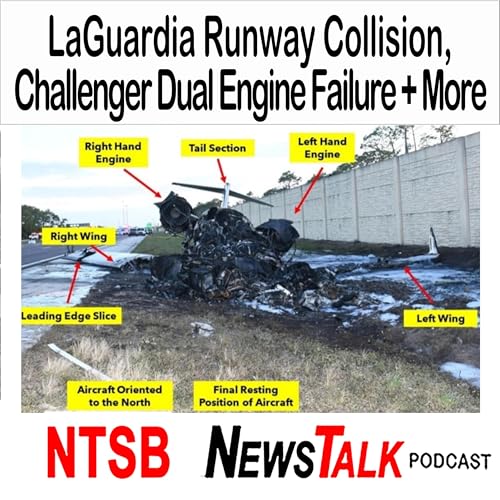
    Max Trescott and Rob Mark analyze the LaGuardia runway collision involving Jazz Flight 646 and an airport firetruck that was cleared to cross runway 4 shortly before the landing regional jet arrived. The discussion focuses on the timing of the crossing clearance, repeated stop instructions, the movement of the firetruck, and the runway entrance lights that extinguished just seconds before impact. Max explains how runway status lights, runway entrance lights, anticipated separation, and ASDE-X are intended to work, and why that design logic may have failed when a moving firetruck reached the runway edge.

    Brought to you by AVEMCO aircraft insurance.

    Support Rob and Max by making a donation at Patreon.com

    The episode also examines the final report on Bombardier Challenger 600 N823KD, which crashed on Interstate 75 near Naples, Florida after both GE CF34-3B turbofan engines flamed out. The NTSB cited corrosion in the engines’ variable geometry systems, which led to near-simultaneous compressor stalls and loss of thrust.

    Additional accidents include Mooney M20J N1151H near Union County Airport, Mooney M20J N205MK near Ironton, Ohio, Beech F-33A Bonanza N8032X at Minneapolis Crystal Airport, Bell 206 N409AE in Tennessee, Beech A36 Bonanza N2882W near Olympic Valley, Beech Super King Air B200GT N886DS near Sharp, Louisiana, Globe GC-1B N2387B near Afton, MN and Extra 300L N22MW near Bandera, Washington. Finally, they talk about N2387B, a Globe GC-1B that crashed while in a flat spin.

    続きを読む 一部表示
    46 分
  • Piper Seminole Crash, Cirrus SR22 Hard Landing, Mooney Door-Pop Spin
    2026/04/22

    Max talks with Rob Mark about a dense lineup of recent accidents and final reports, led by the Piper PA-44 Seminole N595ND crash in Fort Pierce, Florida, the Cirrus SR22 N124SP hard landing in St. Paul, Minnesota, and the Mooney M20K N4387W stall-spin in St. Augustine, Florida, after a cabin door popped open shortly after takeoff. They also examine the Beech 58 Baron N2063G crash in Tennessee, which appears consistent with a VMC demo that turned into a stall-spin, the Sling N166TW crash on Catalina Island after apparent low-level terrain maneuvering, and the Piper Saratoga N4190E runway overrun in Arizona after an excessively fast approach.

    Brought to you by AVEMCO aircraft insurance.

    Support Rob and Max by making a donation at Patreon.com

    In the final-report segment, they break down how distraction likely contributed to the Mooney M20K N4387W crash, why the Piper PA-44 Seminole N595ND shows the danger of trying to salvage a one-engine go-around in a light twin, and how Cessna 172P N781FM likely lost power because of carb ice during a low-power descent. They close with one of the strangest cases in the episode: a damaged battery pack that later ignited and destroyed Mooney M20E N5632Q in Hornell, NY. A brief additional mention covers a separate Cirrus SR22 N285AH that departed the runway in Fullerton, California after the pilot seat slid back on takeoff.

    続きを読む 一部表示
    43 分
  • Cirrus CAPS Save, Go-Around Stall, Advisory Glidepath Trap
    2026/04/08

    Max Trescott and Rob Mark talk about how pilots get into trouble when they misunderstand instrument procedures, mishandle a go-around, or make shockingly poor decisions on the ground and in the air. They open with Max’s unusual call from the NTSB, which asked him to discuss advisory glidepath guidance, the “+V” vertical path shown on some nonprecision approaches. That leads to a sharp discussion of why advisory glidepaths can become traps when pilots confuse LNAV+V or LP+V with true precision-style guidance and fail to respect MDA limits. Garmin has also released a new Service Alert on +V glide paths.

    Brought to you by AVEMCO aircraft insurance.

    Support Rob and Max by making a donation at Patreon.com

    The team first discusses a recent accident in which the pilot of N58544, a Cessna 182, took off from York, PA with at tow bar attached. Rob and Max share what they teach student pilots about the handling of tow bars to avoid these kinds of mishaps.

    They then examine two preliminary reports. In Gulf Shores, Alabama, Beech A36 Bonanza N66519 crashes on approach in weather near minimums after weak radio reception, missed vectors, and a breakdown during the final phase of flight. Near Hartsburg, Missouri, Piper PA-46 Malibu Mirage N451MA breaks up in severe weather after entering a steep descending turn.

    The final reports are just as revealing. Cirrus SR22 N272HM near Lake Elsinore, California becomes a success story when the pilot, task-saturated in IMC, wisely pulls CAPS and survives. Cirrus SR20 N1108T in Key Largo, Florida stalls during a go-around after the flaps are retracted too quickly. The episode also includes a drunk CFI’s VFR-into-IMC Cessna 150 crash, a hand-propping accident in N26AJ, an RV-9, and a runaway Bellanca, N8213R, left idling with a non-pilot onboard.

    続きを読む 一部表示
    41 分
  • LaGuardia Plane Crash Into Fire Truck + Rob Mark on Losing a Pilot Friend
    2026/03/25

    Max Trescott and Rob Mark open with the crash at LaGuardia, where an Air Canada regional jet collided with a fire truck while landing. They examine how a separate emergency, possible controller overload, combined frequencies, and the loss of a second set of eyes may have lined up in a classic Swiss-cheese chain of events. It’s a sobering look at runway-incursion risk, situational overload, and why vehicles and airplanes can never safely share the same space without strong procedural barriers.

    Brought to you by AVEMCO aircraft insurance.

    Support Rob and Max by making a donation at Patreon.com

    Then the episode turns deeply personal. Rob talks about the fatal March 4 crash of Cessna T210M N19FB near Chicago Executive Airport, flown by a pilot he knew personally through the local aviation community and Civil Air Patrol. Using the preliminary report and additional ADS-B analysis, Max and Rob walk through the RNAV Runway 16 approach, the low-altitude alerts, the unstable descent profile, and the danger of pressing an instrument approach near or below minimums.

    What makes this episode stand out is its human side. Max and Rob talk candidly about what it feels like when a crash stops being abstract and becomes the loss of someone you knew, and how pilots can process that loss while turning it into safer decisions in their own flying.

    続きを読む 一部表示
    47 分
  • TNFlyGirl Debonair Crash: Autopilot/Trim PIO + Icing & Night IMC
    2026/03/11

    In episode 25 of NTSB News Talk, Max Trescott and Rob Mark break down seven NTSB reports with a common theme: the accident often starts long before the impact.

    Brought to you by AVEMCO aircraft insurance.

    Support Rob and Max by making a donation at Patreon.com

    They begin with an experimental Carbon Cub (N126C) that appears to have struck power lines during very low flight along the Payette River near Montour, Idaho—another reminder that wires are nearly invisible until they aren’t. Next is a Cessna 310R (N252DL) that descended into terrain on an IFR flight after the pilot stopped responding to ATC, pointing toward possible pilot incapacitation amid icing concerns and other red-flag gaps.

    The episode then tackles the Beech 35-C33 Debonair crash (N5891J) near Pulaski, Tennessee, where ADS-B data showed worsening pitch oscillations consistent with an autopilot/trim misunderstanding and pilot-induced oscillations. Two more reports highlight night risk: a Zenith CH 701 (N4209W) lost to spatial disorientation after VFR flight into deteriorating conditions, and a Cozy Mk IV (N656TE) that departed Half Moon Bay into night IMC and went into the ocean.

    Finally, they cover a Cirrus SR22 (N253BC) overweight takeoff with distraction from alerts, and a Piper Saratoga (N4187Q) engine power loss at night IFR that left the pilot with few runway options.

    続きを読む 一部表示
    36 分
  • Bering Air Flight 445 Crash: Cessna 208B Caravan Icing and Overweight + Other Accidents
    2026/02/24

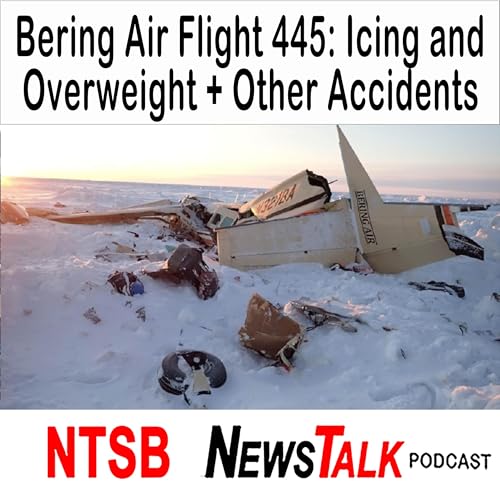
    Max Trescott talks with co-host Rob Mark about new docket details on Bering Air Flight 445—a Part 135 Cessna 208B Grand Caravan, N321BA—that crashed near Nome, Alaska after a troubling sequence of weight, icing, and airspeed issues. They discuss how overweight loading, Alaska-specific operating allowances, and confusing “minimum speed in ice” guidance can combine to erase stall margin fast. The Preliminary Report is here.

    Brought to you by AVEMCO aircraft insurance.

    Support Rob and Max by making a donation at Patreon.com

    They also touch on the Epic E1000 crash of N98FK near Steamboat Springs, Colorado, a night RNAV (GPS) approach where LNAV+V advisory glidepath guidance may have lured the airplane below MDA into terrain—a reminder that LNAV+V can look like LPV but provides no obstacle protection below MDA.

    Plus: an experimental Lancair IV-P, N163BR, suffers an apparent engine failure near Savannah, Georgia, and the occupants survive thanks to a ballistic-parachute deployment. Two final reports round out the episode: a Cessna 182P, N14YY, in Mississippi where a non-venting fuel cap contributed to fuel-starvation symptoms and a loss of control on landing, and a turbocharged Beech A36 Bonanza, N347M, in Pennsylvania where a door-open startle after takeoff, combined with an overweight condition, ended in a stall and crash.

    続きを読む 一部表示
    39 分
  • Reagan National (DCA) Midair Collision Probable Cause + Greg Biffle Citation 550 Preliminary Report
    2026/02/10

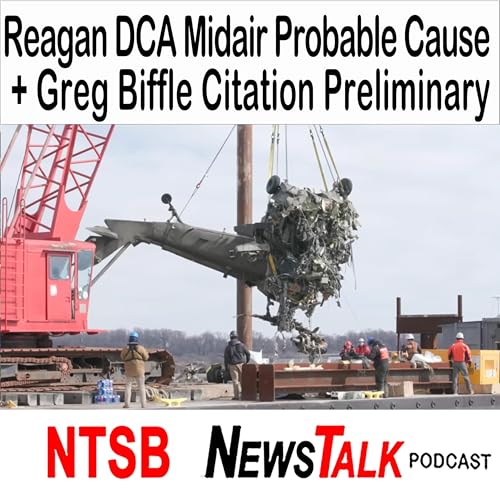
    Max talks with co-host Rob Mark about two headline-making NTSB threads: the DCA midair collision and the preliminary report on the Greg Biffle crash. First, they react to the NTSB’s day-long public hearing on the DCA midair and the board’s newly adopted probable-cause statement—an unusually long, multi-factor finding that points toward fixes in airspace design, controller procedures, ADS-B policy, and military aviation governance.

    Then they pivot to the Cessna Citation 550 accident involving NASCAR driver Greg Biffle (N257BW) near Statesville, North Carolina. The preliminary report raises hard questions about cockpit workload and decision-making: instrument anomalies, an apparent electrical/power issue, and a “second in command required” limitation that wasn’t satisfied by the right-seat occupant.

    The episode also rounds up several other investigations: a Cirrus SR20 CAPS deployment in England where the parachute lines may have separated after snagging power lines, a Cirrus SR22 engine-failure diversion in South Carolina, an IFR Bonanza crash in rain near Sabine, Texas, a Mexican Navy King Air 350i accident near Galveston, and final reports covering a training stall/spin in Georgia and a Musketeer engine failure after an undetected oil-system leak. If you care about real-world lessons—and what the NTSB is signaling for the next wave of safety changes—hit play and share it with another pilot.

    Support

    Support the work that Rob and Max do creating the NTSB News Talk podcast by making a monthly donation via Patreon.

    続きを読む 一部表示
    54 分
  • Bangor Maine Challenger 650 Jet Crash (N10KJ): Icing, Deicing & NTSB Investigation
    2026/01/26

    Max Trescott and Rob Mark talk about the Bangor, Maine Bombardier Challenger 650 crash (N10KJ)—a major breaking story—and what the earliest discussion points usually look like before investigators have hard answers. They outline why takeoff accidents in winter conditions immediately raise questions about contamination, deicing decisions, holdover time, and whether ice or snow could have been present at the start of the takeoff roll.

    Then the episode shifts to set of other NTSB cases with sharply different aircraft and missions—but familiar human factors. These include the American Aviation AA-1A (N9439L) near Alamogordo, NM, Cirrus SR20 (N814) in Watertown, WI, Beech C23 (N76SB) in Virginia, Mooney M20C (N1204X) in Texas, Cessna 206 (N460DC) in California, Piper PA-30 Twin Comanche (N8693Y) in Illinois, and a Beechcraft 95 Travel Air (N369BB) training flight in Alabama. Across them: unstable approaches, late go-arounds, loss of control close to the ground, and pilots pushing past safe margins.

    続きを読む 一部表示
    39 分