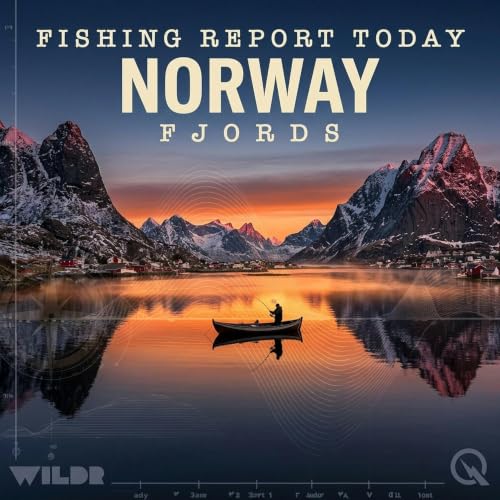
Name’s Artificial Lure, checking in with your evening report from the Norwegian fjords – think Sognefjord, Hardangerfjord, and a nod up toward Trondheimsfjord. Let’s start with conditions. Along the west coast today the Norwegian Meteorological Institute calls for light to moderate southwesterly winds, mostly 3–7 m/s, with scattered showers pushing in off the North Sea between fronts. Air temps are sitting around 13–17°C near the fjords, cooler up the arms, with decent breaks of clear sky between showers. Barometer has been gently falling through the afternoon, which usually perks the fish up in these deep systems. Sunrise along the fjord belt came just before 4 a.m., with sunset a little after 11 p.m., so we’ve got a long grey‑gold twilight on both ends. That low‑angle light around “not‑quite‑dark” has been the prime window – classic fjord timing where the bait comes shallow and the predators follow. On the tide: we’re working small to moderate tides now, with high water mid‑afternoon and again late night on the outer coast, and the turn lagging an hour or so deep inside the fjords. The best bite has lined up an hour either side of the flood pushing in – when you get that steady inward current along points and underwater shoulders the sonar lights up. Fishing has been solid rather than spectacular, but consistent. Local boats out of small harbours around Sognefjord report mixed bags of **coalfish (saithe)** in the 1–3 kg range, a good sprinkle of **cod** to 5–6 kg, and plenty of small **pollack** tight to structure. A few deeper drifts over 80–120 m have produced decent **ling** and **tusk**, plus scattered plate‑sized **plaice** on soft bottoms in the side bays. Up toward Trondheimsfjord there’ve been more **coalfish schools** chasing sandeels mid‑water, with a couple of better **halibut** taken by the guys specifically targeting flats on sand‑over‑mud in 30–60 m. Lure choice has been pretty textbook fjord fishing. Metal **pilkers** around 100–200 g in silver, blue‑silver, and green‑silver are still the workhorses for cod and coalfish – drop to bottom, crank up 10–15 turns, then work them back down with little lifts. Slim **sandeel‑style soft plastics** on 40–80 g jigheads have outfished most other artificials for pollack and better coalfish when fished close to rock walls and submerged ledges. On the lighter gear, small **spoons** and **casting jigs** of 20–40 g have taken fish crashing bait under seabirds, especially on the evening flood. For bait, the locals stick with what’s in the water: strips of **fresh mackerel**, **herring**, or **sandeel** on simple paternoster rigs. A two‑hook rig with luminous beads and smallish 2/0–3/0 hooks has been more effective than the big, gaudy stuff; the water’s clear enough now that subtle out‑fishes silly. On the flatfish grounds, small mackerel or mussel strips dragged slowly across sand is doing the job. Couple of hot spots if you’re heading out: - The outer reaches of **Sognefjord**, near where the deep trench rises toward the mouth – any mark where 200+ m shoots up to a 60–80 m plateau on the chart has been holding cod, coalfish, and ling on the flood. Watch your sounder and don’t be afraid to re‑drift tight contours. - Inside **Hardangerfjord**, points and underwater shoulders near where side fjords join the main basin have produced good evening pollack and mid‑water coalfish. Get your lures working 5–15 m off the rock faces, especially where there’s visible current seams. Overall, if you time your trip around the pushing tide and the long twilight, fish smaller, natural‑looking offerings, and stay mobile until you mark bait, you’ll find life in these fjords right now. Thanks for tuning in to Artificial Lure – if you enjoyed this report, make sure to subscribe so you don’t miss the next session on the water. This has been a quiet please production, for more check out quiet please dot ai. Great deals on fishing gear https://amzn.to/44gt1Pn
続きを読む
一部表示


 4 分
4 分