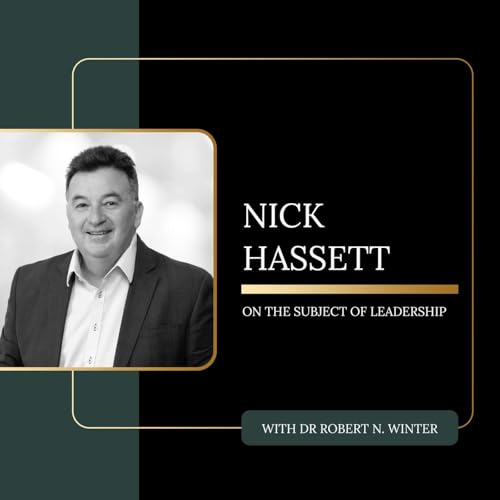
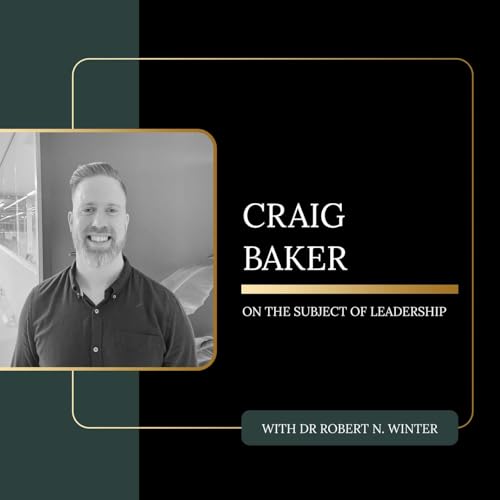
『On the Subject of Leadership』のカバーアート

On the Subject of Leadership

On the Subject of Leadership

著者: Dr Robert N. Winter
無料で聴く

今ならプレミアムプランが3カ月 月額99円

2026年5月12日まで。4か月目以降は月額1,500円で自動更新します。

概要

On the Subject of Leadership is a long-form conversation on what really makes organisations work—and why so much leadership advice doesn’t. Each episode features a business leader or practitioner with lessons earned the hard way. We go beyond anecdotes and into analysis: incentives, power, trust, culture, and the limits of authority. Ideas are challenged, not affirmed. This is not motivational theatre. It’s a search for what holds up under pressure—when decisions have consequences and trade-offs are real. If you lead people, this is for you.Copyright 2026 Dr Robert N. Winter マネジメント マネジメント・リーダーシップ 哲学 社会科学 経済学
エピソード
  • Nick Hassett: The Problem Won't Be Solved by the Thinking That Created It
    2026/04/28
    Nick Hassett has spent more than three decades intervening in organisations under pressure—not as a theorist, but as someone called in when the politics are already difficult and the gap between what the board believes is happening and what is actually happening has grown wider than anyone has yet said aloud. His work spans banking, technology, essential infrastructure, and sport across Australia and Asia, covering the full arc of an organisation in trouble: mobilisation, intervention, and recovery.In this conversation, we explore why transformation programmes fail when the people leading the change are, in important respects, the architects of the conditions they are trying to fix. Drawing on Nick's extensive experience working at the intersection of boards, executive teams, and operational reality, we discuss what it actually takes to bring a different structure of thinking to bear—where alignment breaks down, why accountability cultures can paradoxically produce silos, and what boards are getting wrong about AI governance while their staff adopt it unsanctioned.TakeawaysWhy the thinking that built the current operating model cannot be the same thinking that dismantles it — and what a "different brand of leadership" requires in practice.How accountability cultures, left uncalibrated, create silos and destroy the cross-functional collaboration on which real execution depends.The fragility of organisational alignment — why consensus often evaporates at the boardroom door, and what that costs in misdirected effort.Where the board–CEO relationship breaks down during transformation, and why that single relationship is the first point of failure.What boards are missing about shadow AI adoption — and why banning a technology does not eliminate the risk.The question nobody asks at the start of a transformation: what does success look like, how will we measure it, and what is my exit strategy?Why the pattern repeats — Six Sigma, digital, AI — and what that tells us about the enduring nature of leadership problems beneath the technology of the moment.Chapters[00:00] – Cold open: every box ticked, still failing — the accountability trap that creates silos[01:14] – Subscriber message[01:41] – Show introduction: the thinking that built the problem cannot fix it[03:58] – A career forged by evolution: thirty-five years in strategy execution[05:22] – The constant is people: helping organisations think through problems[05:50] – The common thread across banking, infrastructure, technology, and sport: regulation and complexity[07:58] – Mobilisation, intervention, and recovery: how engagements begin[08:32] – "I'll see you in two years": why organisations that try to go it alone usually fail[10:54] – Headcount reduction as the lazy option, and strategy by "throwing wheat at the side of a barn"[13:13] – The humility to not compete on subject matter expertise[14:23] – Challenging the starting hypothesis: when the board's diagnosis is part of the problem[16:35] – Coaching through the valley of despair — and futures that don't include everyone[18:07] – Scientism versus the relational: why diagnosis alone does not produce change[18:49] – Case study: an accountability culture that siloed itself into failure[21:43] – True accountability is cross-functional: responsibility, ownership, and ramifications[22:42] – Getting off the dance floor and onto the balcony: input measures versus outcomes[23:59] – The disinterested third party: putting yourself in the MD's shoes[26:59] – Pragmatism and the rate of change an organisation can absorb[28:00] – Where alignment breaks down: the board–CEO relationship as first point of failure[31:36] – Translation risk: how board priorities wash through policy, management systems, and operations[33:41] – Alignment that is only room deep: when consensus evaporates at the door[35:08] – The investment in alignment: spend the time or guarantee the points of failure[36:02] – The board's information problem: filtered reporting and the limits of oversight[37:04] – How board directors discharge their obligations: questioning management[38:15] – Intergalactic battlestars: boards that bounce from issue to issue[39:15] – AI and the board: why workshopping how to use AI may be the worst thing a board could do[41:33] – Men in Black and collective panic: when AI-generated material is convincing but not plausible[43:49] – Shadow AI: banning a technology does not eliminate the risk[44:15] – Head in the sand: the competitive cost of inaction on AI[45:56] – Discussing failure rates: the reluctance to talk honestly about what is not working[47:10] – Digital déjà vu: ten years ago it was digital, twenty years ago it was Six Sigma[49:31] – The flight magazine and the sixteen black belts: impetuous adoption without thinking through implications[51:15] – The problem remains a leadership problem: replace the technology label, and the ...
    続きを読む 一部表示
    1 時間 5 分
  • Craig Baker: Leadership at the Point of Contact
    2026/04/14
    Craig Baker has spent the past eighteen months in growth and sales leadership at Jarvis, shaping strategy and securing commitment at the front end of enterprise technology engagements—predominantly in utilities and infrastructure. When a customer gap demanded more than arm's-length management, he chose to step back into delivery. What he found was not the reassurance that a well-sold solution was tracking to plan, but friction: between what leaders confidently promise and what teams can sustainably build, between seamless integration on a slide and the reality of aging systems, regulatory constraint, and field conditions.In this conversation, we explore what happens when a leader closes the distance between the boardroom and the tools—how proximity to consequence reshapes credibility with customers and teams alike, and why the art of saying no is a consultancy's most valuable and least intuitive capability. Craig discusses what organic growth at a firm like Jarvis demands of leaders who treat the company's money and reputation as their own, and how knowing when to hand over—not just when to step in—is itself a leadership act.Along the way, we examine the tension between sales creativity and operational honesty, the distinction between building teams and merely employing them, and why the ultimate measure of leadership may be a silent legacy: behaviours that echo forward through people you no longer manage.TakeawaysWhy stepping back into delivery after selling a solution sharpened Craig's credibility—and chastened his confidenceThe discipline of saying no in the right way: to customers, to stakeholders, and to your own ambition as a consultancyHow change management, not technology, determines whether a transformation succeeds or quietly dies on arrivalThe difference between building a business organically—with your own time, money, and reputation at stake—and simply writing cheques to grow headcountWhy not everyone should be promoted into leadership, and how separating individual contributor and leadership pathways protects both people and performanceThe leader as multiplier: letting go of the tools, absorbing the blame, and ensuring the team takes the bowChapters[00:00] – Cold open: the honesty to say "I can't promise it"[03:34] – From delivery to sales: what drifted when Craig moved to the front end[06:36] – Return to the tools: what he expected versus what he found[08:55] – The confidence to prioritise: why junior staff struggle to say no[10:05] – "Not no—not right now": setting foundations before building features[12:53] – The vendor as scapegoat: saying no when you're the third party in the room[16:52] – What is the actual business problem? Technology as symptom, not cure[17:45] – Experimentation over transformation: testing hypotheses before committing millions[19:31] – Layering trust: from proximity, to process, to empirical proof[22:34] – The cost of outcomes: when the rate of return stops making sense[23:58] – Growing by reputation: why Jarvis invested in advisory over marketing[26:25] – Sales versus operations: creativity within the bounds of deliverability[30:55] – Having their back: absorbing risk so the team can experiment[33:20] – Introversion and humility: why Craig doesn't want the limelight[35:25] – The silent legacy: leadership behaviours that echo through generations[37:11] – Building teams versus employing them[38:58] – Skin in the game: when it's your own money on the line[41:47] – Knowing when to hand over: what gets you to 50 won't get you to 100[43:11] – Building the wings while flying the plane: structure at pace[45:37] – Can leadership be taught? The innate desire to be accountable[47:22] – Valuing individual contributors: not everyone needs to lead[49:56] – What must you let go of? The leader as multiplier, not maker[52:42] – "Let's figure it out together": relating to the problems your team face[54:04] – Training, coaching, mentoring: unlocking dormant capacity[55:42] – Lightning round: promises, proximity signals, and a field lesson from the utilities sectorGuest Links & ReferencesCraig Baker - LinkedInAbout the ShowOn the Subject of Leadership is a long-form conversation series examining leadership, governance, organisational life, and decision-making—without slogans or performative certainty.Hosted by Dr Robert N. Winter.Subscribe / FollowNewsletter / Website: robert.winter.inkLinkedIn: dr-robert-winterX: @DrRobertWinterInstagram: DrRobertWinterMastodon: social.winter.ink/@robertYouTube: @OnTheSubjectOfLeadershipCreditsRecorded remotely via RiversideMusic: The Hidden Thread by Roberto Prado / Artlist
    続きを読む 一部表示
    1 時間
  • Martin Kearns: From Empowerment to Ritual—Agile’s Unintended Consequences
    2026/03/28
    Agile promised empowered teams and faster learning. In many organisations, it has delivered something closer to ritual—stand-ups, sprints, and dashboards—often without the autonomy those practices were meant to enable.Martin Kearns has observed this shift from the inside. An early Scrum practitioner and now an enterprise agility advisor, he has spent two decades helping organisations rethink how work is structured and decisions are made. That experience gives him a clear view of where Agile has travelled—and where it has lost its way.In this conversation, we examine the gap between the rhetoric of empowerment and the reality of managed workflows. Why do frameworks designed to increase adaptability so often produce compliance? When does cadence become control? And why do large organisations struggle to grant autonomy while still demanding predictability?We also explore the broader system: how metrics shape behaviour, how technical debt and complexity are routinely underestimated, and why new technologies such as AI risk amplifying existing organisational confusion rather than resolving it.At its core, this is a discussion about judgement. What does it take to build organisations where professionals are trusted to think, not merely to execute—and where that trust does not come at the expense of coherence or accountability?TakeawaysAgile's original promise was autonomy. In many organisations, however, the language of empowerment has survived while genuine discretion has quietly disappeared.Ritual is not the same as agility. Stand-ups, sprints, and dashboards can create the appearance of progress while masking deeper organisational rigidity.Frameworks often satisfy managerial desire for control. The attraction of scaled Agile models lies partly in their promise of predictability—yet that predictability can undermine adaptability.Complex systems resist simplistic management. Real organisational resilience requires leaders who understand uncertainty, technical debt, and the limits of planning.Leadership in complexity begins with humility. Curiosity, facilitation, and systemic awareness matter far more than adherence to any particular methodology.Technological enthusiasm should be treated cautiously. AI and automation may transform work, but they cannot substitute for clear thinking about how organisations actually function.Chapters[00:00] - Intro[05:12] - The promise vs. reality of frameworks like Scrum and SAFe[07:07] - The systemic roots of organisational dysfunction[09:35] - Navigating the push for certainty in complex work[11:17] - Strategic partnerships versus contractual thinking[13:26] - The challenge of translating strategy to teams[15:35] - The danger of technical debt and iterative band-aids[17:29] - AI hype, failure rates, and agility in the age of technology[19:57] - The influence of investment bubbles on organisational agility[22:36] - The importance of self-awareness and psychological safety[24:53] - Handling complex problems and avoiding oversimplification[27:51] - The role of creativity and discovery in continuous learning[31:28] - The path of least resistance and reframing change[35:32] - Facilitating with authenticity and emotional intelligence[38:33] - The importance of reflection and stopping habits[41:52] - The limitations of NLP, life coaching, and systemically focused agility[44:40] - The leadership boundary of influence and expertise[46:51] - Legal and ethical considerations around mental health at work[51:35] - The value of diverse perspectives and humility in teams[56:52] - The cognitive biases of certainty and overconfidence[61:25] - The power of open dialogue and shared understandingGuest Links & ReferencesMartin Kearns - LinkedInBook (coming soon)About the ShowOn the Subject of Leadership is a long-form conversation series examining leadership, governance, organisational life, and decision-making—without slogans or performative certainty.Hosted by Dr Robert N. Winter.Subscribe / FollowNewsletter / Website: robert.winter.inkLinkedIn: dr-robert-winterX: @DrRobertWinterInstagram: DrRobertWinterMastodon: social.winter.ink/@robertYouTube: @OnTheSubjectOfLeadershipCredits / DisclosuresRecorded remotely via RiversideMusic: The Hidden Thread by Roberto Prado / Artlist
    続きを読む 一部表示
    1 時間 6 分
まだレビューはありません