エピソード

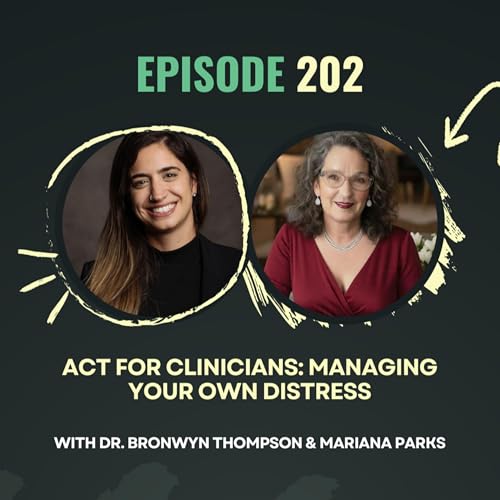
  • Ep 202. How Can ACT Help You Manage Your Own Responses to Patient Distress? with Dr. Bronwyn Thompson
    2026/04/14

    🚨Try Hanna Health free for 30 days - a customizable HEP platform where you can use your own videos, edit quickly, and track patient access. Start your trial here.


    💡 In this insightful episode of PT Pro Talk, Mariana Parks sits down with Dr. Bronwyn Thompson to explore a game-changing perspective: using Acceptance and Commitment Therapy (ACT) for ourselves as clinicians.

    When faced with complex cases and patients in distress, our instinct is to "fix" the problem. But what happens when our treatments don't work, and our minds tell us we aren't good enough? Dr. Thompson explains how psychological flexibility and the therapeutic use of self can transform your practice.

    Discover how to manage your emotional responses, unhook from the pressure of having all the answers, and stay present in difficult interactions. Tune in to learn how reconnecting with your core clinical values can help you navigate uncertainty and build a more compassionate, fulfilling career.


    💭 ‘’Physiotherapists must always have an answer... And yet, we can't always. That's the acceptance part: the willingness to say we don't have all the answers." - Dr. Bronwyn Thompson


    👉🏻 Dr. Bronwyn Thompson leads the Postgraduate Programmes in Pain and Pain Management at University of Otago, based in Christchurch, New Zealand. Dr. Bronwyn Thompson’s clinical background is occupational therapy and psychology, and her clinical and research focus is on supported pain self-management in daily life.

    Her research interests include lived experiences of chronic pain, consumer/lived experience involvement in research, policy and service development, and supported self-management in painful medical procedures. Her primary academic work is teaching an interprofessional approach to pain and pain management to clinicians from a diverse range of clinical backgrounds. She was awarded the University of Otago Teaching Excellence Award in 2022, and the University of Otago Gold Medal for teaching excellence in 2025.


    📚In this episode, you'll learn:

    • How to manage your emotional responses when working with distressed or challenging patients

    • ACT techniques to unhook from unhelpful thoughts like "I'm failing them" or "They should be better’

    • How to stay present during difficult interactions without needing to fix everything immediately

    • Ways to reconnect with your clinical values and take action even when the work feels hard

    🔎Bronwyn's Resource of Information:

    • Harris, R. (2019). ACT made simple: An easy-to-read primer on acceptance and commitment therapy (2nd ed.). New Harbinger Publications

    • PRAXIS Courses

    • Blog

    📲 Bronwyn's contact information:

    • LinkedIn

    • Facebook

    • IG


    🎥Link to interview on Youtube

    👉 ⁠Share Your Feedback⁠


    🎙Join our ⁠email list⁠ to receive podcast updates


    📸⁠Instagram⁠

    📱⁠Facebook⁠

    💻⁠LinkedIn⁠

    🐦⁠Twitter⁠

    📩Email: ⁠mariana@ptprotalk.com⁠


    PT Pro Talk Podcast is only possible with the support of forward-looking and innovative companies like Hanna Health and ⁠SaraHealth⁠.


    続きを読む 一部表示
    1 時間 7 分
  • Ep 201. How Do You Reconcile Biomechanics with Pain Science? With Dr. Greg Lehman
    2026/03/31

    🚨Try Hanna Health free for 30 days - a customizable HEP platform where you can use your own videos, edit quickly, and track patient access. Start your trial here.


    💡 In this episode of PT Pro Talk, Mariana Parks sits down with Dr. Greg Lehman for a deep dive into reconciling biomechanics with pain science in clinical practice. If you’ve ever felt torn between the traditional kinesiopathological model and modern neuroscience, this conversation will shift your perspective.

    Learn the clinical reasoning behind the most critical decision you make: knowing exactly when to use graded exposure and when to protect the tissue. Watch now to learn how to debunk limiting beliefs and keep your patients moving confidently!


    💭 ‘’I've always said like biomechanics are important, but just maybe not the way we've been traditionally taught" - Dr. Greg Lehman.


    👉🏻 Dr. Greg Lehman is a practicing physiotherapist, researcher and educator in Toronto, Canada with over 20 years experience in the rehabilitation field. Greg’s background includes a MSc in Spine Biomechanics, MSc in Physiotherapy and a Chiropractic degree. Greg has published more than 20 peer reviewed publications in the manual therapy and exercise science fields. He has a special interest in the multidimensional nature of pain and injury and believes that simple yet comprehensive approaches are a cornerstone of the biopsychosocial approach to patient care.

    He has taught the popular “Reconciling Biomechanics with Pain Science” & "Running Resiliency" courses for 11 years to 1000s of therapists throughout the world. The courses are about fundamentals and finding the common threads of many rehabilitation approaches to both simplify and improve treatment. "Recovery Strategies" is Greg's popular (more than 50,000 downloads) free e-book on the self management on pain and injuries. You can find Greg at greglehman.ca


    📚In this episode, you'll learn:

    • Why biomechanics and pain science aren't in conflict - and how to integrate both approaches in clinical practice

    • The Symptom Modification Model and how to use it to guide your clinical reasoning and intervention choices

    • How to decide when to "expose versus protect" a patient and what guides that critical clinical decision

    • Common false beliefs about pain and injury that limit recovery - and simple strategies to address them with patients


    🔎Greg's Resource of Information:

    • Clinical Practice Guidelines

    • Lehman, Greg. 2017. Recovery Strategies: Your Pain Guidebook. https://www.greglehman.ca/pain-science-workbooks.

    • PhD thesis


    📲 Greg's contact information:

    • Website

    • Instagram

    • X

    • Youtube


    🎥Link to interview on Youtube

    👉 ⁠Share Your Feedback⁠

    🎙Join our ⁠email list⁠ to receive podcast updates

    📸⁠Instagram⁠

    📱⁠Facebook⁠

    💻⁠LinkedIn⁠

    🐦⁠Twitter⁠

    📩Email: ⁠mariana@ptprotalk.com⁠


    PT Pro Talk Podcast is only possible with the support of forward-looking and innovative companies like Hanna Health and ⁠SaraHealth⁠.

    続きを読む 一部表示
    56 分
  • Ep 200. How Do You Manage Pain Catastrophizing? A practical four-step approach for clinicians With Dr. Cory Alcon
    2026/03/17

    🚨Try Hanna Health free for 30 days - a customizable HEP platform where you can use your own videos, edit quickly, and track patient access. Start your trial here.


    💡 In this episode of PT Pro Talk, Dr. Cory Alcon delivers a conversation on the management of chronic pain, moving beyond purely structural explanations to a modern understanding of neurocognition and the neuroimmune system.

    We dive deep into the clinical nuances of patient communication, exploring the critical differences between structural damage and protective nervous system responses, and how pain catastrophizing impacts executive function and recovery.


    💭 ‘’You can't just tell someone to stop catastrophizing. You have to help them make sense of their pain first - that's step one" - Dr. Cory Alcon.


    👉🏻 Dr. Cory Alcon is an Assistant Professor of Physical Therapy at High Point University and a board-certified Orthopedic Clinical Specialist specializing in chronic neuromusculoskeletal pain. He holds a PhD with a concentration in pain neuromodulation and studies how neuroplasticity can be leveraged to address the cognitive and emotional dimensions of pain.

    His work explores innovative approaches such as non-invasive brain stimulation combined with psychologically informed physical therapy. Dr. Alcon teaches musculoskeletal practice and pain science and is passionate about helping clinicians better understand and treat chronic pain.


    📚You will learn about:

    • How pain catastrophizing and fear avoidance impact brain function and recovery

    • A four-step approach: understanding pain, identifying protective responses, graded exposure, and functional progression

    • How to apply pain neuroscience education and cognitive functional therapy in clinical practice

    • Key research gaps and resources to improve your management of pain-related fear

    🔎Cory's Resource of Information:

    • Butler DS, Moseley GL. Explain pain. 2nd ed. Adelaide: Noigroup Publications; 2013.

    • Noigroup

    📲 Cory's contact information:

    • calcon@highpoint.edu

    • High Point

    • Linkedin

    • Facebook

    • IG


    🎥Link to interview on Youtube

    👉 ⁠Share Your Feedback⁠

    🎙Join our ⁠email list⁠ to receive podcast updates

    📸⁠Instagram⁠

    📱⁠Facebook⁠

    💻⁠LinkedIn⁠

    🐦⁠Twitter⁠

    📩Email: ⁠mariana@ptprotalk.com⁠


    PT Pro Talk Podcast is only possible with the support of forward-looking and innovative companies like Hanna Health and ⁠SaraHealth⁠.

    続きを読む 一部表示
    58 分
  • Ep 199. Lateral Elbow Tendinopathy: What the Evidence Says with Dr. Leanne Bisset
    2026/03/03

    🚨Try Hanna Health free for 30 days - a customizable HEP platform where you can use your own videos, edit quickly, and track patient access. Start your trial here.


    💡 In this episode of PT Pro Talk, we are joined by Dr. Leanne Bisset, Associate Professor at Griffith University and a highly respected upper limb specialist with over 20 years of clinical and research experience focusing on the elbow.

    Leanne delivers a comprehensive masterclass on the assessment and management of Lateral Elbow Pain, moving beyond outdated labels like "epicondylitis" to a modern understanding of tendinopathy. We dive deep into the clinical nuances of differential diagnosis, exploring the critical differences between muscle/tendon, articular, and neural drivers of elbow pain.


    💭 ‘’For lateral elbow tendinopathy, I focus on isometric loading rather than eccentric - the elbow extensors function more for positioning and stability, not energy storage and release like lower limb tendons." - Dr. Leanne Bisset.


    👉🏻 Dr. Leanne Bisset is an Associate Professor in Physiotherapy at Griffith University. She is also a Musculoskeletal Physiotherapist as awarded by the Australian College of Physiotherapists. Dr Bisset's combined academic and clinical track record is underpinned by her clinical and research experience in Musculoskeletal Health and Persistent Pain.

    Her service to health is broad, spanning the supervision of clinical research (clinician-initiated, research higher degree, honours), clinical education and mentoring across all levels of the physiotherapy profession (undergraduate, postgraduate, professional development). Dr Bisset has an extensive service record with the Australian Physiotherapy Association and the International Federation of Orthopaedic and Manipulative Physical Therapists.


    📚You will learn about:

    • How to differentiate lateral elbow tendinopathy from other diagnoses, and when imaging is actually useful

    • Key elements of an effective objective assessment that guide your treatment decisions

    • What the evidence shows about exercise therapy, manual techniques, and how physiotherapy compares to cortisone injections

    • How to manage pain during exercise progression, and what level of discomfort is acceptable


    📲 Leanne's contact information:

    • X

    • LinkedIn


    🎥Link to interview on Youtube

    👉 ⁠Share Your Feedback⁠

    🎙Join our ⁠email list⁠ to receive podcast updates

    📸⁠Instagram⁠

    📱⁠Facebook⁠

    💻⁠LinkedIn⁠

    🐦⁠Twitter⁠

    📩Email: ⁠mariana@ptprotalk.com⁠


    PT Pro Talk Podcast is only possible with the support of forward-looking and innovative companies like Hanna Health and ⁠SaraHealth⁠.

    続きを読む 一部表示
    1 時間 14 分
  • Ep 198. Is Shoulder Instability Driving Your Patient's Shoulder Pain? with Dr. Tania Pizzari
    2026/02/17
    🚨Try Hanna Health free for 30 days - a customizable HEP platform where you can use your own videos, edit quickly, and track patient access. Start your trial here.💡In this episode of PT Pro Talk, we welcome world-renowned shoulder specialist Dr. Tania Pizzari (Associate Professor at La Trobe University) for a clinical masterclass on Shoulder Instability. Many clinicians struggle to differentiate between simple hyperlaxity and true symptomatic instability, often leading to missed diagnoses and stalled rehabilitation.Dr. Pizzari explains why insidious-onset shoulder pain in younger patients should often be treated as instability until proven otherwise. We dive deep into the mechanics of the glenohumeral joint, the "anterior buffer" role of the subscapularis, and why articular-sided tendon tears may actually be driven by instability.💭 “If it's a young person with a gradual onset, I would always consider it an instability until proven otherwise” - Dr. Tania Pizzari.👉🏻 Dr Tania Pizzari is an Associate Professor in the Department of Physiotherapy at La Trobe University, and a physiotherapist continuing to work in clinical practice. She is a co-director of a large private practice in Melbourne, Australia. Her role at the University includes heading up the Post Graduate Physiotherapy courses and undertaking clinical research of musculoskeletal and sporting injuries. She has over 130 peer-reviewed papers and book chapters. Tania currently manages the soft tissue injury registry for the Australian Football League, is a fellow of the Australian Sports Medicine Federation, and board member of the International Confederation of Scientific Societies for Shoulder and Elbow Therapy. 📚You will learn about:How to identify shoulder instability in patients with insidious-onset shoulder painA practical classification system to guide your clinical reasoningEvidence-based rehabilitation strategies for shoulder instabilityKey changes to improve your assessment and treatment of shoulder pain🔎Tania's Resource of Information:PWATSON, L. et al. Rehabilitation for multidirectional instability of the shoulder: part 1 – pathoanatomy and clinical examination. Shoulder & Elbow, 2016.WATSON, L. et al. Rehabilitation for multidirectional instability of the shoulder: part 2 – structured rehabilitation program. Shoulder & Elbow, 2016.WATSON, L. et al. A comprehensive rehabilitation program for posterior instability of the shoulder. Available in: ResearchGate. 2017.📲 Tania's contact information: X LinkedIn IG: Mill Park Physio🎥Link to interview on Youtube 👉 ⁠Share Your Feedback⁠🎙Join our ⁠email list⁠ to receive podcast updates📸⁠Instagram⁠ 📱⁠Facebook⁠💻⁠LinkedIn⁠🐦⁠Twitter⁠📩Email: ⁠mariana@ptprotalk.com⁠PT Pro Talk Podcast is only possible with the support of forward-looking and innovative companies like Hanna Health⁠ and ⁠SaraHealth⁠.
    続きを読む 一部表示
    1 時間
  • Ep 197. Treatment of tendinopathies in the lower extremity with Dr. Ebonie Rio (Re-Airing)
    2026/02/05

    🚨Try Hanna Health free for 30 days - a customizable HEP platform where you can use your own videos, edit quickly, and track patient access. Start your trial here.


    💡 In this episode, Dr. Ebonie Rio discusses the critical importance of differential diagnosis and load management in lower extremity tendinopathies. She explores the nuances of treating Achilles, patellar, hamstring, and gluteal injuries, highlighting why understanding the specific "provocative load" and the dangers of compression are the first steps toward effective rehabilitation.


    💭 “If you had someone with achilles tendinopathy you would want to start early on calf raises but you would not give that exercise to someone with peritendinitis because that is their provocative load.” - Dr. Ebonie Rio.


    👉🏻 Dr. Ebonie Rio, PT, PhD, is a world-renowned Sports Physiotherapist and a leading authority in tendinopathy research. Currently serving as a Senior Clinical Research Fellow at The Australian Ballet and a consultant for the Victorian Institute of Sport.

    With extensive clinical experience spanning the Olympics and Commonwealth Games, she also provides expert guidance on complex injuries to elite organizations. Dr. Rio’s academic background is equally distinguished, holding a PhD in tendon pain (for which she received the prestigious Professor Mollie Holman medal) and multiple degrees in Physiotherapy and Applied Science.

    Ranked fourth worldwide in her field by ExpertScape and maintaining a ResearchGate score of higher than 95% of all academics, her work has earned numerous accolades, including the Victorian Fresh Scientist of the Year and multiple ASICS SMA Best New Investigator awards.


    📚You will learn about:

    • Achilles, patellar, hamstring, and gluteal tendinopathy

    • Differential diagnoses of LE tendinopathies

    • Treatment of tendinopathy in the LE

    🔎Ebonie's Resource of Information:

    • Infographics

    • La Trobe Sport

    • Podcasts

    📲 Ebonie's contact information:

    • LinkedIn


    🎥Link to interview on Youtube

    👉 ⁠Share Your Feedback⁠

    🎙Join our ⁠email list⁠ to receive podcast updates

    📸⁠Instagram⁠

    📱⁠Facebook⁠

    💻⁠LinkedIn⁠

    🐦⁠Twitter⁠

    📩Email: ⁠mariana@ptprotalk.com⁠


    PT Pro Talk Podcast is only possible with the support of forward-looking and innovative companies like Hanna Health and ⁠SaraHealth⁠.

    続きを読む 一部表示
    1 時間 13 分
  • Ep 196. Patellofemoral Pain: 40 Years of Research and Key Clinical Insights with Dr. Danilo De Oliveira Silva
    2026/01/27

    🚨Try Hanna Health free for 30 days - a customizable HEP platform where you can use your own videos, edit quickly, and track patient access. Start your trial here.

    💡 In this episode of PT Pro Talk, host Mariana Parks sits down with Dr. Danilo De Oliveira Silva, Associate Professor at La Trobe University, to unravel the last 40 years of research on Patellofemoral Pain (PFP).

    They take a deep dive into the history of PFP, debunking the effectiveness of early surgical interventions and the long-standing obsession with Vastus Medialis (VMO) isolation. Dr. Danilo clarifies current best practices, explaining why general quadriceps and hip strengthening are the gold standard and how treatments like foot orthoses and taping fit into the clinical puzzle.

    You will also learn about the "Envelope of Function" theory by Scott Dye, why "too much, too soon" is often the real culprit behind the pain, and why you should stop telling your patients to cease the activities they love


    💭 “If you don’t overload your knee, even if you have an impaired quadriceps, high subtalar pronation, or weak hip muscles, you will not have pain.” - Dr. Danilo De Oliveira Silva


    📚You will learn about:

    • How thinking around patellofemoral pain has changed over the last few decades

    • What the evidence shows about strength, movement, and biomechanics

    • The role of pain processing and neural mechanisms in ongoing symptoms

    • How load management and the envelope of function guide treatment today

    🔎 Danilo's resources of information:

    • My Knee Cap

    • Track education

    📲 Danilo's contact information:

    • LinkedIn

    • Facebook

    • IG

    • X


    🎥Link to interview on Youtube

    👉 ⁠Share Your Feedback⁠

    🎙Join our ⁠email list⁠ to receive podcast updates

    📸⁠Instagram⁠

    📱⁠Facebook⁠

    💻⁠LinkedIn⁠

    🐦⁠Twitter⁠

    📩Email: ⁠mariana@ptprotalk.com⁠

    PT Pro Talk Podcast is only possible with the support of forward-looking and innovative companies like Hanna Health and ⁠SaraHealth⁠.


    続きを読む 一部表示
    59 分
  • Ep 195. Beyond the Slip: How to Assess and Treat Spondylolisthesis with Dr. Robert Medcalf
    2026/01/15
    🚨Try Hanna Health free for 30 days - a customizable HEP platform where you can use your own videos, edit quickly, and track patient access. Start your trial here.💡 In this episode of PT Pro Talk, host Mariana Parks sits down with Dr. Robert Medcalf, Physical Therapist and MDT expert. They discuss the challenges of assessing and treating Spondylolisthesis without relying solely on imaging results.Dr. Medcalf shares insights on differentiating between a stable and unstable slip and how to guide patients through recovery using Mechanical Diagnosis and Therapy principles. The conversation also dives deep into the myth that all spondylolisthesis patients must avoid extension, offering a logical framework for when to load the spine and when to focus on stabilization.💭 “The interesting thing about that study is that they found there was no association between spondylolisthesis and back pain..” - Dr. Robert Medcalf📚You will learn about: What spondylolisthesis is, how it’s classified, and why imaging findings don’t tell the whole storyWhere pain in spondylolisthesis truly comes fromHow to assess and manage spondylolisthesis conservatively using mechanical principlesWhen surgery may be appropriate🔎 Robert's resources of information:SPRATT, Kevin F. et al. Efficacy of flexion and extension treatments incorporating braces for low-back pain patients with retrodisplacement, spondylolisthesis, or normal sagittal translation. Spine, v. 18, n. 13, p. 1839–1849, 1993OH, Jacob Yoong-Leong et al. Paradoxical motion in L5-S1 adult spondylolytic spondylolisthesis. European Spine Journal, v. 21, n. 2, p. 262-267, 2011.HARDWICK, D. et al. Outcomes of strengthening approaches in the treatment of low-grade spondylolisthesis. Physical Therapy Reviews, v. 17, n. 5, p. 284-291, 2012. DOI: 10.1179/1743288X12Y.0000000025.📲 Robert's contact information:Linkedin🎥Link to interview on Youtube 👉 ⁠Share Your Feedback⁠🎙Join our ⁠email list⁠ to receive podcast updates📸⁠Instagram⁠ 📱⁠Facebook⁠💻⁠LinkedIn⁠🐦⁠Twitter⁠📩Email: ⁠mariana@ptprotalk.com⁠PT Pro Talk Podcast is only possible with the support of forward-looking and innovative companies like Hanna Health⁠ and ⁠SaraHealth⁠.
    続きを読む 一部表示
    52 分