『Railway Conversations with Doc Frank』のカバーアート

Railway Conversations with Doc Frank

Railway Conversations with Doc Frank

著者: Doc Frank
無料で聴く

Authentic discussions with interesting people about railway subjects that matter.© 2026 Railway Conversations with Doc Frank
エピソード
  • #108 — CBTC Interoperability: Why It's Harder Than You Think, with Dr Alan Rumsey
    2026/07/01

    CBTC has been the world's de facto metro signalling standard for 40 years. In all that time it has never been made interoperable across suppliers, so why is the question suddenly back on the table, and why is it proving so hard to answer?

    My guest is Dr Alan Rumsey, one of the genuine authorities in this field. Alan chaired the IEEE working group that wrote the original CBTC standard, and he has spent a 45-year career on advanced train control projects across North America, Europe and Asia.

    We start by getting our terms straight, because in this industry the same word too often means different things to different people. From there we work through the real questions. Why would a railway want interoperable CBTC at all? What does interoperability actually mean once you get specific about it? And if the business case stacks up, how could the industry ever get there? Along the way we look at why New York took 25 years and a fortune to achieve it, why ETCS managed what CBTC has not, and what China's interoperable standard might mean for the established suppliers.

    If you find this useful, subscribe and pass it on to a colleague who would get something from it.

    If this conversation has got you wanting to go deeper, visit my training platform at www.docfranktraining.com. There you find the most comprehensive suite of online courses in advanced railway signalling anywhere. CBTC, ETCS, high capacity signalling, and more. All in one place, all vendor neutral.

    続きを読む 一部表示
    1 時間 11 分
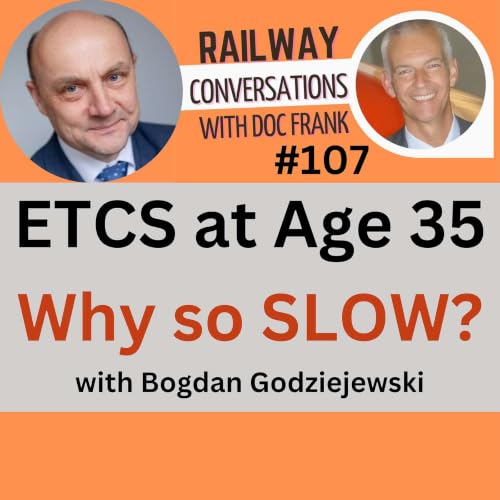
  • #107 — ETCS at Age 35: Why So Slow? With one of its original authors, Bogdan Godziejewski
    2026/06/17

    Thirty-five years ago, a small international team sat down to write the first specification for what would become the European Train Control System. Bogdan Godziejewski was one of them. So when he says ETCS rollout has been disappointingly slow, it carries the weight of someone who has followed the system from its very first idea to today.

    Bogdan is the immediate past president of the Institution of Railway Signal Engineering (IRSE), Rail Director and Fellow at Mott MacDonald, with more than 40 years of international experience across the Netherlands, Belgium, Australia, Denmark, the USA and beyond. Between 1992 and 1996 he worked at the European Rail Research Institute on the first ETCS system requirements specification. Few people are better placed to take stock of where ETCS now stands.

    In this conversation we cover why deployment has crawled in the big countries while smaller ones forged ahead, what Belgium did differently to fit its entire network in record time, and why a countrywide vision matters more than the technology itself. We get into repeatability, approvals and testing as the real levers of an industrialised rollout. We also turn to Bogdan's IRSE presidency and his Generation Unlimited theme: bringing younger people into the discipline and building bridges between generations.

    If you find this conversation valuable, subscribe and share it with a colleague. It costs nothing and helps grow signalling knowledge across the industry.

    If this conversation has got you wanting to go deeper, visit my training platform at www.docfranktraining.com. There you find the most comprehensive suite of online courses in advanced railway signalling anywhere. CBTC, ETCS, high capacity signalling, and more. All in one place, all vendor neutral.

    続きを読む 一部表示
    59 分
  • #106 — Why HS2 Needs More Carriages, with Chris Gibb
    2026/06/03

    Chris Gibb spent 45 years in high-profile positions across the British railways. He knows what a successful railway operation looks like — and right now he is publicly challenging the plans for High Speed 2 (HS2).

    The issue is not the construction. It does not even impact the High Speed Rail service between London and Birmingham, what most people think HS2 is about. It is the impact of the new HS2 train fleet that continues around Birmingham on the West Coast Main Line to the North. Chris foresees a substantial reduction in capacity from today's fleet travelling up North, at times when more, not less, capacity will be needed. And he tries to do something about it before procurement decisions cement a future capacity shortfall. It is a lesson about long-term planning decisions and their consequences.

    If you find this conversation useful, subscribe and share it. It costs nothing and makes a real difference.

    When it comes to advancing your understanding of modern train control technologies, nothing beats world-class training. I've partnered with Informa Connect Academy to create what I believe is the most comprehensive portfolio of online training courses in advanced signalling available anywhere. Find out more here: https://docfranktraining.com/courses

    続きを読む 一部表示
    59 分
adbl_web_anon_alc_button_suppression_t1
まだレビューはありません