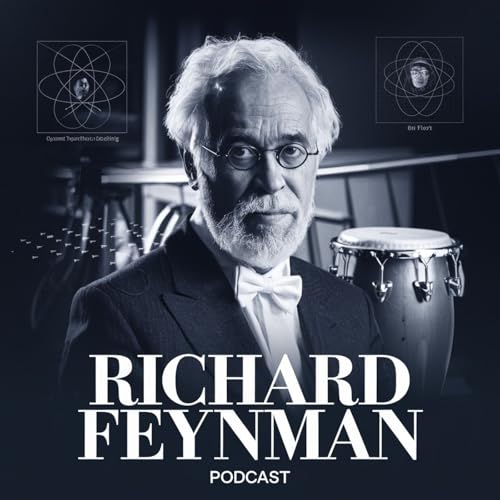
『Richard Feynman』のカバーアート

Richard Feynman

Richard Feynman

著者: Podra Network
無料で聴く

The great explainer — the life, science and irrepressible personality of Richard Feynman.Copyright Podra Network 科学
エピソード
  • The Great Teacher: Feynman's Lectures and Legacy
    2026/06/04
    Explore Richard Feynman's revolutionary approach to physics education in this deep dive into his legendary Caltech lectures. Dr Sarah Quinn examines how Feynman transformed undergraduate physics education in the 1960s through his famous lecture series, which became the groundbreaking "Feynman Lectures on Physics" textbook series. Discover the innovative teaching techniques that made complex quantum mechanics and physics concepts accessible to students worldwide. Learn about the famous "Feynman Technique" for learning and understanding difficult concepts through simplification and analogies. This episode covers Feynman's educational philosophy, his emphasis on first principles thinking, and his belief that anyone can understand physics with the right explanation. We explore how his teaching methods anticipated modern pedagogical research and continue to influence educators across all disciplines today. The episode also discusses the lasting impact of the Feynman Lectures, which remain in print sixty years later and are now freely available online through Caltech. Perfect for educators, students, physics enthusiasts, and anyone interested in effective learning techniques. Discover why Richard Feynman's approach to teaching science revolutionized how we think about education, critical thinking, and making complex ideas understandable. Keywords: Richard Feynman, physics education, Feynman Lectures, teaching methods, science communication, learning techniques, Caltech, quantum mechanics education.
    続きを読む 一部表示
    5 分
  • The Curious Side of Genius: Feynman's Unconventional Adventures
    2026/05/28
    Explore the unconventional side of Nobel Prize-winning physicist Richard Feynman in this fascinating episode about his adventures beyond the laboratory. Dr Sarah Quinn examines three unexpected aspects of Feynman's life: his notorious safecracking skills during the Manhattan Project, his passionate pursuit of bongo drumming, and his systematic observations of human behavior in strip clubs. These seemingly disparate interests reveal Feynman's core philosophy that curiosity should know no boundaries and that everything in our world contains patterns worth investigating. From deciphering lock mechanisms at Los Alamos to jamming with professional musicians at physics conferences, Feynman approached each challenge as an intellectual puzzle deserving rigorous attention. His willingness to explore unconventional territories and find connections between different fields likely contributed to his revolutionary insights in quantum physics. This episode illustrates how Feynman's playful, interdisciplinary approach to understanding the world made him not just a brilliant scientist, but a true renaissance thinker whose curiosity extended into anthropology, music, psychology, and mechanical engineering. Perfect for listeners interested in scientific biography, creative thinking, and the intersection of science with arts and human behavior.
    続きを読む 一部表示
    6 分
  • Nobel Prize and the Weight of Recognition
    2026/05/21
    Join Dr Sarah Quinn as she explores Richard Feynman's complex relationship with fame and recognition after winning the 1965 Nobel Prize in Physics. This episode examines how the prestigious award affected the renowned physicist's approach to science and life. Discover Feynman's initial reaction to winning the Nobel Prize for his groundbreaking work in quantum electrodynamics, shared with Julian Schwinger and Shin'ichiro Tomonaga. Learn about his famous Feynman diagrams that revolutionized particle physics calculations and made complex quantum interactions understandable. The episode delves into Feynman's fears about how recognition might compromise his scientific integrity and curiosity-driven research approach. Explore his decision to decline many honorary positions, including membership in the National Academy of Sciences, and his preference for teaching over ceremonial duties. The discussion includes his later use of Nobel status for important causes, particularly his role in the Challenger disaster investigation. This podcast episode offers insights into the psychological burden of scientific fame and the challenge of maintaining authenticity after achieving the highest recognition in one's field. Perfect for science enthusiasts, students, and anyone interested in the human side of scientific achievement and the complex relationship between recognition and creativity in academic careers.
    続きを読む 一部表示
    4 分
adbl_web_anon_alc_button_suppression_t1
まだレビューはありません