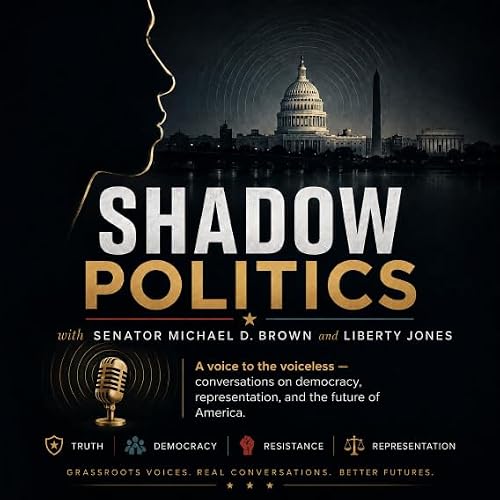
『Shadow Politics with US Senator Michael D Brown』のカバーアート

Shadow Politics with US Senator Michael D Brown

Shadow Politics with US Senator Michael D Brown

著者: Senator Michael D. Brown
無料で聴く

Shadow Politics is a grass roots talk show giving a voice to the voiceless. For more than 200 years the people of the Nation's Capital have ironically been excluded from the national political conversation. With no voting member of either house of Congress, Washingtonians have lacked the representation they need to be equal and to have their voices heard. Shadow Politics will provide a platform for them, as well as the millions of others nationwide who feel politically disenfranchised and disconnected, to be included in a national dialog. We need to start a new conversation in America, one that is more inclusive and diverse and one that will lead our great nation forward to meet the challenges of the 21st century. At Shadow Politics, we hope to get this conversation started by bringing Americans together to talk about issues important to them. We look forward to having you be part of the discussion so call in and join the conversation. America is calling and we're listening… Shadow Politics is about America hearing what you have to say. It's your chance to talk to an elected official who has spent more than 30 years in Washington politics. We believe that if we start a dialog and others add their voices we will create a chorus. Even if those other politicians in Washington don't hear you — Senator Brown will. He's on a mission to listen to what America has to say and use it to start a productive dialog to make our democracy stronger and more inclusive. If we are all part of the solution we can solve any problem.Copyright 2026 Senator Michael Brown 政治・政府 政治学
エピソード
  • Shadow Politics, July 5, 2026
    2026/07/06
    Shadow Politics with Senator Michael D. Brown and Co-host Liberty Jones America at 250: Hope, Division, and the Fight to Keep Democracy Human A Fourth of July Conversation About America’s Future In this episode of Shadow Politics, host Michael D. Brown and co-host Liberty Jones use the Fourth of July weekend and America’s 250th birthday as the starting point for a broad conversation about democracy, opportunity, division, and the future of the country. Brown opens by asking whether America is still the land of opportunity, while Jones, speaking as a first-generation American and recent college graduate, says her expectation is that the United States can persevere through division, injustice, and political instability without crumbling. Opportunity, Generational Anxiety, and the American Promise Brown reflects on his own life story, describing himself as a high-school dropout and orphan who eventually earned a master’s degree, started a business, served as a United States senator, raised a family, and built a life he believes could only have happened in America. He contrasts that experience with his fear that younger generations may not have the same chances. Jones responds that her generation faces economic uncertainty, nonstop media pressure, and government inconsistency, but she also believes hard work, adaptability, and optimism remain necessary. Together, they frame America as a country still capable of renewal, but only if opportunity remains real for ordinary people. Political Theater, Trump, and the Power of Performance A major section of the program centers on Brown’s critique of a presidential Fourth of July event and speech. He says the event was well-staged, emotionally powerful, and carefully designed through flags, veterans, astronauts, military imagery, crowd placement, and cheering sections. Brown argues that this kind of political production can be dangerous when it wraps nationalism, fear of socialism or communism, Christian identity, and anti-immigrant rhetoric into a patriotic spectacle. Jones agrees that modern politics increasingly resembles performance and “clickbait politics,” where citizens are drawn into emotional theater rather than honest civic discussion. MAGA, Division, and the Need to Rebuild Common Ground Jones challenges Democrats and anti-Trump voters not merely to attack MAGA supporters, but to understand why they feel heard by the movement. She argues that division will only worsen if Americans keep treating one another as enemies, and she uses the World Cup as a metaphor for fierce competition followed by mutual respect. Brown expands that point, saying Americans must recover respect for one another by focusing on shared concerns such as children, family, safety, and opportunity. Both speakers argue that the country needs a new way to speak across political lines without surrendering core principles. Immigration, Guns, and Fear as a Political Tool Brown discusses immigrant workers he sees building homes in his community and rejects rhetoric that broadly labels immigrants as criminals. He compares today’s immigrants to earlier generations of American families who came seeking work, dignity, and survival. He then turns to guns, arguing that many people cling to firearms because they feel afraid and want control. Brown says the gun debate should be reframed around protecting children rather than insulting gun owners, while Jones adds that gun violence has become dangerously normalized, especially when young people can buy guns before they can vote or drink alcohol. Universal Health Care, Rights, and Accountability in Government When Jones asks Brown what he would prioritize in a future presidential agenda, he says his first major goal would be universal health care, ideally guaranteed through constitutional amendment. Brown argues that people fear what they cannot control, and health care is one of the clearest examples. He also says politicians should face consequences for knowingly spreading falsehoods, and he emphasizes that American freedom was not fully present at the founding but had to be expanded through later law and struggle. His larger point is that the Constitution’s strength is its ability to evolve toward a more inclusive and more perfect union. Freedom, Acceptance, and Preparing for the Next Chapter The closing section returns to sports, humility, and preparation. After joking about soccer, Brazil, Norway, and the World Cup, Jones says Brazil is already preparing for the next four years, and America should do the same. She argues that people should not let political “giants” make them hopeless or allow any one leader to define the country’s 250th anniversary. Brown agrees and closes by saying the episode was meant to share how he and Jones feel about America at this moment. The program ends with a dedication of Neil Diamond’s “America,” a nod to Bubba the dog, and the Shadow Politics outro theme about representation, freedom, ...
    続きを読む 一部表示
    58 分
  • Shadow Politics, June 29, 2026
    2026/06/30
    Shadow Politics with Senator Michael D. Brown and Co-host Liberty Jones Across the Divide Trump, Immigration, War, and the Fight to Keep Talking A Conversation Across Political Lines In this episode of Shadow Politics, host Michael D. Brown and co-host Liberty Jones welcome Steve, a friend of Senator Brown’s and a three-time Donald Trump voter, for a direct but civil conversation about politics, values, immigration, foreign policy, and America’s divisions. Brown opens by stressing that people on the other side of political disagreement are not enemies, but friends, family, neighbors, and coworkers whose views should be heard. The episode’s central purpose is dialogue: not telling listeners how to feel or vote but modeling a difficult conversation across political lines. Why Steve Supports Trump Steve explains that his support for Donald Trump is rooted primarily in policy and action. He says he wanted an outsider who could get things done, rather than another traditional politician who promised everything and accomplished little. He also says he admired Trump’s business image for many years. When Liberty asks what Trump may be remembered for historically, Steve points to immigration, arguing that Trump closed the border and took action on an issue he believes other politicians ignored. At the same time, Steve acknowledges that people who have lived in the United States for many years, worked, paid taxes, and built lives here should have some fair path toward legal status. Immigration, Benefits, and Competing Narratives Much of the early conversation centers on immigration. Steve argues that illegal immigration affects public safety, jobs, benefits, and fairness to taxpayers. Brown challenges several of those claims, especially the idea that undocumented immigrants receive broad government benefits, saying that many such claims are myths or exaggerated political narratives. Liberty asks Steve when he first felt personally affected by illegal immigration, and Steve describes experiences from his youth in California. The exchange reveals the emotional and factual gap between how immigration is experienced by some voters and how Brown and Liberty interpret the policy realities. Foreign Policy, Iran, Venezuela, and Military Power The discussion then moves into Trump’s foreign policy and the question of whether he broke his promise not to involve the United States in foreign wars. Brown criticizes military actions involving Iran and Venezuela, arguing that regime-change thinking and resource interests are driving decisions. Steve defends Trump’s willingness to act decisively against dictators and threats, especially when allies such as Israel are involved. Liberty raises concerns about taxpayer money, military depletion, and U.S. intervention in the domestic politics of other countries, while Steve maintains confidence in America’s military strength and Trump’s instincts. Trump’s Conduct, Profit, and Public Image Brown presses Steve on Trump’s personal conduct, business history, side ventures, taxes, treatment of women, racial rhetoric, and public spectacle. Steve largely defends Trump or says those issues do not bother him as much as Trump’s policies and results. The hosts debate whether the presidency should carry a higher standard of dignity, especially regarding events on White House grounds, Trump’s public language, and the image America projects to the world. Liberty adds that Trump’s celebrity instincts may be part of both his appeal and the reason American politics has become so polarized. Democrats, Democratic Socialism, and the Future of Elections Steve asks Brown to explain the difference between Democrats and democratic socialists. Brown describes democratic socialism as a belief that government should provide more basic services and stability for citizens, distinguishing it from communism. He names Bernie Sanders as a classic example and says he personally identifies with democratic socialism, especially in a future shaped by AI and economic disruption. Brown predicts that Democrats are likely to retake the House and may have a slim chance at the Senate, though he also jokes that Democrats have a talent for losing winnable elections. Finding Common Ground in a Polarized Country The conversation closes with Liberty emphasizing that most Americans want the same broad things: safety, freedom, fairness, and a better country. She asks whether constant blame-shifting helps the nation move forward, and Steve agrees that both parties need to stop blaming the past and work together. The final exchange touches on Israel, Palestine, internal party conflict, protest politics, and political violence. Despite sharp disagreement, Steve thanks Brown and Liberty for the conversation and says he hopes Americans can better understand one another. Brown ends by suggesting that more conversations like this may help, then closes the episode with humor and music.
    続きを読む 一部表示
    57 分
  • Shadow Politics, June 21, 2026
    2026/06/22
    Shadow Politics with Senator Michael D. Brown and Co-host Liberty Jones Unstoppable in Iowa: India May on Rural Power, Health Care, and Speaking Truth to Power Guest, India May, Political Candidate, Speaker, Advocate A Grassroots Conversation About Local Courage In this episode of Shadow Politics, hosts Michael D. Brown and Liberty Jones welcome India May, Democratic candidate for Iowa House District 58, covering Floyd, Chickasaw, and Bremer counties. Michael introduces her as a nurse, librarian, medical examiner investigator, mother, and community advocate who gained attention after publicly confronting Senator Joni Ernst about Medicare and Medicaid cuts. The episode focuses on local power, rural politics, health care, LGBTQ rights, campaign finance, voter access, and what it means for an ordinary citizen to step into public leadership. Discovering the Power of One Civilian Voice India says one of the biggest lessons she has learned over the past year is how much power civilians truly have. She points to her public criticism of Senator Joni Ernst, who later announced retirement, and her scrutiny of her opponent’s unpaid property taxes, after which he paid them. India’s point is that people do not have to wait until they hold office to make a difference. By speaking plainly, documenting facts, and refusing to be silent, ordinary citizens can pressure powerful figures and create real consequences. From Independent Voter to Democratic Candidate Liberty asks India about the difference between her expectations and the realities of running for office. India explains that she spent much of her voting life as an independent and is now running as a Democrat in red, rural Iowa. She says she has been pleasantly surprised by the number of people willing to step up, volunteer, knock doors, join parades, and publicly support a campaign that calls for change. She describes live music, community energy, and people applauding the campaign at local events as signs that many rural Iowans know something is wrong and want a different direction. A Campaign Rooted in Fair Voting When Liberty asks what policies are most important to India, she names voting reform as her top priority. India supports efforts discussed by Iowa gubernatorial candidate Rob Sand to make voting more fair and less dependent on party structures. She criticizes Iowa’s ban on ranked-choice voting and says she is interested in open primaries, star voting, approval voting, and ballot measures. Her goal is to make Iowa’s political system more responsive to voters rather than party machinery. Medicaid, Mental Health, and a Broken Health System Michael asks about India’s well-known confrontation with Senator Ernst over Medicaid cuts and how those cuts affect Iowans. India says Iowa has already been ahead of the curve in damaged health care because Medicaid was privatized in 2016. She describes delayed care, denied care, unpaid reimbursements to hospitals, work requirements, and hospitals struggling to stay open. She also says Iowa ranks at the bottom for inpatient mental health care availability and faces severe health care deserts, rising cancer concerns, and limited oncology access across many counties. The “Big Beautiful Bill” and Political Timing India argues that federal cuts tied to the so-called “big beautiful bill” will be devastating and says the timing of implementation appears politically calculated. According to her, the cuts are delayed until November, creating an opening for Republicans to blame Democrats if the party balance changes after the election. Michael responds that this shows she has learned one of the central lessons of politics: policy and timing are often structured to shape public blame. Christianity, MAGA, and Moral Accountability The conversation turns to religion and politics when Michael, speaking as a Christian and father of an openly gay daughter, asks how Christians reconcile cruelty toward LGBTQ people, immigrants, and vulnerable groups. India, who says she was raised Methodist, contrasts the Methodist slogan “open hearts, open minds, open doors” with what she describes as MAGA cruelty. She says even the Old Testament emphasizes hospitality to strangers and kindness to those in need, and she argues that current right-wing politics often represents the opposite of what Christ or Christianity teaches. LGBTQ Rights, Book Bans, and Iowa’s Culture War India discusses the legislative push in Iowa against LGBTQ protections, trans and nonbinary people, and public libraries. She says Republicans have enacted or pursued punishing policies against LGBTQ Iowans and banned local governments from passing protective ordinances. As a former librarian, she criticizes book bans and groups such as Moms for Liberty, saying the fear that books about gay families will “turn children gay” is baseless. She connects the fight over libraries and education to broader attempts to control speech, identity, and public ...
    続きを読む 一部表示
    54 分
adbl_web_anon_alc_button_suppression_t1
まだレビューはありません