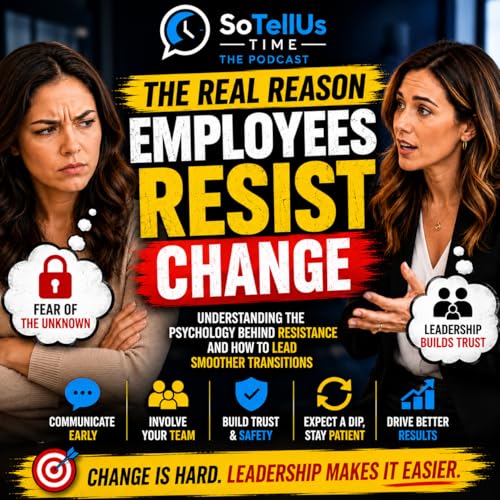
『Stop Employee Resistance Before It Kills Your Business Growth』のカバーアート

Stop Employee Resistance Before It Kills Your Business Growth

Stop Employee Resistance Before It Kills Your Business Growth

無料で聴く

ポッドキャストの詳細を見る
Have you ever rolled out a new system, process, schedule, software, policy, or expectation in your business… only to have your team push back, complain, avoid it, or quietly refuse to adopt it? Most business owners and leaders assume employees resist change because they are being difficult, lazy, negative, or stuck in their ways. But the truth is deeper than that. In this episode of SoTellUs Time, we break down the real reason employees resist change and how business owners, managers, and leaders can guide their teams through smoother transitions without chaos, confusion, frustration, or loss of trust. Whether you run a childcare center, home service company, med spa, salon, dental office, law firm, restaurant, agency, or local service business, change is unavoidable. Growth requires new systems. Scaling requires better processes. Better customer service requires new expectations. Better operations require better tools. But if your team does not understand the change, trust the process, or feel supported through the transition, even the best idea can fail. The mistake most leaders make is thinking change is about the system. It is not. Change is about people. Your employees are not always resisting the change itself. They are often resisting uncertainty, loss of control, fear of failure, lack of clarity, or the feeling that something familiar is being taken away from them. In this episode, we explain why resistance to change is usually emotional before it is logical, and why great leaders do not take pushback personally. Instead, they get curious, communicate clearly, involve their team, and create the kind of psychological safety that makes adoption easier. You will learn why employees subconsciously ask questions like: "What am I losing?" "Will this make my job harder?" "Am I still valued?" "Will I look incompetent?" "Will I be able to succeed?" "Does leadership actually understand what this means for me?" These questions matter because every business transition creates perceived loss. Employees may feel like they are losing comfort, routine, competence, confidence, status, control, or relationships. That is why a teacher in a childcare center may avoid a new parent communication app, a technician may complain about new scheduling software, or a team member may ignore a new policy even when the change is obviously good for the business. The change may be logical to leadership. But to the employee, it may feel threatening. That is why leaders must communicate more than the "what." They must communicate the "why." If you simply tell your team, "We are switching systems Monday," you leave room for fear, assumptions, frustration, and resistance. But when you explain why the change is happening, how it helps the business, how it improves the customer experience, how it reduces daily stress, and how the team will be supported through it, buy-in increases dramatically. People support what they understand. In this episode, we also talk about the biggest leadership mistake during change: taking resistance personally. When an employee says, "This won't work," "The old way was better," "This is too complicated," or "We already tried that," it may not be rebellion. It may be fear. It may be confusion. It may be insecurity. It may be a lack of trust from past changes that were handled poorly. Great leaders do not get defensive. They ask better questions. "What concerns you most?" "What feels unclear?" "What obstacles do you see?" "What support would help?" "What would make this transition easier?" Those questions lower emotional resistance because they help employees feel heard instead of steamrolled. If you are a business owner, entrepreneur, operator, manager, team leader, or anyone responsible for implementing change, this episode will help you understand how to lead through change with more clarity, confidence, patience, and trust. We cover practical strategies like: Communicating change early before anxiety builds Explaining the "why" repeatedly, not just once Connecting change to the company mission and customer experience Involving employees before implementation Asking for feedback from the people closest to the work Expecting a temporary dip in performance during the learning curve Coaching instead of criticizing during transition Modeling calm and confidence as a leader Creating psychological safety so employees are willing to learn Helping your team feel informed, supported, included, and safe One of the biggest takeaways from this episode is this: The success of change is rarely about the software, system, policy, or process itself. It is about whether your people feel supported through the transition. If your business is growing, your systems will need to change. Your processes will need to improve. Your team will need to adapt. But the way you lead that change will determine whether your employees embrace the next level of growth or quietly resist it. The next time your team pushes back on change,...
adbl_web_anon_alc_button_suppression_t1
まだレビューはありません