エピソード

  • #238 - RN Staffing Report: The Numbers That Matter
    2026/07/14
    $60,090 Per Nurse Exit, 3.35 Million Workers Finally Protected & Virtual Nursing Is WorkingJuly 13th, 2026. Bo, Luke, and ASHHRA Executive Director Jeremy Sadlier cover three stories that all connect to the same question: are you doing everything you can to keep the people you have?💰 The Number Your CFO Hasn't Modeled: $60,090 The NSI 2026 National Healthcare Retention and RN Staffing Report — 527 acute care hospitals, nearly a million workers — puts the cost to replace one staff RN at $60,090. National RN turnover is 17.6%, costing the average hospital $5.2 million annually. Every percentage point shift in turnover is worth $295,000. And 56.8% of all RN departures have less than two years of service.Action: Bring $60,090 into your next budget conversation about retention. The ROI on almost any retention investment looks different at that baseline. Also: know how your health system makes money today. Ambulatory care is running 43% profit margins at some systems. Internal mobility toward high-margin service lines changes what you can invest everywhere else.🧠 3.35 Million Healthcare Workers Can Now Seek Help Without Fear The Dr. Lorna Breen Healthcare Provider Protection Act was reauthorized for five more years. As of May 27th, more than 3.35 million healthcare workers now practice in states or systems that removed stigmatizing mental health questions from licensure applications — 44 medical boards, 9 nursing boards, 11 pharmacy boards have made the change. Action: Check your state's status at the Lorna Breen Foundation tracker and share it with your CMO and credentialing team. If EAP utilization and wellness participation are low, the upstream problem may be built into the credentialing system itself.📺 Virtual Nursing Is No Longer an Experiment The 2026 CNO Survey from Wolters Kluwer: nearly 9 in 10 nurse leaders have adopted new care models and 90% say they are working. Across 10 health systems at scale — including Advocate, Ochsner, Henry Ford, Piedmont, and UC Health — one 69-hospital system saved 43,000 nursing hours in a year. Patient experience improved as much as 80% at some sites. Nursing turnover reduction saved one system $6.3 million. Action: If this conversation is already happening in your clinical or operational teams, HR needs to be at that table. Which roles you recruit for, how you compensate, and how you design career paths for nurses shifting to virtual roles — that is an HR design problem.Enjoying the show? Subscribe to The ASHHRA Podcast on your favorite podcast platform so you never miss an episode.This episode is brought to you by AP3 — the ASHHRA Preferred Partner Program.Healthcare HR leaders are navigating rising costs, workforce shortages, and an overwhelming vendor landscape. AP3 cuts through the noise.Managed in collaboration with Lockton and backed by ASHHRA, AP3 is a governed ecosystem of vetted, healthcare-aligned solution providers across talent acquisition, benefits administration, workforce compliance, financial wellness, and employee engagement. Every partner is rigorously vetted. Every relationship is governed. Every solution is built for healthcare.No directories. No bidding wars. Just trusted partners proven to perform.Visit AP3.info to learn more and get connected with a partner.News LinksStory 1 — NSI 2026 National Health Care Retention & RN Staffing ReportBecker's: The Cost of Nurse Turnover in 10 Points — 2026Nurse.org: Nurse Turnover Is Rising Again — And It's Costing Hospitals MillionsPeopleElement: The $60,090 Problem Most Health System CFOs Have Not ModeledNSI Nursing Solutions: 2026 National Health Care Retention & RN Staffing Report (Full PDF)Story 2 — Dr. Lorna Breen: Mental Health Licensing MilestoneDr. Lorna Breen Heroes' Foundation: More Than 3.35 Million Health Workers Now Practice in States and Systems That Support Their Mental HealthAMA: Congress Extends Dr. Lorna Breen Law for Five YearsDr. Lorna Breen Heroes' Foundation: Remove Barriers Initiative — Full Board TrackerJ&J Nursing: Reauthorizing the Dr. Lorna Breen Act: Mental Health Support for Healthcare WorkersStory 3 — Virtual Nursing: What's WorkingBecker's: Virtual Nursing at 10 Systems — 23 Results to KnowWolters Kluwer / Lippincott: Nurse-Led Innovation and New Care Models — 2026 CNO SurveyMUSC: Demonstrating the Value of Virtual Nursing — 2026 Report (PDF)AONL 2026: The Future of Virtual Nursing and Care Model Redesign Support the show
    続きを読む 一部表示
    42 分
  • #237 - Stop Losing Great Candidates After They Apply
    2026/07/09

    The Hiring Automation Gap No One Is Talking About

    Featuring Mike DeMarco, Senior Product Marketing Manager, Phenom

    Healthcare is ranked #2 out of eight industries for overall hiring automation maturity. Healthcare was among the first to deploy voice screening agents. So why are nurses still taking 64 days to fill and internal positions taking 57?

    Bo and Luke welcome Mike DeMarco — the self-described "Bruce Springsteen of Product Marketing" — to unpack Phenom's 2026 State of Hiring Automation Report, which audited over 200 companies across eight industries and surfaced a gap that explains almost everything.

    📊 The Gap: You're Good at Getting Candidates In. You're Not Qualifying Them.
    Across all eight industries, organizations scored above 50% maturity on attraction, engagement, and conversion — getting candidates to click apply. Hiring automation scores — what happens at the moment of application — dropped to sub-28%. The candidates are there. The qualification infrastructure is not. And for the first time in the survey's history, quality of hire (54%) outranked speed and cost as HR leaders' top hiring priority.

    🤖 What Good Looks Like
    Baylor Scott & White completes 1,000 voice screens in a single day when a job is posted. Allara Caring reduced time to offer by 32% and found that 40% of screens happen after hours — candidates engaging on their own schedule, not waiting for a recruiter callback. Seven-minute apply-to-interview-scheduled flows exist in retail today. Healthcare is next.

    🔎 Where to Start — This Week, Almost Free
    Luke's practical framework: record conversations with your best and worst performers in each TA role. Ask what they actually do — not what they're supposed to do. Then run everything through Claude: compare top and bottom performers, identify automation opportunities, and generate a business process map. Total cost: roughly $100/month. Mike's team is also offering a complimentary two-role hiring automation audit for listeners.

    📋 Resources
    Phenom 2026 State of Hiring Automation Report + free audit.

    AI isn't replacing recruiters. People who know how to use AI will replace people who don't. Start today.

    Enjoying the show? Subscribe to The ASHHRA Podcast on your favorite podcast platform so you never miss an episode.

    This episode is brought to you by AP3 — the ASHHRA Preferred Partner Program.

    Healthcare HR leaders are navigating rising costs, workforce shortages, and an overwhelming vendor landscape. AP3 cuts through the noise.

    Managed in collaboration with Lockton and backed by ASHHRA, AP3 is a governed ecosystem of vetted, healthcare-aligned solution providers across talent acquisition, benefits administration, workforce compliance, financial wellness, and employee engagement. Every partner is rigorously vetted. Every relationship is governed. Every solution is built for healthcare.

    No directories. No bidding wars. Just trusted partners proven to perform.

    Visit AP3.info to learn more and get connected with a partner.

    Support the show

    続きを読む 一部表示
    41 分
  • #236 - Praise Boosts Nurse Retention, AI Predicts Quitting
    2026/07/06
    Healthcare Is Dead Last in Recognition Culture. Plus: AI That Predicts Who's About to Quit & What CEOs Are Betting On in 2026July 6th, 2026. Bo, Luke, and ASHHRA Executive Director Jeremy Sadlier are back from the long weekend with a deliberately positive episode — three stories built to give you energy heading into the week.🏆 Healthcare Is Last in Recognition Culture — and the Fix Is FreeThe OC Tanner 2026 State of Employee Recognition Report (42,000 employees, ten countries) found healthcare at the bottom for recognition champions — leaders who actively build cultures of appreciation. The cost: employees at organizations with strong recognition cultures have four times greater odds of staying two-plus years and seven times greater odds of feeling belonging. Recognition also compounds — employees who work with recognition champions are three times more likely to recognize their own coworkers.Action: You don't need a platform to start. Walk down the hall and tell someone specifically what they did well today. Four times retention. Seven times belonging. That's the ROI on a 30-second conversation.🤖 AI Is Now Predicting Who's About to Quit — Before They Know It ThemselvesMount Sinai implemented predictive analytics flagging nurses at high attrition risk by analyzing absenteeism, overtime, survey responses, and workload patterns. Results: 17% reduction in voluntary nurse turnover and 15% reduction in burnout-related resignations. Health systems using these tools report 15–25% reductions in contingency labor costs and 10–18% improvements in nurse retention within two years.Action: You don't need Mount Sinai's stack to start. Pull your absenteeism and overtime data by unit — the patterns are already there. The barrier is data quality, manager trust, and readiness to act on what the data tells you.📊 The CEO Playbook: Three Bets Healthcare Leaders Are Making Right NowPwC, EY, and Witt Kiefer's 2026 healthcare outlooks converge on three moves: AI shifting from experiment to infrastructure (57% of health systems planning clinical AI investment, nearly tripling in two years), ambulatory care as the growth engine, and culture as a competitive retention strategy — not HR overhead. 98% of healthcare CEOs expect to pursue M&A or strategic alliances in the next 12 months.Action: Know your CEO's playbook and build your people strategy around it. Your mission is the recruiting advantage your competitors cannot replicate.Enjoying the show? Subscribe to The ASHHRA Podcast on your favorite podcast platform so you never miss an episode.This episode is brought to you by AP3 — the ASHHRA Preferred Partner Program.Healthcare HR leaders are navigating rising costs, workforce shortages, and an overwhelming vendor landscape. AP3 cuts through the noise.Managed in collaboration with Lockton and backed by ASHHRA, AP3 is a governed ecosystem of vetted, healthcare-aligned solution providers across talent acquisition, benefits administration, workforce compliance, financial wellness, and employee engagement. Every partner is rigorously vetted. Every relationship is governed. Every solution is built for healthcare.No directories. No bidding wars. Just trusted partners proven to perform.Visit AP3.info to learn more and get connected with a partner.News LinksStory 1 — O.C. Tanner: 2026 State of Employee RecognitionO.C. Tanner: Full 2026 State of Employee Recognition ReportBusinessWire: O.C. Tanner Releases the State of Employee Recognition 2026 ReportO.C. Tanner: Overview & Key Insights from the 2026 ReportO.C. Tanner: 5 Workplace Culture Trends for 2026Story 2 — AI Predictive Analytics & Workforce PlanningHealthTech Magazine: How Healthcare Organizations Can Benefit from Predictive Scheduling Systems (March 2026)Shiftmed: AI-Driven Predictive Staffing Analytics in HealthcareCWS Health: Using Predictive Analytics to Solve Healthcare Staffing ShortagesShiftmed: From Reactive to Proactive — Using AI and Analytics for Workforce OptimizationStory 3 — The CEO Playbook: Business Bets on HealthcarePwC: 2026 Healthcare Investment ThemesHIT Consultant: PwC 2026 Outlook — Health Services M&A Poised for Rebound as AI Becomes "Core Driver" of ValueEY: Healthcare Sector Outlook in 2026WittKieffer: Healthcare CEOs' Agenda — Top Priorities for 2026Fierce Healthcare: Key Trends That Will Shape Healthcare M&A Activity in 2026 Support the show
    続きを読む 一部表示
    33 分
  • #234 - Proven AI Scribes Reduce Physician Burnout Quickly
    2026/06/30
    Hospitals Are Building Their Own Schools, AI Scribes Cut Burnout 13 Points in 30 Days & Healthcare Is the Only Thing Keeping the US Job Market PositiveJune 29th, 2026. Bo, Luke, and ASHHRA Executive Director Jeremy Sadlier cover three stories this week that all point in the same direction: healthcare HR is not a support function. It is the engine.🎓 Health Systems Are Building Their Own Talent Pipelines A CLASP report declares 2026 the year of the talent pipeline, and the data backs it up. Sierra View Medical Center, Cleveland Clinic, and Froedtert Health are all funding internal training pathways — nursing, surgical tech, apprenticeships — for their own employees. Froedtert opened surgical tech training internally and got nearly 100 applicants. The retention math is the real story: 67% of employees say they would stay with an organization offering clear advancement and upskilling. Action: Ask who already works here and could become what we need. Community college partnerships, internal apprenticeships, and removed degree requirements for entry-level roles all work. ASHHRA is convening a coalition with Dallas College and Baylor Scott & White to share what's working — email Jeremy Sadlier at jeremy.sadlier@ashhra.org to join.🩺 Ambient AI Scribes Cut Clinician Burnout 13 Points in 30 Days New peer-reviewed research covered by Mass General Brigham and The Advisory found burnout among 263 physicians and APPs across six health systems dropped from 51.9% to 38.8% after just 30 days of ambient AI scribe use. A separate Mass General Brigham study found a 21.2-point absolute reduction. Clinicians save 13 to 16 minutes daily on documentation. Oversight is still required — these are tools, not replacements, and hallucinations remain a real concern.Action: If your organization hasn't evaluated ambient AI scribes as a retention strategy — not just a clinical efficiency play — you're missing the connection. Administrative burden is a people problem. Solve it and you solve for turnover.📈 Healthcare Is the Only Thing Keeping the US Labor Market Positive Revelio Labs research, covered by Bloomberg and Fortune, found that since January 2025 the US economy added a net 208,800 jobs across all sectors — while healthcare alone added 410,700. Without healthcare, the rest of the economy has been shedding jobs.Action: Bring this data into your next budget conversation. You are not asking for resources. You are maintaining the engine.Enjoying the show? Subscribe to The ASHHRA Podcast on your favorite podcast platform so you never miss an episode.This episode is brought to you by AP3 — the ASHHRA Preferred Partner Program.Healthcare HR leaders are navigating rising costs, workforce shortages, and an overwhelming vendor landscape. AP3 cuts through the noise.Managed in collaboration with Lockton and backed by ASHHRA, AP3 is a governed ecosystem of vetted, healthcare-aligned solution providers across talent acquisition, benefits administration, workforce compliance, financial wellness, and employee engagement. Every partner is rigorously vetted. Every relationship is governed. Every solution is built for healthcare.No directories. No bidding wars. Just trusted partners proven to perform.Visit AP3.info to learn more and get connected with a partner.News LinksStory 1 — Hospitals Building Their Own Talent PipelinesMedical Daily: U.S. Hospitals Are Now Paying to Train Their Own WorkersClasp: 2026 Is the Year of the Talent PipelineClasp Webinar Replay: 3 Workforce Shifts Health Systems Must Make NowAHA: Health Systems Shine as Job Creators (May 2026)McKnight's: Grow Our Own — Building a Sustainable Nursing WorkforceStory 2 — Ambient AI Scribes & BurnoutMass General Brigham: AI Scribes Linked to Reductions in EHR Use and BurnoutThe Advisory: Are Ambient AI Tools the Key to Reducing Physician Burnout? (Feb 2026)PMC: Use of Ambient AI Scribes to Reduce Administrative Burden and Professional BurnoutPMC: Transforming Clinical Documentation with Ambient AI Scribes (Narrative Review)Story 3 — Healthcare Holding Up the U.S. Labor MarketRevelio Labs: Healthcare Job Growth Is Propping Up the 2026 Labor MarketBloomberg: Health Care Workers Are Reshaping the US Labor Market's Future (April 2026)Fortune: Healthcare Has Been Propping Up a Shaky Labor Market (March 2026)Yale Budget Lab: How Surprising Is the Role of Healthcare Employment Growth? Support the show
    続きを読む 一部表示
    27 分
  • #233 - Winning Healthcare - Workforce Leaders Embrace Smart AI
    2026/06/25

    What It Actually Looks Like to Move Beyond Traditional HR

    Featuring Nakesha Lopez, Chief People & Culture Officer, Advocate Health

    Recorded live at Advocate Health's The Pearl innovation quarter in Charlotte, North Carolina.

    Advocate Health is one of the three largest nonprofit health systems in the country — 175,000 teammates across six states. Nakesha Lopez leads the people and culture function for all of it. She started in HR because someone mentioned a job posting at Memorial Sloan Kettering. She didn't know what HR was. Twenty-five years later, she's redefining what it can be.

    📍 HR's Seat at the Table Isn't Given — It's Earned Through Business Fluency Nakesha's definition of non-traditional HR starts here: the people and culture strategy cannot be separate from the organizational strategy. HR leaders must speak CFO, speak operations, speak clinical — and translate across all of it. The interpreter who removes barriers and co-creates with operational leaders before rolling anything out. Her biggest early-career mistake taught her that lesson permanently.

    🤖 People-Led, AI-Enabled — Not the Other Way Around Advocate Health's AI strategy is co-led by Nakesha and the Chief AI Officer. The frame is workforce transformation, not AI transformation — because the goal is improved teammate experience, not technology deployment for its own sake. Advocate is rolling out AI literacy organization-wide: helping 175,000 teammates assess where they are in their AI maturity and build from there. If your organization is not building AI literacy now, the new grad you hire in 2027 will notice.

    ⚡ Work Forward: Advocate's Workforce Transformation Strategy Work Forward is Advocate's structured approach to redesigning work alongside the teammates who do it — cross-functional teams identifying workflows to improve, enabled by AI, with clear accountability for what happens to the work that goes away and the new skills required to replace it. It is not a project. It is a culture being built over multiple years.

    🔎 The Takeaway for Every Healthcare HR Leader Embrace the future — but do it together. Your peers, your vendors, your frontline teammates are your co-designers. The best outcomes come from bringing different minds into the same room and letting the debate happen.

    Connect with Nakesha: https://www.linkedin.com/in/nakesha-lopez-b817821

    Enjoying the show? Subscribe to The ASHHRA Podcast on your favorite podcast platform so you never miss an episode.

    This episode is brought to you by AP3 — the ASHHRA Preferred Partner Program.

    Healthcare HR leaders are navigating rising costs, workforce shortages, and an overwhelming vendor landscape. AP3 cuts through the noise.

    Managed in collaboration with Lockton and backed by ASHHRA, AP3 is a governed ecosystem of vetted, healthcare-aligned solution providers across talent acquisition, benefits administration, workforce compliance, financial wellness, and employee engagement. Every partner is rigorously vetted. Every relationship is governed. Every solution is built for healthcare.

    No directories. No bidding wars. Just trusted partners proven to perform.

    Visit AP3.info to learn more and get connected with a partner.

    Support the show

    続きを読む 一部表示
    51 分
  • #232 - Proven Secrets to Win the Hiring Battle
    2026/06/24

    Pay Transparency Hits July 1, Two-Thirds of HR Leaders Don't Know What AI Can Do & 84% of Healthcare Workers Feel Taken for Granted

    June 22nd, 2026. Luke Carignan is flying solo — Bo and Jeremy are out — and he is not slowing down. Three stories: compliance, technology, and the most human challenge in healthcare right now.

    ⚖️ Pay Transparency Laws Hit Virginia and Maine July 1
    Every job posting in Virginia and Maine must include an actual salary range beginning July 1st. No "competitive compensation." No DOE. Virginia's law has no employer size threshold — a 20-person clinic and a 50,000-employee health system face the same requirement. A salary history ban is also in effect. 16 states now have pay transparency laws. Penalties start at $1,000 per violation, with a 15-day correction window that protects you from a lawsuit on that specific posting.
    Action: Audit your postings today. Then stop treating this as compliance and start treating it as competitive advantage. Candidates are three times more likely to apply when a salary range is included. In a market with 1.3 million open healthcare jobs, that is not a small number.

    🤖 SHRM 2026: The AI Gap Is Awareness, Not Budget
    SHRM surveyed 1,700+ HR professionals and found the number one barrier to AI adoption is not cost or security — it is a lack of awareness. 67% of HR leaders don't fully understand what AI can do in hiring. Meanwhile, 92% of CHROs expect greater AI integration in 2026. And 57% of HR professionals in states with AI hiring laws don't know those laws exist. 19 of the most populous states have enacted them.
    Action: Schedule a real AI literacy session for your HR team — not a vendor demo. Find out what AI hiring laws apply in your state. If your legal team doesn't know, that is also useful information.

    🧠 84% of Healthcare Workers Feel Taken for Granted
    ProLink's 2026 Pulse of Travel Healthcare and a Harris Poll align on the same finding: burnout (29%), declining morale (21%), and turnover (20%) are the top three workforce threats — all people problems. 80% say well-being programs don't work. Workers are short-staffed 43% of the time. No mindfulness app fixes that.
    Action: Stop solving a retention problem with a benefits solution. Flexibility — shift autonomy, compressed schedules, hybrid models for admin roles — is what the data points to. Go ask someone on your team today how they are actually doing. Really ask.

    Enjoying the show? Subscribe to The ASHHRA Podcast on your favorite podcast platform so you never miss an episode.

    This episode is brought to you by AP3 — the ASHHRA Preferred Partner Program.

    Healthcare HR leaders are navigating rising costs, workforce shortages, and an overwhelming vendor landscape. AP3 cuts through the noise.

    Managed in collaboration with Lockton and backed by ASHHRA, AP3 is a governed ecosystem of vetted, healthcare-aligned solution providers across talent acquisition, benefits administration, workforce compliance, financial wellness, and employee engagement. Every partner is rigorously vetted. Every relationship is governed. Every solution is built for healthcare.

    No directories. No bidding wars. Just trusted partners proven to perform.

    Visit AP3.info to learn more and get connected with a partner.

    Support the show

    続きを読む 一部表示
    16 分
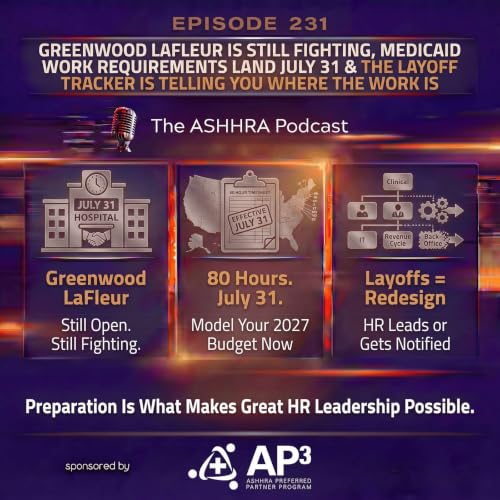
  • #231 - Medicaid Work Requirements 2026: 80 Hours a Month, Effective July 31 — What HR Leaders Must Do Now
    2026/06/15

    Greenwood LaFleur Is Still Fighting, Medicaid Work Requirements Land July 31 & the Layoff Tracker Is Telling You Where the Work Is

    June 15th, 2026. Bo and Luke open with a Mississippi hospital that was supposed to close today — and is still open. Then a Medicaid rule taking effect without a real comment window. Then a layoff tracker that, read correctly, is actually a roadmap for HR.

    🏥 Greenwood LaFleur: Still Open, Still Fighting
    The 25-bed public hospital in Greenwood, Mississippi extended its WARN Act closure date from June 15th to July 31st as negotiations with UMMC continue. UMMC submitted a formal acquisition proposal last week. LaFleur County has a 13% uninsured rate and very few alternatives. The City Council president is cautiously optimistic. Whether this hospital is open August 1st depends entirely on whether this deal gets done.
    HR Action: Review your WARN Act procedures, severance frameworks, and workforce communication templates this week. Not because you expect to need them — because preparation is what makes great HR leadership possible in any environment.

    📋 Medicaid Work Requirements: 80 Hours, Effective July 31
    CMS published its interim final rule on Medicaid work requirements June 1st — effective July 31st, the same day public comments are due. No meaningful comment window. Starting January 1, 2027, states must require Medicaid enrollees to document 80 hours per month of work, education, or community service to maintain eligibility. Nebraska is live now. Fifty different state implementation processes are coming.
    HR Action: Model what a 5% and 10% increase in self-pay volume does to your workforce budget in 2027 by service line. Get that in front of your CFO before June ends.

    📉 The Layoff Tracker Is a Workforce Transformation Map
    Central Health, Optim, PacificSource, and UnityPoint Health all added to the tracker this week — but the pattern has shifted. IT, revenue cycle, and back-office functions are now absorbing a larger share of cuts through outsourcing and automation. This is not just reduction. It is redesign.
    HR Action: Find out this week whether your organization has active outsourcing or automation initiatives in motion. If yes, make sure HR is embedded in the planning from the start — not notified when WARN notices need to go out. Change management, reskilling, and culture continuity are yours to lead.

    Enjoying the show? Subscribe to The ASHHRA Podcast on your favorite podcast platform so you never miss an episode.

    This episode is brought to you by AP3 — the ASHHRA Preferred Partner Program.

    Healthcare HR leaders are navigating rising costs, workforce shortages, and an overwhelming vendor landscape. AP3 cuts through the noise.

    Managed in collaboration with Lockton and backed by ASHHRA, AP3 is a governed ecosystem of vetted, healthcare-aligned solution providers across talent acquisition, benefits administration, workforce compliance, financial wellness, and employee engagement. Every partner is rigorously vetted. Every relationship is governed. Every solution is built for healthcare.

    No directories. No bidding wars. Just trusted partners proven to perform.

    Visit AP3.info to learn more and get connected with a partner.

    Support the show

    続きを読む 一部表示
    29 分