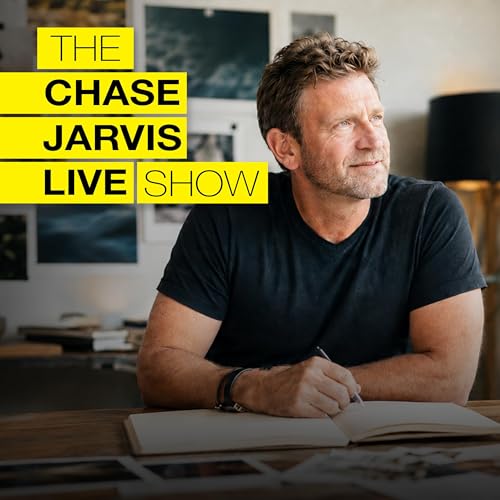
『The Chase Jarvis LIVE Show』のカバーアート

The Chase Jarvis LIVE Show

The Chase Jarvis LIVE Show

著者: Chase Jarvis
無料で聴く

今ならプレミアムプランが3カ月 月額99円

2026年5月12日まで。4か月目以降は月額1,500円で自動更新します。

概要

Chase Jarvis is a visionary photographer, artist and entrepreneur. Cited as one of the most influential photographers of the past decade, he is the founder & CEO of CreativeLive. In this show, Chase and some of the world's top creative entrepreneurs, artists, and celebrities share stories designed to help you gain actionable insights to recognize your passions and achieve your goals.© Chase Jarvis 個人的成功 出世 就職活動 経済学 自己啓発
エピソード
  • How to Find Your Creative Voice
    2026/05/06
    Hey friends, Chase here Let's talk about one of the most important questions every creator eventually asks: How do I find my creative voice? Or maybe you've heard it framed another way: How do I develop a personal style? How do I make work that actually feels like mine? How do I stop copying what everyone else is doing and start creating from a place that is uniquely my own? This question comes up all the time because it sits at the center of the creative life. Whether you're a photographer, designer, writer, filmmaker, musician, entrepreneur, or someone who simply feels called to make things, there comes a point where technical ability is not enough. You can know how to use the tools. You can understand the software. You can study the masters. You can follow the trends. You can learn the settings, the systems, the formulas, the workflows. But eventually, you hit a deeper question: What makes this mine? That is what this episode is about. And I want to be clear from the start: finding your creative voice is not about inventing some perfect brand identity overnight. It's not about locking yourself into one narrow lane forever. It's not about deciding, intellectually, "This is my style now," and then forcing every piece of work to fit inside that box. Your creative voice is much more organic than that. It is your fingerprint. Your point of view. Your taste. Your history. Your instincts. Your lived experience. Your way of seeing the world, translated through the things you make. And the only way to find it is to make. Not once. Not occasionally. Not only when you feel inspired. Again and again and again. The Big Question: What Is Personal Style? Personal style can sound like one of those vague creative phrases that floats around in the universe without ever becoming useful. People say things like, "You need to find your style," or "You need to develop your voice," but what does that actually mean? At its simplest, personal style is the thing that makes your work recognizable. It's the equivalent of your handwriting. You don't have to think about your handwriting every time you write your name. It's not something you consciously construct letter by letter. It just comes out of you because it has been shaped by repetition, history, muscle memory, and identity. Your creative style works the same way. It is the unique aesthetic fingerprint that you unconsciously put on everything you make. Think about music. You can hear a Prince song for just a few measures and know it's Prince before his voice even enters. There's a signature there. A rhythm. A tone. A sensibility. A way the work announces itself. Think about photography. You can look at an Ansel Adams landscape and recognize the scale, the drama, the tonality, the reverence for nature. It has a point of view. That's personal style. It's not just what you make. It's how you see. It's what you notice. It's what you repeat without realizing you're repeating it. It's the pattern behind the work. And that matters because without some kind of recognizable point of view, you're just bouncing around. You might be technically capable. You might be able to make a good photograph, a good song, a good design, a good film, a good essay. But if there's nothing distinctive about the way you make it, people have a harder time connecting that work back to you. Personal style is what helps the work become yours. Why Your Creative Voice Matters There are two big reasons personal style matters. The first is personal. If you spend your life chasing everyone else's style, you're going to end up miserable. Now, let's be honest: early in the creative journey, imitation is part of the process. That's normal. That's healthy. That's how we learn. You see someone whose work you admire and you try to understand how they did it. You copy a lighting setup. You study a sentence structure. You recreate a beat. You reverse-engineer a design. You try to make something that looks or sounds or feels like the thing that inspired you. There's nothing wrong with that. In the beginning, imitation helps you learn how to move the tools around. It helps you close the gap between what you see in your mind and what you're actually capable of making. But imitation is not the destination. If all you ever do is copy what's trendy, or borrow someone else's point of view, or chase whatever style is getting attention right now, you are not expressing yourself. You are expressing the culture around you. And that is a direct path to burnout. Because the reason we make things, at the deepest level, is expression. We make because something inside wants to come out. We make because it feels good to turn an internal experience into something real in the world. We make because creativity is one of the ways we become more fully ourselves. If your work is always a response to someone else's style, you lose that connection. You become a mirror instead of a source. The second reason personal style matters is practical...
    続きを読む 一部表示
    20 分
  • Stop Asking Permission to Create Your Life
    2026/04/29
    Hey friends, Chase here Let's talk about reality. Not the abstract, philosophical version. Not the version you argue about over coffee or read about in some dusty book. I mean the reality you wake up inside every day. The job. The schedule. The obligations. The story you tell yourself about what is "practical." The version of your life that everyone around you seems to agree is reasonable. And then there's the other thing. The thing you can see in your mind that does not exist yet. The book. The business. The body of work. The new way of living. The creative practice. The conversation. The project. The identity. The version of your life that keeps tapping you on the shoulder, quietly asking, "Are we ever going to build this?" This episode is about that tension. It started with a Nietzsche quote I love: No artist tolerates reality. But the point is not Nietzsche. The point is you. Because too many of us spend years — sometimes decades — living inside somebody else's plan for our one precious life. We inherit the well-worn path. We internalize the "shoulds." We mistake convention for truth. We tell ourselves that creativity is indulgent, impractical, selfish, lofty, or naive. And the more we repeat that story, the more it starts to feel like reality. But here's the thing I want you to hear clearly: Reality is not fixed. Reality is shaped. And one of the most powerful ways you shape it is by creating. This is the heart of the episode: You are not here to simply accept the world as it has been handed to you. You are not here to blindly follow the plan someone else wrote. You are not here to wait until the world gives you permission to make something, become something, or live in a way that feels more true. You are here to create. And I don't mean that in a soft, decorative way. I mean it in the most practical way possible. Creativity is not just painting, writing, photography, music, or design. Creativity is the foundation underneath every act of making anything in the world. A conversation is co-created. A relationship is co-created. A business is co-created. A life is co-created. You cannot build anything meaningful without creativity. Which means creativity is not extra. Creativity is your birthright. The Core Idea Stop asking permission to create your life. That's the message. Not because you should abandon responsibility. Not because every idea you have will work. Not because the path is easy, obvious, or guaranteed. But because waiting for permission is one of the most common ways we avoid our own agency. We wait for someone to tell us it's okay. We wait until the timing is better. We wait until we have more money, more confidence, more clarity, more proof. We wait until the world gives us a clean, logical reason to begin. But most meaningful creative acts do not start with certainty. They start with a pull. A nudge. A frustration. A vision. A refusal to accept that the current version of reality is the only version available. That is what artists do. That is what entrepreneurs do. That is what builders do. That is what every person who has ever changed anything does. They look at reality and say, "This is not the whole story." Why Creativity Is Practical as Hell One of the biggest lies our culture tells is that creativity is impractical. You've probably heard some version of it. Be realistic. Have a backup plan. Don't waste your time. That's not how the world works. Do something more responsible. And to be clear, I'm not arguing against responsibility. I'm arguing against the idea that suppressing your creative agency is responsible. Because the truth is, every useful thing around you was once imagined by someone. The chair you're sitting in. The phone in your hand. The building you're inside. The app you use. The song that changed your mood. The book that changed your mind. The business that changed your life. All of it was invented, dreamed up, shaped, built, and brought into the world by people who were no more inherently magical than you. They saw something that did not yet exist, and they acted. That is creativity. And the more you practice creating in small ways, the more you build the muscle to create in bigger ways. It's only by creating something that you learn you can create anything. And eventually, you start to understand that you can create not just objects, projects, or art — but change. Change in your work. Change in your habits. Change in your relationships. Change in your identity. Change in the way you experience your own life. What You'll Hear in This Episode This is a short micro show, but it goes straight at the heart of creative agency. Here are the ideas worth listening for — and coming back to when you need a reminder that you are allowed to build the thing you see in your mind. Why so many of us live inside someone else's plan without realizing itHow culture trains us to see creativity as impractical when it is actually foundationalWhy creativity is your birthright ...
    続きを読む 一部表示
    12 分
  • Don't Wait for Inspiration
    2026/04/22
    Hey friends, Chase here Let's talk about something that gets romanticized way too much in the creative world: inspiration. We've been taught to wait for it. To trust it. To believe that the best work comes when lightning strikes, when the muse shows up, when the feeling is right. And while inspiration is real — and beautiful when it arrives — it's also wildly unreliable. That's the trap. If you build your creative life around inspiration, you build it around something you cannot control. And anything you can't control is a dangerous foundation for a meaningful body of work. This episode is about a better way. A steadier way. A more durable way. It's about why creativity doesn't really grow from waiting for a feeling — it grows from compounding action. Small acts. Repeated over time. Daily deposits into the account of your craft. Tiny efforts that don't seem like much in the moment, but eventually become impossible to ignore. Because the truth is simple: you do not need to feel inspired to make something meaningful. You need to begin. And then begin again tomorrow. The Real Problem With Waiting for Inspiration At the start of the episode, I ask a question that's worth sitting with for a minute: When was the last time you made something just for the sake of making it? Not for a client. Not for social media. Not because someone was expecting it. Not because it was due. Just because you felt a pull to create. For a lot of people, that question lands hard. Not because the desire to create is gone — but because somewhere along the way, the conditions got heavy. The pressure increased. The stakes changed. Creation stopped being play and started becoming performance. And once that happens, inspiration starts to feel like a requirement. Like you need the right mood, the right window of time, the right environment, the right burst of confidence before you can begin. But that's backwards. Inspiration is not the engine. It's the byproduct. The people who make meaningful work consistently are rarely sitting around waiting to feel magical. They're working. They're practicing. They're trying things. They're showing up on ordinary days. They're making imperfect things and learning from the process. They understand that action creates momentum — and momentum often creates the feeling we mistakenly thought had to come first. The Core Idea: Creativity Compounds Most people understand compounding in the context of money. You invest a little. That investment earns returns. Then those returns start earning returns of their own. If you stick with it long enough, the early effort starts to multiply in ways that seem almost disproportionate to the original input. That same principle applies to creativity. Every day you make something, you are making a deposit into your creative future. You're not just producing one photo, one page, one sketch, one draft, one conversation, one attempt. You're building skill. You're building confidence. You're building pattern recognition. You're building stamina. You're building trust with yourself. That one photograph teaches you how to see a little better tomorrow. That paragraph in your journal makes the next paragraph easier to write. That rough idea you abandon still shapes the way your brain approaches the next one. None of it is wasted. That's important, because a lot of creative people dismiss the small efforts. They only count the big breakthroughs. They only respect the obvious wins. They think the work "counts" once it becomes polished, public, profitable, or impressive. But real creative growth doesn't work that way. The invisible reps are where the change is happening. Why the Early Returns Feel So Small One reason people stop too soon is because the beginning is incredibly deceptive. You show up. You try. You make the thing. And at first? Not much seems to happen. You don't feel transformed. You don't suddenly become excellent. You don't necessarily get recognition. You may not even like what you made. That's normal. It's a lot like going to the gym. The first handful of workouts don't make you feel powerful. Usually they make you feel sore. Awkward. Behind. You don't see visible results yet, so your brain starts questioning whether the effort is worth it. That's exactly where most people quit. Not because the process isn't working — but because the results are still compounding beneath the surface. The habit is the investment. The work is the interest. And in the background, whether you notice it or not, something is building. What Compounding Looks Like in Real Life If you commit to a creative practice, the shifts usually happen in phases. Day one: you make something and it feels mediocre. Maybe embarrassing, even. You put it out there anyway. Or maybe you keep it private. Either way, you made something. That matters. Day 30: you've stayed with it long enough to feel a difference. You might not be able to articulate exactly how you're better, but something is ...
    続きを読む 一部表示
    13 分
adbl_web_anon_alc_button_suppression_c
まだレビューはありません