『The Chief Healthcare Officer』のカバーアート

The Chief Healthcare Officer

The Chief Healthcare Officer

著者: Dr. Fatih Mehmet Gul
無料で聴く

The Chief Healthcare Officer Podcast seeks to decode the secrets of success in healthcare management, dissect the latest trends, and build a community of forward-thinking healthcare leaders…

From advancing the healthcare industry to championing sustainability and amplifying patient experiences, the podcast dives into the topics that matter most for healthcare professionals and leaders.

Follow Dr Fatih Mehmet Gül on LinkedIn
https://www.linkedin.com/in/drfameg/

Visit Dr Fatih's Website
https://www.fatihmehmetgul.com/

Visit The CHO Podcast Website
https://www.chiefhealthcareofficer.com/

Subscribe to the CHO LinkedIn Newsletter
https://www.linkedin.com/newsletters/the-chief-healthcare-officer-6939938177927241728/

© 2026 The Chief Healthcare Officer
マネジメント マネジメント・リーダーシップ 出世 就職活動 経済学 衛生・健康的な生活 身体的病い・疾患
エピソード
  • The Healthcare Technology Trap Leaders Must Avoid
    2026/05/23

    In this episode of The Chief Healthcare Officer, Dr. Fatih Mehmet Gül speaks with Nancy Wright, VP of Commercial Services and Digital Platforms at GE HealthCare, about what it really takes to make healthcare technology work for people.

    Nancy brings a unique operations-led perspective to commercial healthcare transformation, helping health systems think beyond equipment and technology procurement. Together, Dr. Fatih and Nancy explore why the future of healthcare is not simply about buying better technology, but about redesigning care around clinicians, patients, workflows, safety and long-term system resilience.

    The conversation covers some of the most urgent questions facing healthcare leaders today: workforce shortages, digital transformation, cybersecurity, predictive maintenance, AI-enabled asset management, rural and ambulatory care, cultural safety, and the future role of hospitals.

    A key theme runs throughout the discussion: technology must not become another layer of complexity. It should amplify empathy, extend human capacity and make care delivery smoother, safer and more sustainable.

    Nancy also explains why healthcare leaders must stop treating digital transformation as a project and start seeing it as a cultural shift. Successful transformation, she argues, requires leaders to “lead from the centre,” create psychological safety, involve clinicians early, understand community needs, and avoid the costly trap of buying technology before defining the problem.

    The episode also explores cybersecurity as a patient safety issue, not just an IT concern. Nancy shares why health systems must embed cybersecurity into every technology decision and treat system resilience as part of care quality.

    The conversation closes with a powerful look ahead to the future of hospitals, digital twins, and the possibility that every patient may one day have a data-backed “digital carbon copy” that helps healthcare teams deliver more proactive, personalised care.

    Key topics covered

    Healthcare digital transformation
    Human-centred technology
    GE HealthCare advanced services
    Workforce shortages in healthcare
    Cybersecurity as a patient safety issue
    Predictive maintenance and medical equipment
    AI in biomedical engineering and asset management
    Rural healthcare and remote patient monitoring
    Ambulatory care and hospital capacity
    Cultural safety in digital transformation
    The future of hospitals
    Digital twins in healthcare
    Connected Care and healthcare leadership

    Check out Dr. Fatih's Connected Care Book on Amazon:
    https://www.amazon.com/Connected-Care-Transformation-Human-Centred-Healthcare/dp/9699797118

    Listen to the episode and let us know what you think using the contact form on our website: https://www.chiefhealthcareofficer.com.

    Follow Dr Fatih Mehmet Gül on LinkedIn - https://www.linkedin.com/in/drfameg/
    Visit Dr Fatih's Website - https://www.fatihmehmetgul.com/

    Subscribe to the CHO LinkedIn Newsletter - https://www.linkedin.com/newsletters/the-chief-healthcare-officer-6939938177927241728/

    続きを読む 一部表示
    58 分
  • The Burnout Cure: Why Transparency is More Profitable Than Efficiency
    2026/04/14

    In a healthcare landscape increasingly dominated by administrative load and systemic pressure, physicians often feel like the "last thought" in the design of the systems they work within.

    Dr. Graham Walker and Jake Horowitz, the minds behind Offcall, join Dr. Fatih Mehmet Gul in this episode to discuss their mission to build "for and by physicians". The conversation explores the "invisible load" of modern medicine; the cognitive and moral weight of providing individualized care within a system optimized for scale. They share how Offcall provides a first-of-its-kind transparency tool, allowing doctors to anonymously benchmark their contracts and salaries to ensure they are being treated fairly. Finally, the guests offer a "cautious optimist" view of AI, arguing that technology must be deployed as a partner to clinical judgment rather than an administrative burden.

    Key Takeaways

    - Systemic Abuse of Dedication: Physician dedication and ownership have been exploited by health systems and insurers, leading to a significant loss of autonomy and agency.
    - The "Invisible Load": Doctors face a crushing weight of emotional, cognitive, and moral pressures while trying to provide individualized care within a system optimized for scale.
    - Contractual Information Asymmetry: There is a lack of standardization in physician contracts, often leaving doctors unaware if their pay, hours, or patient loads are fair compared to their peers.
    - The Transparency Solution: Offcall provides a tool for physicians to anonymously benchmark their contracts and salaries against real-time data to restore their negotiating power.
    - Failure of Surface-Level Wellness: Traditional "wellness" initiatives, such as pizza parties or yoga sessions, fail to address the core structural issues that cause burnout.
    - The AI Participation Gap: While most physicians use AI and find it helpful, over 80% are dissatisfied with how their organizations deploy it because they are denied a seat at the leadership table.
    - A Shift Toward Independence: Due to exploitation and lack of autonomy in large systems, there is a growing trend of physicians looking to return to independent practice models.
    - The "Win-Win" of Engagement: Transparent compensation and active listening are more effective for retention than simple perks, as it is extremely expensive for a hospital to replace a disgruntled physician.

    Check out Dr. Fatih's Connected Care Book on Amazon:
    https://www.amazon.com/Connected-Care-Transformation-Human-Centred-Healthcare/dp/9699797118

    Listen to the episode and let us know what you think using the contact form on our website: https://www.chiefhealthcareofficer.com.

    Follow Dr Fatih Mehmet Gül on LinkedIn - https://www.linkedin.com/in/drfameg/
    Visit Dr Fatih's Website - https://www.fatihmehmetgul.com/

    Subscribe to the CHO LinkedIn Newsletter - https://www.linkedin.com/newsletters/the-chief-healthcare-officer-6939938177927241728/

    続きを読む 一部表示
    51 分
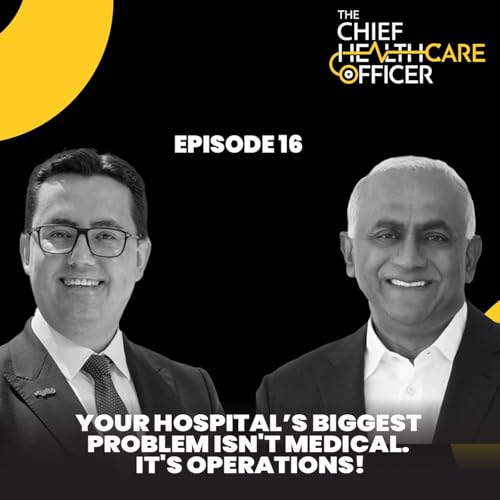
  • Your Hospital’s Biggest Problem Isn't Medical. It's Operations!
    2026/02/27

    This episode of the Chief Healthcare Officer Podcast features Mohan Giridharadas, founder and CEO of LeanTaaS and author of Better Healthcare Through Math. Host Dr. Fatih Mehmet Gül discusses with Mohan how applying sophisticated mathematical algorithms and "lean" principles can solve the operational "chaos" often found in hospitals.

    The conversation explores the massive gap between healthcare’s clinical brilliance (e.g., robotic surgery) and its operational antiquity (e.g., scheduling via spreadsheets and faxes). Mohan explains how "level loading" and predictive analytics can reduce patient wait times, increase capacity, and alleviate staff burnout by automating mundane tasks.

    Key Takeaways

    • The Airline Comparison: Just as airlines moved from manual gate assignments to sophisticated network optimization to handle thousands of flights, hospitals must adopt mathematical modeling to manage patient flow.
    • Predictive Orchestration: Instead of reacting to a "bed crunch" when it happens, hospitals can use data to predict discharges and incoming volume hours in advance, fixing bottlenecks before they affect patients.
    • Combating Burnout: By using AI to automate mundane tasks—like copying numbers or making routine screening calls—nurses are freed to work at the "top of their license," focusing on actual patient care.
    • The "Level Loading" Solution: Most "rush hour" chaos in clinics is caused by scheduling peaks that exceed capacity. Spreading the burden mathematically (level loading) reduces chaos without requiring more staff or chairs.

    Check out Dr. Fatih's Connected Care Book on Amazon:
    https://www.amazon.com/Connected-Care-Transformation-Human-Centred-Healthcare/dp/9699797118

    Listen to the episode and let us know what you think using the contact form on our website: https://www.chiefhealthcareofficer.com.

    Follow Dr Fatih Mehmet Gül on LinkedIn - https://www.linkedin.com/in/drfameg/
    Visit Dr Fatih's Website - https://www.fatihmehmetgul.com/

    Subscribe to the CHO LinkedIn Newsletter - https://www.linkedin.com/newsletters/the-chief-healthcare-officer-6939938177927241728/

    続きを読む 一部表示
    41 分
adbl_web_anon_alc_button_suppression_t1
まだレビューはありません