エピソード

  • Ep. 110 The Return of Operational Discipline
    2026/06/11
    Today on The Cutting Onions Podcast, Myles and I talk about the return of operational discipline.
    Here’s what we know:
    • Restaurants are entering a season where fundamentals matter more than ever.
    • Technology, AI, dashboards, kiosks, loyalty platforms, delivery, and automation are all useful tools, but they do not replace the discipline of running a great shift.
    • The winning operators will consistently execute labor, food cost, cleanliness, speed, hospitality, prep, manager presence, opening routines, closing routines, and daily communication.
    • Operational discipline is not old-school. It is the foundation that makes growth, hospitality, and technology actually work.
    The big question we ask is this…

    “Have we accidentally made restaurant leadership too complicated by chasing every new tool, trend, and technology — when what our teams really need first is clarity, standards, and a manager who is present?”

    Spoiler Alert: We don’t think so, but this is a good gut check for all leaders to make sure that we stay focused on the fundamentals.

    We can use technology as an accelerator to make us more efficient, but nothing will replace the basics. It can support what we do operationally, but it can’t replace what we do as leaders.

    All these years later, after leading hundreds of restaurants, we still believe some of the most important leadership lessons are hiding inside those basic routines.

    We hope you enjoy this episode! You can listen in wherever you consume your podcast content.
    続きを読む 一部表示
    33 分
  • 110. The Return of Operational Discipline
    2026/06/11
    Today on The Cutting Onions Podcast, Myles and I talk about the return of operational discipline. Here’s what we know:
    • Restaurants are entering a season where fundamentals matter more than ever.
    • Technology, AI, dashboards, kiosks, loyalty platforms, delivery, and automation are all useful tools, but they do not replace the discipline of running a great shift.
    • The winning operators will consistently execute labor, food cost, cleanliness, speed, hospitality, prep, manager presence, opening routines, closing routines, and daily communication.
    • Operational discipline is not old-school. It is the foundation that makes growth, hospitality, and technology actually work.
    The big question we ask is this…“Have we accidentally made restaurant leadership too complicated by chasing every new tool, trend, and technology — when what our teams really need first is clarity, standards, and a manager who is present?”Spoiler Alert: We don’t think so, but this is a good gut check for all leaders to make sure that we stay focused on the fundamentals. We can use technology as an accelerator to make us more efficient, but nothing will replace the basics. It can support what we do operationally, but it can’t replace what we do as leaders.All these years later, after leading hundreds of restaurants, we still believe some of the most important leadership lessons are hiding inside those basic routines.We hope you enjoy this episode! You can listen in wherever you consume your podcast content.
    続きを読む 一部表示
    33 分
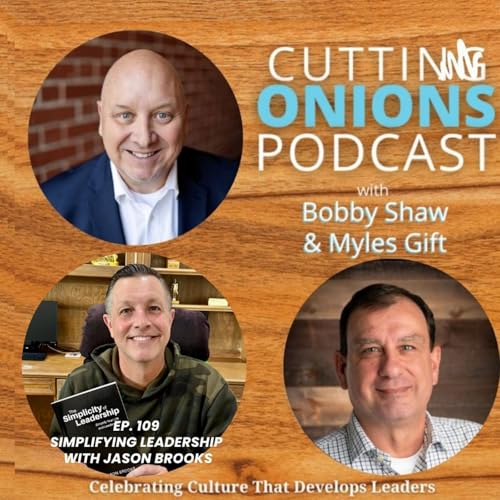
  • Ep. 109 Simplifying Leadership with Jason Brooks
    2026/06/06
    Welcome to The Cutting Onions Podcast! On today's episode we are excited to feature our conversation with restaurant executive and author, Jason Brooks.

    Jason has an incredible leadership story, which we get into on the podcast and it's equal parts inspiring and tactical. Jason has just written a new book titled "The Simplicity of Leadership" and it is fantastic.

    The Simplicity of Leadership is built around one core premise: Complexity kills. Simplicity scales.
    Jason’s message is that leadership does not have to be heavy, over-engineered, or buried under frameworks, meetings, reports, and corporate language. The work of a leader is to simplify the noise so people can focus, grow, communicate clearly, feel valued, own accountability, and build something that lasts. He frames the book around four leadership lanes: mindset, people, accountability, and legacy.

    Jason opens by grounding the book in his own hospitality journey, from server to executive leadership with Outback/Bloomin’ Brands, eventually overseeing 150 locations and nearly 10,000 hourly team members. His credibility comes from lived operational experience, not theory.

    The book is written as a practical playbook for leaders who want better results by subtracting the unnecessary rather than constantly adding more.

    Please check out Jason's ⁠website⁠ to learn more about what Jason is up to and connect with him on LinkedIn to follow along with the insights, industry updates, and lessons from the hospitality industry.
    続きを読む 一部表示
    1 時間
  • 109. Simplifying Leadership with Jason Brooks
    2026/06/06
    Welcome to The Cutting Onions Podcast! On today's episode we are excited to feature our conversation with restaurant executive and author, Jason Brooks.Jason has an incredible leadership story, which we get into on the podcast and it's equal parts inspiring and tactical. Jason has just written a new book titled "The Simplicity of Leadership" and it is fantastic.The Simplicity of Leadership is built around one core premise:Complexity kills. Simplicity scales.Jason’s message is that leadership does not have to be heavy, over-engineered, or buried under frameworks, meetings, reports, and corporate language. The work of a leader is to simplify the noise so people can focus, grow, communicate clearly, feel valued, own accountability, and build something that lasts. He frames the book around four leadership lanes: mindset, people, accountability, and legacy. Jason opens by grounding the book in his own hospitality journey, from server to executive leadership with Outback/Bloomin’ Brands, eventually overseeing 150 locations and nearly 10,000 hourly team members. His credibility comes from lived operational experience, not theory. The book is written as a practical playbook for leaders who want better results by subtracting the unnecessary rather than constantly adding more.Please check out Jason's website to learn more about what Jason is up to and connect with him on LinkedIn to follow along with the insights, industry updates, and lessons from the hospitality industry.
    続きを読む 一部表示
    1 時間
  • Ep. 108 Gratitude and Grit: The Two Engines of Leadership
    2026/06/02
    Welcome back to The Cutting Onions Podcast.

    In today’s episode, we’re talking about Gratitude and Grit: The Two Engines of Leadership.
    Because leadership is not just about pushing harder, and it’s not just about staying positive. It takes both. Gratitude keeps us grounded, humble, and connected to the people around us. Grit keeps us moving when the work gets hard, the pressure builds, and the outcome is not guaranteed.

    The best leaders learn how to carry both.

    Gratitude reminds us of what matters. Grit reminds us to keep going. And when leaders bring those two together, they create the kind of culture people want to be part of.

    So this week, ask yourself: Where do I need more gratitude? And where do I need more grit?
    続きを読む 一部表示
    1 時間
  • 108. Gratitude & Grit: The Two Engines of Leadership
    2026/06/02
    Welcome back to The Cutting Onions Podcast.In today’s episode, we’re talking about Gratitude and Grit: The Two Engines of Leadership.Because leadership is not just about pushing harder, and it’s not just about staying positive. It takes both. Gratitude keeps us grounded, humble, and connected to the people around us. Grit keeps us moving when the work gets hard, the pressure builds, and the outcome is not guaranteed.The best leaders learn how to carry both.Gratitude reminds us of what matters. Grit reminds us to keep going. And when leaders bring those two together, they create the kind of culture people want to be part of.So this week, ask yourself: Where do I need more gratitude? And where do I need more grit?
    続きを読む 一部表示
    1 時間
  • Ep. 107 Bullets Before Cannonballs & The 20-Mile March
    2026/03/16
    Today on The Cutting Onions Podcast, Myles and I discuss two principles from Jim Collins’ excellent book, Great By Choice, published in 2012. Jim has a new book coming out on April 7th titled What To Make of A Life, and we can’t wait to get our hands on it! In today’s conversation, we discussed firing bullets before cannonballs and the 20-mile march.

    Bullets Before Cannonballs:
    Imagine two ships trying to hit an enemy target. One captain loads the cannon immediately and fires a massive cannonball. Huge risk. Huge cost. Huge commitment. But the other captain takes a different approach. He fires a bullet first. A small test shot. Then another. And another. And when those bullets start hitting the target… Then he loads the cannon and fires the cannonball. Jim Collins defines a bullet like this: ‘A bullet is a low-cost, low-risk, low-distraction experiment.’

    In the context of the restaurant/hospitality industry, it looks like running pilots (not systemwide rollouts without testing), and then gathering data and feedback. Those are bullets.

    Then they scaled it and fired the cannonball. The 20-mile march story Jim Collins touches on is fascinating.

    He tells the story of two explorers racing to the South Pole: Roald AmundsenandRobert Falcon Scott. Amundsen approached the expedition with incredible discipline.
    • He committed to marching 20 miles every single day.
    • If the weather was beautiful, they marched 20 miles.
    • If the weather was brutal, they marched 20 miles.
    • No heroics. No overextending.
    Just disciplined progress.
    Scott’s team took the opposite approach.
    • When conditions were good, they pushed themselves to exhaustion.
    • When conditions were bad, they stopped.
    • And that lack of consistency ultimately cost them the race—and tragically, their lives.
    So what does this have to do with leadership? Great leaders combine two things:
    1. They fire bullets before cannonballs.
    2. And they march 20 miles every day.
    They test ideas before committing huge resources. And they build disciplined, consistent progress over time.

    That combination—experimentation and discipline—is what allows organizations to win over the long haul.

    Are you firing cannonballs before you know where the target is?

    Or are you firing bullets… learning… adjusting… and then committing your resources? And once you find the target…

    Are you marching 20 miles every single day?

    Because great leadership isn’t about heroic bursts of activity.

    It’s about disciplined progress and smart experimentation.
    続きを読む 一部表示
    25 分
  • 107. Bullets Before Cannonballs & The 20-Mile March
    2026/03/16
    Today on The Cutting Onions Podcast, Myles and I discuss two principles from Jim Collins’ excellent book, Great By Choice, published in 2012. Jim has a new book coming out on April 7th titled What To Make of A Life, and we can’t wait to get our hands on it!In today’s conversation, we discussed firing bullets before cannonballs and the 20-mile march.
    Bullets Before Cannonballs:
    Imagine two ships trying to hit an enemy target.One captain loads the cannon immediately and fires a massive cannonball.Huge risk. Huge cost. Huge commitment.But the other captain takes a different approach.He fires a bullet first.A small test shot.Then another.And another. And when those bullets start hitting the target… Then he loads the cannon and fires the cannonball.Jim Collins defines a bullet like this:‘A bullet is a low-cost, low-risk, low-distraction experiment.’
    In the context of the restaurant/hospitality industry, it looks like running pilots (not systemwide rollouts without testing), and then gathering data and feedback. Those are bullets.
    Then they scaled it and fired the cannonball.The 20-mile march story Jim Collins touches on is fascinating. He tells the story of two explorers racing to the South Pole: ⁠Roald Amundsen⁠ and ⁠Robert Falcon Scott⁠.Amundsen approached the expedition with incredible discipline.
    • He committed to marching 20 miles every single day.
    • If the weather was beautiful, they marched 20 miles.
    • If the weather was brutal, they marched 20 miles.
    • No heroics. No overextending.

    Just disciplined progress.
    Scott’s team took the opposite approach.
    • When conditions were good, they pushed themselves to exhaustion.
    • When conditions were bad, they stopped.
    • And that lack of consistency ultimately cost them the race—and tragically, their lives.

    So what does this have to do with leadership?Great leaders combine two things:
    1. They fire bullets before cannonballs.
    2. And they march 20 miles every day.

    They test ideas before committing huge resources.And they build disciplined, consistent progress over time.That combination—experimentation and discipline—is what allows organizations to win over the long haul. Are you firing cannonballs before you know where the target is?Or are you firing bullets… learning… adjusting… and then committing your resources?And once you find the target…Are you marching 20 miles every single day?
    Because great leadership isn’t about heroic bursts of activity.
    It’s about disciplined progress and smart experimentation.
    続きを読む 一部表示
    25 分