• Fleeing to France to afford life-saving meds. Sanofi's Dupixent and the pricing cliff.
    2026/02/26

    As a health care provider, and former pharmaceutical industry researcher and executive, I explore in this podcast the stark contrast between international healthcare costs and the expensive medical landscape in the United States. Helping me is AI which creates a two-way narrative based on my research and personal viewpoint.

    One narrative follows an American woman who moved to France, where her annual asthma treatment costs dropped from $36,000 to $3,000, highlighting the benefits of universal healthcare and stricter pharmaceutical regulations. Corporate filings from Sanofi further reveal the significant market risks and pricing pressures pharmaceutical giants face due to legislative shifts like the Inflation Reduction Act. Additionally, the texts note that biologic therapies for conditions like asthma and COPD remain a primary driver of high costs in the American system. These sources collectively suggest that medical emigration is becoming a viable solution for citizens burdened by rising drug prices and toxic food standards. Overall, the collection serves as a comparative study of how regulatory frameworks and government drug-pricing policies directly influence patient well-being and corporate strategy.

    続きを読む 一部表示
    15 分
  • Laser hunting cartel drones over El Paso
    2026/02/26

    I am interested in new developments related to the southern cartels and our own local militant groups, and how they are adopting new tech, and what we can do about it. I explore the escalating security challenges facing the United States, specifically focusing on the nexus of drug cartels, foreign adversaries, and emerging technology. Expert testimonies and news reports highlight how Mexican transnational criminal organizations are adopting sophisticated drone warfare tactics, often mirrored from global conflicts like the war in Ukraine. There is significant concern regarding the interference of China, Russia, and Iran in the Western Hemisphere, which threatens regional stability and maritime security. Domestically, authorities are grappling with institutional corruption within law enforcement and the need for advanced counter-UAS systems to protect critical infrastructure. Furthermore, the reports detail a shift in federal policy toward designating cartels as foreign terrorist organizations to combat their evolving "gray zone" activities. Together, these sources underscore a transition toward a high-tech, multi-domain defense strategy required to safeguard the southern border and national interests.

    続きを読む 一部表示
    31 分
  • America - is it defenseless against weaponized drones?
    2026/02/26

    This podcase explores the escalating security challenges facing the United States, specifically focusing on the nexus of drug cartels, foreign adversaries, and emerging technology. Expert testimonies and news reports highlight how Mexican transnational criminal organizations are adopting sophisticated drone warfare tactics, often mirrored from global conflicts like the war in Ukraine. There is significant concern regarding the interference of China, Russia, and Iran in the Western Hemisphere, which threatens regional stability and maritime security. Domestically, authorities are grappling with institutional corruption within law enforcement and the need for advanced counter-UAS systems to protect critical infrastructure. Furthermore, the reports detail a shift in federal policy toward designating cartels as foreign terrorist organizations to combat their evolving "gray zone" activities. Together, these sources underscore a transition toward a high-tech, multi-domain defense strategy required to safeguard the southern border and national interests.

    続きを読む 一部表示
    21 分
  • Why USA can't bomb Mexican drug cartels?
    2026/02/24

    My AI-enhanced podcase on what is keeping USA from closing down drug cartels as part of the War on Drugs

    続きを読む 一部表示
    27 分
  • Iran military business empires decide the dictator's fate
    2026/02/24

    In this AI-enhanced podcast, I analyze the political stability and military vulnerabilities of the Iranian government following years of civil unrest and regional conflict. I show how advanced technology and targeted air strikes have compromised Iran’s once-impenetrable nuclear sites and air defense networks. Research indicates that the Revolutionary Guard's financial integration with the state makes the military less likely to defect during the mass protests led by women and ethnic minorities. Furthermore, international reports document the regime’s violent suppression of dissent through arbitrary arrests, internet blackouts, and the frequent use of the death penalty. Ultimately, I explain why I think now is the time for regime collapse regardless of the hated Islamic government's structural resilience and its willingness to use extreme coercion to maintain power.

    続きを読む 一部表示
    17 分
  • Software Obsolescence and the Crisis of Wasteful Windows Digital Ownership
    2025/12/27

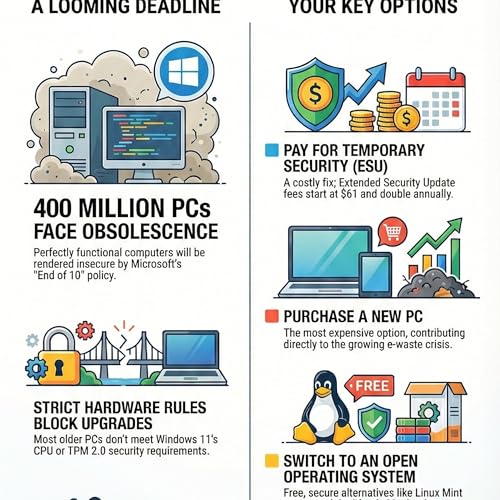
    I examine the widespread issue of planned obsolescence, specifically focusing on Microsoft's decision to end Windows 10 support in October 2025. This transition forced a massive hardware turnover because many existing computers lack the TPM 2.0 chips and specific CPU requirements necessary to officially run Windows 11. Experts warn this policy could lead to hundreds of millions of functional devices becoming e-waste, while also creating significant cybersecurity vulnerabilities for those who cannot afford to upgrade. To combat these issues, users are exploring alternatives such as Linux distributions, specialized IoT Enterprise editions, and third-party tools like Rufus to bypass installation restrictions. Simultaneously, international advocacy groups like Euroconsumers are pushing for right-to-repair legislation and mandatory software update durations to protect consumers from artificial product lifespans. Ultimately, the texts highlight a growing tension between corporate security standards and the environmental and economic impact of forced technological aging.

    続きを読む 一部表示
    35 分
  • Capitalism's_Endgame: AI, Inequality, and the Battle for a Post-labor world
    2025/12/27

    This conversation draws on my analysis covering general questions regarding major economic and societal challenges. Common themes include the analysis of wealth and income inequality, lack of affordability, critiques of prevailing economic systems, and the disruptive impact of technological change, particularly concerning Universal Basic Income in a post-labor economy, its application to vulnerable populations like the unemployed and the homeless, A.I., and the sustainability of crucial social systems like US Healthcare.

    続きを読む 一部表示
    13 分
  • Twilight Before the Storm: Neoliberalism, Crisis of Capitalism, and the 1930s Parallel
    2025/12/27

    Review by Donald Harvey Marks concerning Viktor Shvets' fantastic recent book: The Twilight Before the Storm. I analyze the book's central arguments, which posit that the world is in a dangerous transitional period marked by the decline of neoliberalism - an ideology rooted in free-market capitalism that sounds reasonable, but went astray. A core concept in the book is the "Fujiwara Effect," describing how advanced technology combined with financialization is reshaping the global economy and creating abundance. Shvets draws historical parallels to the 1930s to illustrate today's social and political fractures, warning of potential conflict unless we can reach a new societal consensus.

    続きを読む 一部表示
    15 分