エピソード

  • The Eterra Cycle Podcast - Episode 6 - The Last Letter of the Architect
    2026/04/05

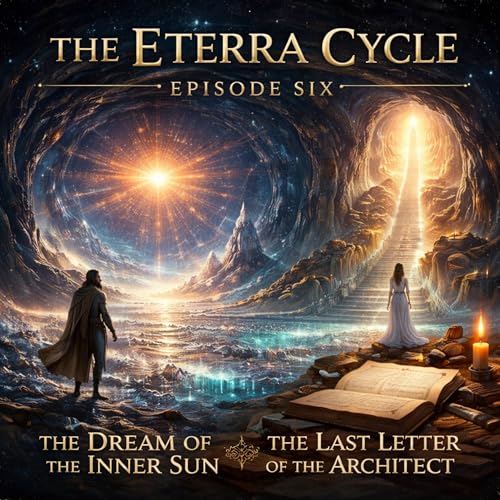
    In episode six of the Eterra Cycle series, Christina stays with the codas — The Dream of the Inner Sun and The Last Letter of the Architect — to explore how they do far more than simply follow the ending of the novel. A true coda does not just extend a story; it changes the scale of what came before. These two pieces reveal that the emotional, spiritual, and metaphysical frame of Eterra has always been larger than the immediate plot. One coda is visionary and dreamlike, opening into a reality that feels less like fantasy than disclosure: an inward kingdom of crystal dust, rivers of light, luminous mountains, and the mysterious Inner Sun. The other is confessional and historical, a final testimony shaped by ruin, regret, inheritance, and moral failure. Together, they deepen one of the central questions beneath the entire series: what does it mean to approach something sacred without trying to possess it.

    The episode reflects on the Inner Sun not as a source of domination or simple illumination, but as memory — a living fidelity at the hidden heart of the world, something that does not merely shine, but remembers. Christina explores how memory in Eterra is never only personal or psychological: stone remembers, places remember, songs remember, and worlds remember. From that perspective, the dream becomes less an escape from reality than a thinning of it, a threshold where the deeper grammar of existence becomes briefly visible. The woman in white, the path, the pillars, and the stair all take on the force of spiritual reorientation rather than ordinary explanation, guiding the listener toward one of the governing principles of the cycle: the old design was not made to be owned, but entered.

    From there, the episode moves into The Last Letter of the Architect, where revelation arrives not through radiant image, but through testimony, weariness, and care. Christina examines the Architect’s voice as one shaped not by untouchable wisdom, but by damage, delayed recognition, grief, and humility. The letter becomes a warning against one of the deepest corruptions in the world of Eterra: the human desire to mistake nearness for ownership, mystery for doctrine, and sacred thresholds for thrones. What makes the deeper world tragic is not simply that wicked people sought power, but that even those entrusted with wonder slowly began to reinterpret reverence as control, and contact as entitlement. In that sense, the episode is not only about hidden worlds and ancient truths, but about the moral posture required to approach them without destroying them.

    Throughout the discussion, Christina draws out the spiritual tension linking both codas: the difference between being chosen and being called, between mastery and accord, between conquest and listening. The dream offers radiance, summons, and the possibility of answer; the letter offers conscience, warning, and the record of how badly sacred things can be wounded when human beings try to explain them too completely or use them too quickly. Together, the two pieces insist that the deepest realities in Eterra are not prizes for the worthy, nor rewards for those bold enough to descend, but mysteries that demand humility, witness, and restraint. This is an episode about inward light, damaged inheritance, sacred memory, and the moral difference between entering a mystery and trying to own it.

    続きを読む 一部表示
    21 分
  • The Eterra Cycle Podcast - Episode 5 - The World
    2026/03/29

    In episode five of the Eterra Cycle series, Christina explores the deeper origins of the novel — not just where the story began, but where its feeling began. She reflects on the first image that gave rise to Eterra: a layered world built above what it no longer understands, a buried order beneath civilization, and a silence below that is not empty, but watchful. From there, the episode examines how descent became the central logic of the book: not only a movement through space, but a passage into inheritance, memory, danger, and irreversible contact with hidden truth.

    Christina also discusses the emotional and symbolic architecture of the novel, from Aelit’s bond to the tuning fork and the legacy of her father, to the vertical design of the city itself as a physical expression of denial, concealment, and buried history. The episode reflects on transformation as something costly rather than heroic, on the difference between reverence and domination, and on why the deeper world of Eterra had to remain immense, partially legible, and dangerous rather than comforting. It is a rich and intimate episode about origins, inheritance, architecture, and the mark truth leaves on those who dare to touch it

    続きを読む 一部表示
    16 分
  • Episode 4: The Night Everything Was Taken - The Eterra cycle
    2026/03/21


    In this episode, Chris lingers inside one of the most important moments in The Last Architect of Eterra: the prologue—not just as an opening, but as the event that forms Aelit’s identity and defines the emotional logic of the entire story.

    This is not simply the night Aelit loses her father.

    It is the night she is given a command that will shape the next ten years of her life: become nothing.

    As the Wardens arrive—calm, precise, and terrifying in their lack of chaos—we begin to understand what kind of world Eterra truly is. This is not a world where power explodes or rages. It is a world where power corrects. Where it hollows instead of destroys. Where it leaves behind not bodies, but perfect order.

    Through Aelit’s eyes, we witness something far more disturbing than violence: the erasure of the human self. Her father is not simply taken—he is emptied, reduced to function, aligned into obedience. And in that moment, his final act is not resistance, but instruction. Survival, here, does not mean fighting back. It means disappearing.

    Hiding becomes more than a tactic. It becomes identity.

    This episode explores how that single night fuses together three defining forces in Aelit’s life:

    • Aelit herself, a child shaped not by destiny, but by terror, compression, and the learned instinct to vanish
    • The Wardens, whose quiet, procedural presence reveals a system that values order over humanity
    • The tuning fork, an object introduced not as a relic of power, but as an inheritance bound to loss, fear, and impossible responsibility

    At the center of it all is the tuning fork’s first appearance—a moment of strange, almost merciful containment. As Aelit’s power threatens to overwhelm her, the artifact responds, drawing the chaos out of her body and holding it. In the middle of catastrophe, something answers her.

    And yet, just as quickly, it is lost—falling into the dark, buried within the machinery of the world. That loss becomes symbolic as much as literal: inheritance disappearing, power deferred, and a life shaped by absence.

    From that moment forward, Aelit’s world is defined by concealment. Dead names. Stolen identities. Gray routines. A life built on avoiding notice. Because in Eterra, visibility is danger—and to be seen is to risk being hollowed out.

    But even in a world built on suppression, something always survives.

    A memory. A scent. A fragment. A buried object waiting to be found again.

    This episode unpacks how the prologue does more than introduce a story—it establishes a philosophy. A world where silence is pressure, where order is more terrifying than chaos, and where the most powerful inheritances arrive fused with trauma.

    Because before Aelit can ever understand what she might become, she learns the first and most important rule of survival:

    Disappear.

    Next episode, we move closer to the tuning fork itself—exploring it not just as an artifact, but as a language, a container, and a bridge between fear and power.

    続きを読む 一部表示
    17 分
  • Episode Three: Where the World Begins to Break
    2026/03/19

    In this episode of The Eterra Cycle, Chris steps away from analysis and into something more immersive—language, atmosphere, and the raw opening movement of the story itself.

    Rather than breaking the world apart from the outside, this episode invites listeners to experience The Last Architect of Eterra from within. Through a reading of the prologue, we descend into the lowest tiers of the city, where rust replaces air, silence carries weight, and survival begins with learning how to disappear.

    This is where Aelit’s story truly begins.

    Not with destiny.

    Not with power.

    But with fear.

    Through the lens of a single childhood moment, we witness the event that shaped everything: the night the Wardens came, the night her father was taken—not by death, but by something far more precise—and the night Aelit learned the cost of being seen.

    This episode explores the opening not as exposition, but as emotional code. Every detail—the pressure of the workshop, the unnatural silence of the Wardens, the strange and living presence of the tuning fork—builds the foundation of a world where nothing is ever truly gone, only buried.

    And beneath that burial, something waits.

    What makes this beginning so powerful is not just its darkness, but its scale. Even here, in a single room, the story hints at something far larger: a living planet, a hidden signal, and forces older than the systems that claim control.

    Because in Eterra, silence is not empty.

    It is enforced.

    It is weaponized.

    It is survival.

    And for Aelit, this is the moment it becomes everything.

    続きを読む 一部表示
    18 分
  • The Eterra Cycle - Episode Two: Aelit — The Girl Who Learned to Disappear
    2026/03/19

    In a world built on silence, control, and buried truths, understanding Eterra means understanding the people shaped by it.

    And at the center of that story is Aelit.

    In this episode, Chris—co-producer and editor of The Last Architect of Eterra—dives deep into the emotional and psychological core of the series’ protagonist. Not as a chosen hero or a figure of destiny, but as something far more intimate: a survivor shaped by fear, concealment, and the constant threat of being seen.

    Aelit is not separate from the world of Eterra—she is its living reflection. A person forged in silence, trained from childhood to disappear, to suppress, to become “dust in the cracks.” But when the system finally notices her, what emerges is not ambition or rebellion—but a raw, uncontrollable response to survive.

    This episode explores Aelit not just as a character, but as a force in transformation. From the trauma that defined her early life, to the moment her buried power—the Spark—begins to surface, we examine how fear becomes instinct, how memory becomes identity, and how suppression begins to fracture into something dangerous and alive.

    At the heart of it all is a simple but powerful shift:

    Aelit is no longer only hiding.

    She is beginning to answer.

    Through thoughtful analysis and narrative insight, Episode Two unpacks what makes Aelit such a compelling and human protagonist—her fragility, her restraint, her intelligence under pressure, and the cost of every step she takes toward becoming something more.

    Because in Eterra, power is never just power.

    It is memory.

    It is resistance.

    It is the moment silence breaks.

    And Aelit is where that breaking begins.

    続きを読む 一部表示
    14 分
  • The Eterra Cycle Podcast - Episode one
    2026/03/19

    Episode One: The Descent

    In the lowest tiers of Eterra, where الضوء rarely reaches and الهواء tastes like rust, people learn quickly that survival comes at a cost—and mistakes are never forgiven.

    Aelit has spent her life hiding.

    Hiding what she is.

    Hiding what she can do.

    Hiding from a world that would erase her if it knew the truth.

    But when a routine checkpoint turns violent, something inside her awakens—something القديم، dangerous, and impossible to contain. In a single moment, the fragile balance of her life shatters, forcing her to flee everything she has ever known.

    With nothing but a relic left behind by her father—and no clear understanding of why it matters—Aelit descends into the forbidden depths beneath the city. A place whispered about in fear. A place where العمال disappear, where abandoned machines still hum with unknown purpose, and where the النظام above no longer reaches.

    Down there, the rules are different.

    And something is waiting.

    As the first cracks in Eterra’s carefully constructed order begin to show, Episode One sets the stage for a journey into darkness—where buried truths stir, ancient systems begin to wake, and one choice will pull Aelit into a story far larger than herself.

    Because beneath the city…

    nothing stays buried.

    続きを読む 一部表示
    14 分