エピソード

  • Master Human-First AI Marketing and Answer Engine Optimization with Mike Montague
    2026/07/01

    In this conversation, Mike Montague, founder and CEO of Avenue9, discusses how businesses can use AI in a human-first way to improve marketing, sales, and customer relationships. He explains why AI should support people rather than replace them, how strong strategy and context shape better AI results, and why generative AI is only one part of a larger set of tools that includes automation, machine learning, predictive analytics, and answer engine optimization. The discussion also covers practical AI use cases for content creation, sales calls, customer service, podcast repurposing, and business workflows, while highlighting the need for original human thinking at the center of every AI-driven process.


    Takeaways

    • Human-first AI marketing starts with improving the customer experience, not just saving time.
    • AI works best when it supports people like an assistant, rather than replacing full roles.
    • Strong strategy must come before AI, because AI can make weak ideas fail faster.
    • Context engineering helps AI create better results for a specific business, team, and audience.
    • No single AI tool fits every job, so teams need the right mix of tools for each task.
    • Generative AI is powerful, but automation, machine learning, and predictive analytics still matter.
    • Meeting transcripts, podcast transcripts, and customer service tickets can become rich sources of business insight.
    • Answer engine optimization focuses on how people find businesses through AI-driven search and direct questions.
    • Original human content gives AI stronger material to repurpose into posts, summaries, keywords, and sales assets.
    • Agentic workflows, AI skills, and tools like Claude Cowork may shape the next stage of knowledge work.


    Today's guest, Mike Montague , can be found at:

    Website: https://avenue9.com/

    LinkedIn: https://www.linkedin.com/in/mikedmontague/

    Instagram: https://www.instagram.com/mikedmontague/


    Your host, Hunter Jensen, can be found online at:

    Website: https://www.barefootsolutions.com/

    LinkedIn:https://www.linkedin.com/in/hunterjensen/


    Keywords

    AI marketing, human-first AI, content marketing, sales conversations, customer relationships, strategy, context engineering, generative AI, automation, machine learning, predictive analytics, answer engine optimization, AEO, SEO, LLMs, ChatGPT, Claude, Copilot, Grok, Gamma, Whispr Flow, meeting transcripts, podcast transcripts, customer service tickets, trust signals, LLMs.txt, LinkedIn, YouTube, Reddit, Wikipedia, AI search, marketing automation, sales calls, customer success, content repurposing, long-form content, agentic workflows, Claude Cowork, AI skills, Perplexity Sonar, knowledge work

    続きを読む 一部表示
    38 分
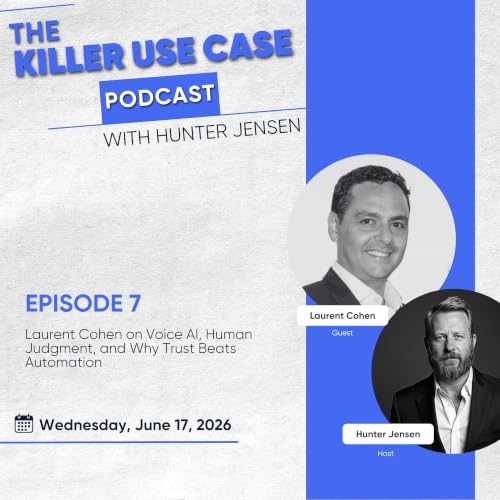
  • Laurent Cohen on Voice AI, Human Judgment, and Why Trust Beats Automation
    2026/06/17

    In this episode, entrepreneur Laurent Cohen, founder of GetOblic, shares his journey from the early days of e-commerce and SEO to building an AI company focused on voice AI solutions for small and medium-sized businesses. He explains why trust, not technology, is the biggest challenge when selling AI to SMBs and how GetOblic uses a unique business directory model to demonstrate value before asking customers to pay. The conversation explores the rapid evolution of generative AI, the rise of AI agents as digital coworkers, the limits of current AI systems, and the importance of human judgment in achieving exceptional results. Laurent also discusses transparency in AI, the risks of voice cloning, the future of voice interfaces, and why he believes we are living through one of the most exciting periods in human history.


    Takeaways

    • GetOblic focuses on voice AI for SMBs and prioritizes building trust before selling subscriptions.
    • The company provides free AI-powered business profiles that allow business owners to experience the technology before purchasing.
    • Laurent believes the SMB market is one of the largest long-term opportunities for voice AI adoption.
    • AI agents should be treated like team members, with clear expectations, processes, and oversight.
    • Human judgment remains essential because AI often produces average results without guidance and refinement.
    • AI allows entrepreneurs to quickly develop expertise across multiple disciplines and tackle challenges that once required specialized knowledge.
    • The biggest limitation for many AI users is not technology, but the quality of their direction and involvement.
    • Voice AI is already capable of replacing many traditional call center functions through multilingual support, availability, and scalability.
    • Transparency is critical when deploying AI, especially with technologies such as voice cloning, which can undermine customer trust.
    • Laurent views AI as a new form of currency that can be exchanged for knowledge, resources, and influence, while amplifying the intentions of the person using it.


    Today's guest, Laurent Cohen, can be found at:

    Website: https://getoblic.com/?v3=true

    LinkedIn: https://www.linkedin.com/in/laurent-cohen-usa/

    Facebook: https://www.facebook.com/GetOblic/


    Your host, Hunter Jensen, can be found online at:

    Website: https://www.barefootsolutions.com/

    LinkedIn:https://www.linkedin.com/in/hunterjensen/


    Keywords

    Voice AI, Generative AI, AI Agents, Artificial Intelligence, SMB Technology, Small Business Automation, Business Directory, Customer Trust, AI Adoption, Conversational AI, Entrepreneurship, Digital Marketing, E-commerce, SEO, AI Workflows, Human Judgment, Voice Assistants, AI Ethics, Voice Cloning, Transparency, Business Automation, AI Productivity, Agent Management, Social Media Content, AI Strategy, Customer Experience, Call Center Automation, Technology Innovation, Future of Work, AI Integration, Startup Growth, Business Scaling, AI Tools, Machine Learning, Automation Technology, Digital Transformation

    続きを読む 一部表示
    37 分
  • Greg Grand on AI Sales Coaching, Roleplay Training, and Building Better Sales Teams
    2026/06/03

    In this episode, Greg Grand, CEO of G Squared Advisors, shares how he integrates AI into sales leadership, coaching, and business operations. Drawing on more than three decades of sales experience, Greg explains how his approach evolved from chasing new AI tools to focusing on solving specific business problems. The conversation explores practical AI applications in sales training, role play coaching, meeting analysis, hiring, workflow automation, and productivity. Greg also discusses the future of AI in sales, why consultative selling remains irreplaceable, and how sales professionals can start using AI today to save time, improve performance, and stay competitive in a rapidly changing market.


    Takeaways

    • Greg Grand transitioned into fractional sales leadership after seeing small and mid-sized businesses struggle to scale without experienced sales management.
    • His breakthrough with AI came when he stopped chasing tools and started identifying business problems first.
    • AI serves as a brainstorming partner, helping solo consultants and business leaders generate new ideas and challenge assumptions.
    • Sales role play training powered by AI can provide personalized coaching, grading, and feedback at scale.
    • AI-driven interview analysis helps evaluate candidates for cultural fit, sales skills, and role suitability.
    • Meeting transcription and automated summaries save significant administrative time for sales leaders and consultants.
    • AI is most effective today in preparation, research, training, documentation, and workflow optimization rather than replacing complex sales conversations.
    • High-value consultative sales skills remain difficult to automate because trust, relationships, and human judgment drive buying decisions.
    • Entry-level sales development and transactional sales roles face greater disruption from AI than senior consultative sales positions.
    • The best way to start with AI is to dedicate regular learning time, follow trusted AI educators, and look for opportunities to save time in daily work activities.


    Today's guest, Greg Grand, can be found at:

    Website: https://gsquaredadvisors.com/

    LinkedIn: https://www.linkedin.com/in/greggrand/


    Your host, Hunter Jensen, can be found online at:

    Website: https://www.barefootsolutions.com/

    LinkedIn:https://www.linkedin.com/in/hunterjensen/


    Keywords

    Artificial Intelligence, AI, Sales Leadership, Fractional CRO, Revenue Growth, Sales Coaching, Sales Training, Role Play Training, Sales Enablement, Business Development, Prospecting, CRM Management, Workflow Automation, Meeting Transcripts, Zoom AI, Custom GPTs, Gemini, Claude, Perplexity, ChatHub, AI Agents, Make Automation, Sales Process, Consultative Selling, Sales Strategy, Candidate Assessment, Hiring, Revenue Operations, Productivity, Knowledge Work, Sales Playbooks, Pipeline Management, Lead Generation, B2B Sales, Sales Technology, Business Scaling, Time Management, AI Adoption, Voice AI, Sales Performance, Customer Discovery, Objection Handling, Coaching Frameworks, Automation Tools, LinkedIn Prospecting, Dux-Soup, Sales Operations, Human Connection, Trust Building, Revenue Leadership, AI Workflows, Digital Transformation

    続きを読む 一部表示
    37 分
  • Stephen Arthur on AI Tutors, Student Feedback, and the Future of Higher Education
    2026/05/20

    In this episode, Hunter Jensen speaks with Stephen Arthur, Director of AI and Analytics at ECPI University, about how artificial intelligence is reshaping higher education. Stephen explains how ECPI moved from early caution around generative AI to building practical AI systems for students, faculty, and administrators. The conversation explores conversational assignments, AI governance policies, curriculum challenges, student adoption, analytics, and the long-term vision of creating AI-powered academic assistants that can support every part of a student’s educational journey. They also discuss the future of work, the impact of AI on careers and universities, and why adaptability and AI literacy will become critical skills for the next generation


    Takeaways

    • ECPI University began its AI journey after the release of ChatGPT 3.5 and gradually expanded adoption as model reliability improved.
    • The university partnered with OpenAI to provide enterprise AI access for faculty and staff before expanding student-facing tools.
    • ECPI introduced “conversational assignments,” where students interact with AI tutors instead of submitting traditional essays.
    • AI-driven assignments provide students with real-time feedback and increase engagement with course material.
    • The university developed a four-tier AI governance framework that defines how students may use AI in coursework.
    • Stephen Arthur believes AI literacy and prompt engineering will become foundational workforce skills across industries.
    • ECPI is building AI tools that integrate with Canvas and other student systems to automate academic support and administrative tasks.
    • AI-powered semantic analysis is helping the university process large amounts of student feedback and operational data more effectively.
    • The discussion highlights growing concerns around AI-generated job applications, privacy, surveillance, and the future of knowledge work.
    • Stephen predicts higher education will split into two models: elite intellectual institutions and career-focused schools centered on workforce skills and AI adoption.


    Today's guest, Stephen Arthur, can be found at:

    LinkedIn: https://www.linkedin.com/in/stephen-arthur/


    Your host, Hunter Jensen, can be found online at:

    Website: https://www.barefootsolutions.com/

    LinkedIn:https://www.linkedin.com/in/hunterjensen/


    Keywords

    Artificial Intelligence, Generative AI, Higher Education, AI Governance, Conversational Assignments, Student Learning, AI Tutoring, OpenAI, ChatGPT, Claude, Canvas LMS, Analytics, Workforce Development, Career Colleges, ECPI University, AI Literacy, Prompt Engineering, Student Engagement, Curriculum Development, Semantic Search, Automation, AI Tools, Knowledge Work, Future of Work, Robotics, AI Strategy, Educational Technology, Cybersecurity Education, Nursing Education, Adaptive Learning, Large Language Models, AI Adoption, Operational Efficiency, Data Analysis, Personalized Learning, AI Assistants, Student Information Systems, Machine Learning, Academic Innovation, AI Ethics, Workforce Skills, AI Integration, Learning Management Systems, Educational Innovation

    続きを読む 一部表示
    57 分
  • Patryk Laurent on Privacy-Safe Video AI and Turning Cameras into Smart Sensors
    2026/05/06

    In this conversation, Patryk Laurent, CEO of Scenera, discusses how the company uses edge-based video AI to improve safety, security, and building operations in commercial real estate. He explains how Scenera turns existing cameras into intelligent sensors that can detect events such as falls, loitering, fence climbing, unattended objects, and spills without relying on constant video streaming to the cloud. The discussion also covers edge computing, privacy, AI model tuning, event-based foundational models, low-energy AI, neuromorphic hardware, and the future of smarter, more private IoT systems.


    Takeaways

    • Scenera provides a cloud-managed edge AI platform for safety, security, and building intelligence.
    • The system uses existing cameras to detect important events and send real-time alerts.
    • Edge processing helps reduce the need to stream full video feeds to the cloud.
    • Video AI can identify events such as falls, loitering, fence climbing, and unattended objects.
    • Pose detection can help identify human actions while protecting personal identity.
    • Scenera uses analytics to find trends across time, weather, traffic, and building activity.
    • The company fine-tunes models for specific buildings to improve accuracy.
    • Scenera is developing an event-based foundational model for reasoning about activity in physical spaces.
    • Low-energy AI and neuromorphic hardware could move more intelligence directly into cameras.
    • Privacy will be central to the future of camera-based sensors and IoT systems.


    Today's guest, Patryk Laurent, can be found at:

    Website: https://pakl.net/

    LinkedIn: https://www.linkedin.com/in/patryk-laurent


    Your host, Hunter Jensen, can be found online at:

    Website: https://www.barefootsolutions.com/

    LinkedIn: https://www.linkedin.com/in/hunterjensen/


    Keywords

    Edge AI, Video AI, Computer Vision, Smart Cameras, Building Operations, Commercial Real Estate, Safety, Security, Fall Detection, Loitering Detection, Object Detection, Pose Detection, Data Lake, Edge Computing, Cloud Managed Edge Platform, Azure, IoT Edge, MLflow, Foundational Models, Event-Based AI, Neuromorphic Hardware, Low-Energy AI, Internet of Things, Privacy, Smart Buildings

    続きを読む 一部表示
    40 分
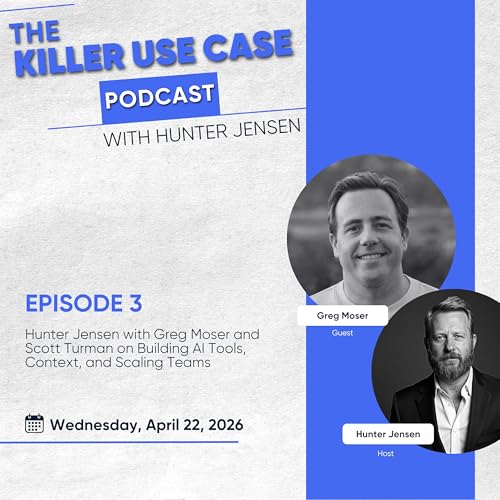
  • Hunter Jensen with Greg Moser and Scott Turman on Building AI Tools, Context, and Scaling Teams
    2026/04/22

    In this wide-ranging technical discussion, founders and operators across consulting, logistics, and software development compare how agentic AI is reshaping the way they build software, run operations, and structure daily work. The conversation explores a shift from traditional SaaS tools to rapidly built internal applications powered by LLMs, including ephemeral apps, workflow automation, and agent-driven DevOps pipelines. A major theme is the emergence of persistent memory systems and context management strategies that allow AI agents to operate more effectively over time. The participants also examine the tradeoffs of speed versus control, including security isolation, prompt injection risks, and the growing need for production hardening as “vibe-coded” tools move toward real-world deployment. Along the way, they highlight both the productivity gains and psychological intensity of working in highly agentic, always-on AI environments.


    Takeaways

    • Agentic AI has made it possible to build functional internal tools in hours instead of weeks or months.
    • Many SaaS products are being replaced by quickly built, purpose-specific internal applications.
    • Latency in LLM interactions is a major bottleneck, driving demand for faster, more local, or embedded solutions.
    • Speech-to-text integrated directly into workflows can dramatically increase interaction speed with AI systems.
    • Persistent memory is a key unlock, enabling agents to retain and reuse context across sessions.
    • Structuring memory into topics or organized files improves reliability and reduces context confusion.
    • Running multiple subagents in parallel enables high throughput but increases cognitive and coordination load.
    • Slack-based or chat-based environments are emerging as operational layers for agent collaboration.
    • Security isolation is critical, especially around credentials, email access, and prompt injection risks.
    • “Vibe coding” accelerates prototyping but creates a growing need for dedicated production hardening and QA processes.


    Today's guests can be found at:

    Greg Moser:

    Website: https://www.shipcalm.com/

    LinkedIn: https://www.linkedin.com/in/gregmoser/


    Scott Turman:

    Website: https://scottturman.com/, https://brightray.com/

    LinkedIn: https://www.linkedin.com/in/scottturman/

    IMDb: https://www.imdb.com/name/nm14602682/


    Your host, Hunter Jensen, can be found online at:

    Website: https://www.barefootsolutions.com/

    LinkedIn:https://www.linkedin.com/in/hunterjensen/


    Keywords

    agentic AI, large language models, persistent memory, context management, speech to text, workflow automation, subagents, DevOps automation, SaaS disruption, internal tools, software development, orchestration, Slack workflows, AI collaboration, security isolation, prompt injection, cloud deployment, Azure, Google Cloud, QA testing, product hardening, vibe coding, automation systems, latency optimization, enterprise AI systems

    続きを読む 一部表示
    1 時間 7 分
  • Scott Turman on AI-Driven Outreach, Authenticity, and Scaling Publishing Without Slop
    2026/04/08

    In this episode, Scott Turman, CEO of BrightRay Publishing, shares his journey as a serial entrepreneur and explains how his company blends traditional publishing with modern AI-driven workflows. The conversation explores how large language models are transforming sales, marketing, and research processes, enabling massive scale while simultaneously creating challenges around trust and authenticity. Scott outlines how BrightRay uses AI for data aggregation, outreach personalization, and media targeting, while deliberately rejecting AI-generated writing in favor of human-authored content. The discussion highlights a growing tension between automation and authenticity, the saturation of digital channels, and why returning to high-touch strategies like direct mail and real human interaction may be the key to standing out in an AI-saturated world.


    Takeaways

    • BrightRay Publishing was born from a collaborative book-writing process that evolved into a scalable business model.
    • AI has significantly improved research and personalization through automated dossier generation and data aggregation.
    • Tasks that once required teams of researchers can now be scaled to thousands of prospects per day using AI workflows.
    • Overuse of AI in outreach has led to declining trust, as highly personalized messages are often assumed to be automated.
    • Saturation of digital channels is pushing marketers back toward traditional methods like direct mail and physical books.
    • BrightRay enforces a strict no-AI policy for writing book content, prioritizing human authenticity and narrative quality.
    • AI struggles with long-form storytelling, making human-written content more valuable in publishing.
    • Advanced AI agents are transforming PR workflows by matching book themes with relevant journalists at scale.
    • Media outreach success increasingly depends on combining AI insights with real human interaction and relationship-building.
    • The future of business communication will hinge on authenticity, as audiences and platforms push back against AI-generated “slop.”


    Today's guest, Scott Turman, can be found at:

    Website: https://scottturman.com/, https://brightray.com/

    LinkedIn: https://www.linkedin.com/in/scottturman/

    IMDb: https://www.imdb.com/name/nm14602682/


    Your host, Hunter Jensen, can be found online at:

    Website: https://www.barefootsolutions.com/

    LinkedIn:https://www.linkedin.com/in/hunterjensen/


    Keywords

    AI, large language models, publishing, book writing, marketing strategy, personalization, automation, authenticity, direct mail, PR strategy, media outreach, content creation, workflow automation, data research, sales outreach, digital marketing, AI tools, human connection

    続きを読む 一部表示
    36 分
  • Gerry Widmer on AI Adoption, Culture, and Why Training Matters More Than Tools
    2026/03/25

    In this episode, Gerry Widmer, CEO of FIDUS Advisor, joins the podcast to discuss his roll up the sleeves approach to business turnarounds and executive consulting. The conversation centers on the necessity of building a culture of sales and financial transparency to drive organizational growth. Widmer also provides a deep dive into the second wave of AI, explaining why CEOs must move beyond fear to lead deliberate adoption and training for their teams. From the evolution of vibe coding and legal automation to the total disruption of the lean startup model, this discussion explores how modern technology is shifting the economics of software development and market discovery.


    Takeaways

    • A culture of sales requires every employee to understand the company's financial goals and how their role impacts them.
    • Business turnarounds usually involve solving problems related to people, processes, and profit.
    • Communication is the foundation of a winning team, a lesson Widmer carries from his background in high level soccer.
    • AI adoption within a company fails when it is driven by fear rather than a deliberate, top down culture.
    • Leaders must invest in training to reduce the frustration that often prevents employees from adopting new tools.
    • The return on investment for AI is directly tied to the percentage of the workforce that successfully integrates it.
    • Vibe coding and vibe lawyering are disrupting traditional business models in engineering and legal services.
    • Modern AI tools allow for the creation of complex financial models and legal documents in a fraction of the usual time.
    • The concept of the Minimum Viable Product is changing because AI makes it affordable to build and test multiple versions of a product.
    • Conventional startup wisdom is being challenged by the ability to adapt technology to multiple markets simultaneously.


    Today's guest, Gerry Widmer, can be found at:

    Website: https://www.fidusadvisor.com/

    LinkedIn: https://www.linkedin.com/in/gerrywidmer/


    Your host, Hunter Jensen, can be found online at:

    Website: https://hunterjensen.co/

    LinkedIn:https://www.linkedin.com/in/hunterjensen/

    Facebook: https://www.facebook.com/hunterjensen

    Twitter: https://x.com/hunterjensen


    Keywords

    AI, Artificial Intelligence, Business Turnaround, Culture of Sales, Financial Transparency, SaaS, Startups, Lean Startup, MVP, Vibe Coding, Leadership, CEO Strategy, Customer Discovery, Technology Adoption, Consulting, Growth Strategy, Software Development, Automation, Market Fit, Efficiency

    続きを読む 一部表示
    40 分