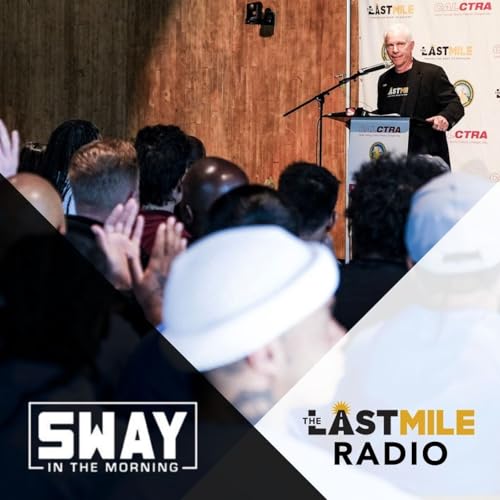
『The Last Mile Radio』のカバーアート

The Last Mile Radio

The Last Mile Radio

著者: SiriusXM
無料で聴く

TLM Radio shares inspirational stories from justice-impacted people who have experienced personal transformation. The show also amplifies the voices of influencers and agents of change in the evolution of the U.S. Justice SystemCopyright 2023 SiriusXM マネジメント・リーダーシップ リーダーシップ 政治・政府 社会科学 経済学
エピソード
  • “You Are Not Forgotten”: Sway Calloway on Hope, Prison, and Second Chances
    2026/05/27

    In this crossover episode, we present a segment from SiriusXM 45's "Sway In The Morning", in which Sway Calloway reflects on his emotional visit to the San Quentin Rehabilitation Center, sharing firsthand stories about the humanity, intelligence, and potential of incarcerated individuals. The conversation explores how rehabilitation programs focused on education, skilled trades, entrepreneurship, and emotional support can dramatically reduce recidivism while improving public safety. Listeners will hear moving calls from former corrections officers, family members of incarcerated individuals, and parents using the discussion as a teaching moment for their children. The episode also examines systemic issues surrounding sentencing, reentry barriers, literacy, poverty, and generational incarceration, while highlighting how hope, mentorship, and practical opportunity can fundamentally change lives.

    (00:00:00) Introduction to Sway’s visit to the San Quentin Rehabilitation Center and The Last Mile’s mission
    (00:01:38) Sway describes the atmosphere inside San Quentin and the emotional reactions from incarcerated men during his visit
    (00:04:24) Discussion about empathy, rehabilitation, and The Last Mile’s impact on recidivism and public safety
    (00:07:14) Former corrections officer and social worker discusses prison conditions, resources, and humanity inside the prison system
    (00:10:20) Former federal prison recreation director explains how music programs unified incarcerated people and created hope
    (00:13:47) Mother calls with her son after a school suspension and uses the conversation as a lesson about choices and consequences
    (00:19:22) Sway reflects on prison, bad decisions, and the importance of rehabilitation programs for reentry into society
    (00:20:00) Caller shares his cousin’s journey through incarceration, education, and preparing for release after decades in prison
    (00:24:25) Sway discusses San Quentin’s rehabilitation initiatives, including service dog programs and the removal of death row facilities
    (00:25:53) The Last Mile co-founder Chris Redlitz joins the show to discuss prison reform, education, and the transformation of San Quentin
    (00:28:37) Chris Redlitz shares success stories of formerly incarcerated students becoming software engineers at major tech companies
    (00:32:52) Discussion about recidivism, workforce training, skilled trades, and preparing incarcerated people for modern employment opportunities
    (00:36:32) Sway and Chris discuss hope as a catalyst for transformation and rehabilitation inside prison systems
    (00:39:00) Sway and the crew reflect humorously on the prison visit and the realities of prison yard culture and invisible boundaries
    (00:42:00) Mike Muse discusses literacy, parenting, education gaps, and the school-to-prison pipeline affecting underserved communities


    Information On Sway In The Morning: https://www.siriusxm.com/hosts/sway-calloway
    Sway's Youtube: https://www.youtube.com/channel/UCuS96jkLKpTaGB_OWnwZV_A

    The Last Mile Radio is a production of The Last Mile and Sirius XM Radio. The show's executive producers are Chris Redlitz and Beverly Parenti at TLM and Liz Aiello at Sirius XM. The show is produced by Robert Roche at TLM, with technical production by Greg Sahakian, James Bilodeau at Sirius XM. Original music by Maserati-E. For more, visit www.thelastmileradio.org

    続きを読む 一部表示
    49 分
  • Reimagining Prison Through Public Health
    2026/05/09
    Prison environments shape human behavior in profound ways. Years spent in conditions defined by stress, isolation, surveillance, and constant vigilance affect the body, the mind, and the ability to relate to other people. Yet after that experience, society expects people to return home prepared to build relationships, regulate emotions, hold jobs, and reintegrate into their communities. This episode explores how incarceration functions as a public health issue and why the conditions inside correctional facilities play a major role in determining outcomes after release. In collaboration with the Brennan Center for Justice, this is part two of a two-episode series exploring their recent national report on innovative prison reform efforts across the United States focused on dignity, safety, normalization, and rehabilitation. Featuring insights from LB Eisen, Senior Director of the Justice Program at the Brennan Center for Justice, Darrell Norcott, Director of Community Partnerships and Special Projects at AMEND, and Courtney Grubb, Statewide Program Administrator for the Washington Way at the Washington State Department of Corrections, this episode examines prison reform through the lens of public health. Through the AMEND initiative and the Washington Way, we explore how system-wide culture change can reshape correctional environments through staff wellness initiatives, restrictive housing reform, dynamic security, normalization, and relationship-based safety. The episode examines how prolonged isolation impacts both incarcerated people and correctional staff, how communication and mentorship can reduce violence, and how prison systems can evolve into environments that support stability, rehabilitation, and long-term cultural change. Episode Outline: (00:00:00) Prison as a public health issue shaped by stress, trauma, and isolation (00:01:05) Brennan Center report overview and introduction to the AMEND model (00:02:00) Interview with LB Eisen on incarceration and unmet human needs (00:04:03) Restrictive housing, isolation, and rebuilding human interaction (00:07:08) Correctional officers as participants in rehabilitation and reform (00:10:12) Shifting prison culture through everyday human interaction (00:11:18) Introduction to AMEND and the public health framework for incarceration (00:13:14) Individualized care and treating prison as a health environment (00:14:38) The Washington Way and system-wide correctional reform (00:17:10) Staff burnout, PTSD, and the public health crisis affecting corrections officers (00:19:00) Why AMEND begins reform in the most volatile prison environments (00:22:01) Violence, trauma exposure, and transforming prison conditions upstream (00:24:00) Dynamic security and relationship-based safety inside prisons (00:25:50) Communication as a tool for reducing violence and de-escalation (00:29:27) Normalization and redesigning prison environments around dignity (00:30:19) Staff wellness, environmental redesign, and institutional culture change (00:31:18) Contact staff, mentorship, and progression-focused rehabilitation (00:33:16) Defining normalization and aligning prison conditions with reentry goals (00:34:32) Why lasting prison reform depends on culture change (00:35:41) Transforming restrictive housing through engagement and human interaction (00:39:06) A case study of someone leaving restrictive housing after 31 years (00:40:42) Resident-led innovation and proposal-driven prison programming (00:41:55) Gardening programs, peer mentorship, and Norway prison exchange initiatives (00:44:28) Scaling AMEND and adapting reform across entire prison systems (00:47:08) Learning organizations, decarceration, and long-term transformation (00:49:26) Core AMEND principles: public health, normalization, and dynamic security (00:50:22) How prisons can evolve into systems that learn and adapt (00:51:20) Closing reflections and resources for learning more about AMEND Episode Resources: Brennan Center for Justice — Source of the national prison reform report discussed throughout the episodeAMEND at UCSF — Primary initiative featured in the episodeThe Washington Way — WA Statewide implementation of AMEND principlesThe Last Mile — Podcast producer and reform organization The Last Mile Radio is a production of The Last Mile and Sirius XM Radio. The show's executive producers are Chris Redlitz and Beverly Parenti at TLM and Liz Aiello at Sirius XM. The show is produced by Robert Roche at TLM, with technical production by Greg Sahakian, James Bilodeau at Sirius XM. Original music by Maserati-E. For more, visit www.thelastmileradio.org
    続きを読む 一部表示
    50 分
  • Inside the Movement to Humanize Prison in America
    2026/04/13

    Prison is designed to be a fundamentally abnormal experience—one that removes autonomy, suppresses individuality, and restructures daily life around control and compliance. Yet at the end of that experience, we expect people to return to society as self-directed individuals capable of making decisions, building relationships, holding jobs, and forming identities beyond incarceration.

    This episode explores that central tension: if the daily experience of prison is misaligned with the outcomes we want, then the structure of daily life inside facilities becomes one of the most important variables in criminal justice reform. In collaboration with the Brennan Center for Justice, this is part one of a two-episode series exploring their recent national report examining innovative prison reform efforts across the United States focused on normalization, dignity, safety, and rehabilitation.

    Featuring insights from LB Eisen of the Brennan Center for Justice, Nick Turner of the Vera Institute of Justice, Restoring Promise director Chloe Aquart, and former participant turned researcher Christopher Belcher, this episode focuses on the foundational ideas highlighted in the report. Through the Restoring Promise initiative, we examine redesigned housing units for young adults built around mentorship, responsibility, restorative practices, and meaningful out-of-cell time.

    The conversation explores what it means to humanize correctional environments—creating spaces where people are treated as individuals capable of growth, where staff operate as mentors and stabilizers, and where safety emerges from relationships rather than coercion—suggesting that when incarceration is organized around dignity, prisons can better prepare people for life after release while improving conditions for both residents and staff.

    Episode Resources:

    • Brennan Center for Justice — Source of the national prison reform report discussed throughout the episode
    • Vera Institute of Justice — Developer of the Restoring Promise model
    • Restoring Promise — Primary case study for humanizing prison culture
    • The Last Mile — Referenced as a workforce and education program example
    • Designing for Dignity

    The Last Mile Radio is a production of The Last Mile and Sirius XM Radio. The show's executive producers are Chris Redlitz and Beverly Parenti at TLM and Liz Aiello at Sirius XM. The show is produced by Robert Roche at TLM, with technical production by Greg Sahakian, James Bilodeau at Sirius XM. Original music by Maserati-E. For more, visit www.thelastmileradio.org

    続きを読む 一部表示
    45 分
adbl_web_anon_alc_button_suppression_t1
まだレビューはありません