『The Middle Ground Podcast』のカバーアート

The Middle Ground Podcast

The Middle Ground Podcast

著者: The Middle Ground Podcast with Imam Marc Manley
無料で聴く

今ならプレミアムプランが3カ月 月額99円

2026年5月12日まで。4か月目以降は月額1,500円で自動更新します。

概要

This podcast will explore ideas important and pertinent to Muslims everywhere, especially in America, tackling challenges and hoping to inspire as we navigate this worldly life.

www.imammarc.comImam Marc Manley
イスラム教 スピリチュアリティ
エピソード
  • Islamic Psychology?
    2026/05/04

    al-Ḥamdulillāh it was my pleasure to speak at the 10th Annual Family Symposium for Muslim Family Foundation: Roots of Wellness, alongside Dr. Deana Helmy, sister Ahlam Gheith and Shaykh Ḥasan Radi.

    Imam’s Corner is a reader-supported publication. To receive new posts and support my work, consider becoming a free or paid subscriber.

    Being a non-professional I wanted to bring a somewhat different perspective to the table to challenge and, in shā’ Allāh, improve how Muslim, mental health professionals and otherwise, look at and trust the wester secular approach to healing the human soul.

    In the talk I referenced mainly two works of interest.

    * Hunter, James Davison. The Death of Character: Moral Education in an Age Without Good or Evil. Basic Books, 2000.

    * Rieff, Philip. The Triumph of the Therapeutic: Uses of Faith After Freud. Harper Torchbooks, 1968.

    Many thanks to Muslim Family Foundation, Dr. Ali Al-Saadoon, the panel members, all who attended and especially brother Mohamad Nasser for inviting me.


    Get full access to Imam’s Corner at www.imammarc.com/subscribe
    続きを読む 一部表示
    1 時間 20 分
  • The Truth Will Set You Free
    2026/03/21

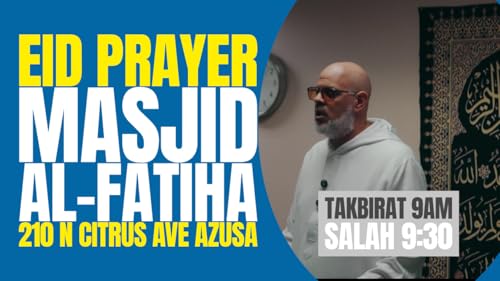
    al-Ḥamdulillāh I was invited again by the gracious folks at Masjid al-Fatiha of America, located in Azusa, California. I’ve worked closely with this family-run masjid for years.

    Imam’s Corner is a reader-supported publication. To receive new posts and support my work, consider becoming a free or paid subscriber.


    Get full access to Imam’s Corner at www.imammarc.com/subscribe
    続きを読む 一部表示
    32 分
  • Fear, Love, and Mercy in the Qur’ān
    2025/09/24

    Many Muslims today speak of “love”: for Allāh, for the Prophet ‎ﷺ, etc. And while having love for Allāh and the Prophet ‎ﷺ are indeed noble ambitions it would also seem that the current emphasis on love has come at the cost how we see obedience. It would seem for some Muslims today that talk of fearing Allāh and striving for obedience is akin to negativity. Others have conflated love with mercy. But the Qur’ān, however, addresses these qualities quite differently and separately.

    If we examine how the Qur’ān commands us to fear Allāh, such admonitions are unencumbered and straightforward. In contrast love is conditional:

    “If you love Allah, then follow the Prophet ﷺ.” — ‘Āl ‘Imrān v. 31

    or that there are those that Allāh loves, and those He doesn’t:

    “Surely Allah loves those who always turn to Him in repentance and those who purify themselves.” — al-Baqarah v. 222

    and

    “Surely He [Allāh] does not like the wasteful.” — al-Aʿrāf v.31

    In other words love—especially love to Allāh and/or His Prophet ‎ﷺ is proven through devotional commitment (ittibāʿ) and obedience (ṭāʿah), not merely self-selecting sentiment.

    As for mercy (raḥmah), Allāh says that it encompasses everything:

    “My mercy encompasses everything.” — al-Aʿrāf v. 156

    In fact, Allāh’s mercy—in this life—extends even to those who don’t believe in Him or even reject Him outright. Yes, Allāh shows mercy to the believer and the non-believer alike (though not necessarily equally). In fact, as we leaned in our Satuday ʿaqīdah class, Allāh’s mercy can be understood as having two branches if you will: the aforementioned all-encompassing mercy for everything and everyone in this life, and a specially mercy reserved for those who believe in Him for the Next Life. The point being here is that we should not collapse mercy into love.

    Imam’s Corner is a reader-supported publication. To receive new posts and support my work, consider becoming a free or paid subscriber.

    A great example of this is the sotry of Qarūn (Korah, in the Bible). His story illustrates how misplaced love—especially of wealth—can blind judgment. Those around him admired him, even coveting to be in his place. But when Allāh caused the earth to swallow him, they realized that Allāh alone expands and constricts provision. In fact, in the Qālūn (Madanī) reading of the 82nd verse, we see an additional highlight that differs from the Ḥafṣ reading,

    وَيَقْدِرُ ۖ لَوْلَآ أَن مَّنَّ ٱللَّهُ عَلَيْنَا لَخَسَفَ بِنَا ۖ

    “Had it not been for the grace of Allah, He could have surely caused the earth to swallow us up!”

    in the reading according to Qālūn, it becomes,

    وَيَقْدِرُ ۖ لَوْلَآ أَن مَّنَّ ٱللَّهُ عَلَيْنَا لَخُسِفَ بِنَا ۖ

    “Had it not been for the grace of Allāh we would have been swallowed up by the earth!” (passive)

    In the latter case, the verb in the passive voice underscores our powerlessness and the need for fear in order to sober and reorientate our hearts.


    Get full access to Imam’s Corner at www.imammarc.com/subscribe
    続きを読む 一部表示
    15 分
まだレビューはありません