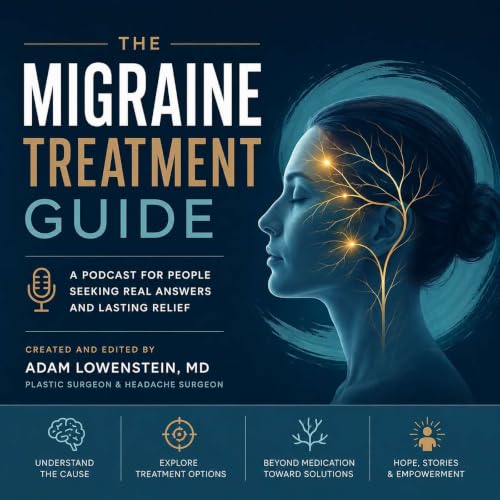
『The Migraine Treatment Guide Podcast』のカバーアート

The Migraine Treatment Guide Podcast

The Migraine Treatment Guide Podcast

著者: Adam Lowenstein MD
無料で聴く

Medications, Procedures, and Surgery Explained for the management of chronic headaches, including migraine, tension headache, cluster headache, NDPH, and other headache diagnoses. Created and edited by Dr. Adam Lowenstein of the Migraine Surgery Specialty Center, this podcast covers diagnosis, medication, surgical, and non-surgical alternatives to headache medication in order to educate patients with chronic headache pain on their options for headache relief.

© 2026 The Migraine Treatment Guide Podcast
衛生・健康的な生活 身体的病い・疾患
エピソード
  • Hormone Related Menstrual Headaches Explained
    2026/07/14

    Menstrual migraines get framed as an invisible hormone math problem, but that story breaks down the moment you ask a simple question: if estrogen and progesterone circulate everywhere, why does the pain keep bottlenecking in the same square inch above your eyebrow or the same band at the base of your skull? We follow a different path and treat hormone-related migraines like an anatomy puzzle, where soft tissue swelling and reactive blood vessels can physically crowd and irritate specific peripheral nerves.

    We unpack how an estrogen drop can make small scalp and facial arteries more reactive, turning a normally quiet “neighbor” into a pulsing source of rhythmic pressure on nearby nerves. Then we add progesterone’s downstream fluid retention effects, explaining how perineural edema can tighten fascial and muscular tunnels that have almost no spare room. Along the way we map the classic trigger points: the superorbital and supratrochlear nerves at the brow, the zygomaticotemporal nerve at the temple, and the greater occipital nerve where muscle, fascia, and the occipital artery can collide at the base of the skull.

    We also connect the dots across life stages, from predictable premenstrual migraines to the severe postpartum cliff and the chaotic swings of perimenopause migraines, where timing stops helping and location becomes the real clue. Finally, we cover why hormone therapy may reduce frequency but not erase pain when chronic compression leaves lasting narrowing, how a diagnostic nerve block can act as the “smoking gun,” and what peripheral nerve decompression surgery is designed to change for carefully selected patients.

    If you’ve ever felt dismissed with “it’s just hormones,” this conversation gives you a sharper vocabulary and a better map. Subscribe for more deep dives, share this with someone who tracks their cycle and their pain, and leave a review with the one trigger spot you want explained next.


    If you have questions about nerve decompression for severe chronic menstrual headaches, learn more at headachesurgery.com.

    続きを読む 一部表示
    24 分
  • Post-traumatic Headache Explained
    2026/07/14

    A headache that starts after a crash or a hard hit can feel exactly like migraine and that’s the problem. When the pain is throbbing, relentless, and hijacks your life, it’s natural to assume the source must be inside the skull. But there’s a lesser-known explanation that can hide in plain sight: a mechanical injury in the neck that keeps firing pain signals into the head for years.

    We walk through the anatomy and physics behind post-traumatic headaches, focusing on the greater occipital nerve and the dense muscle and fascia it has to travel through. In a whiplash event, those neck tissues act like emergency brakes for a bowling-ball-heavy head, and the nerve can get yanked and compressed in the process. The twist comes later, when soft tissue heals into stiff scar tissue and thickened fascia that can form a constant “vise” around the nerve. That chronic peripheral nerve compression can mimic chronic migraine so closely that people end up stuck in a loop of normal imaging, migraine meds that barely help, and a growing sense that nothing will change.

    We also dig into why CT and MRI are often the wrong tools for this specific problem, then explain the practical diagnostic step that can cut through the uncertainty: symptom mapping and a targeted occipital nerve block. If that temporary numbing brings major relief, it points toward a treatable, structural cause and can help patients avoid unnecessary cervical spine procedures. From there, we discuss surgical nerve decompression and scar tissue release, what surgeons actually see, and what published outcomes suggest for carefully selected post-traumatic cases.

    If you or someone you care about has chronic head pain after a collision or fall, share this conversation, subscribe for more deep dives like this, and leave a review with your biggest question about post-traumatic headache and occipital nerve compression. If you suffer from chronic headaches after a whiplash or other head trauma, visit headachesurgery.com to learn about outpatient nerve decompression surgery or call Dr. Lowenstein's office at 805-969-9004 for more information.

    続きを読む 一部表示
    22 分
  • Headaches After Illness Like COVID Explained
    2026/07/14

    A headache shows up with a cold and then refuses to leave for years. That sounds like a neurological mystery, but we walk through a different possibility: a purely mechanical problem at the base of the skull where the greater occipital nerve travels through a tight, crowded corridor of muscle, fascia, blood vessels, and occipital lymph nodes.

    We connect the dots from reactive lymphadenopathy after infections (including Epstein-Barr, COVID, and other common viruses) to a surprising long-term outcome: a lymph node that stays enlarged and gradually becomes firm, fibrotic, and scarred. In that hardened state, it can press on or grind against the greater occipital nerve every time you move your head, creating relentless sharp, throbbing pain that gets mislabeled as chronic tension headache or intractable migraine. We also unpack why standard imaging can miss it, because MRI and CT are designed to find dangerous pathology, not subtle millimeter-level compression of a tiny peripheral nerve by a benign structure.

    From there, we get practical about diagnosis and next steps: symptom mapping, a hands-on exam that can sometimes find a palpable firm node, and the diagnostic greater occipital nerve block that can temporarily “turn off” the pain and prove the source is peripheral. We reference clinical documentation from headache surgery.com, the work of Dr. Adam Lowenstein at the Migraine Surgery Specialty Center, and published surgical case reports that show how removing a scarred node and freeing the nerve can meaningfully reduce symptoms for the right patient.

    If you or someone you love has a headache that started after an illness and never let up, listen through and share it with them. Subscribe, leave a review, and tell us: have you ever had a “normal scan” but very real pain?

    If you suffer from chronic headache after COVID or other illness, know that there is hope. Learn about nerve decompression for chronic headaches at headachesurgery.com or call Dr. Lowenstein's Clinic at 805-969-9004 for an in-person or virtual appointment.

    続きを読む 一部表示
    13 分
adbl_web_anon_alc_button_suppression_t1
まだレビューはありません