エピソード

  • Nobody Tries to Join a Cult
    2026/07/09

    Why do ordinary people become devoted members of increasingly extreme organizations?

    This episode explores the psychology of gradual commitment—from harmless slogans and small acts of participation to identity, groupthink, and institutional influence. Using a fictional anti-bullying movement as a case study, we examine how individuals and organizations become radicalized, why these processes often emerge without a central conspiracy, and how understanding them can help us recognize similar patterns in the real world.

    続きを読む 一部表示
    22 分
  • The Biggest Asshole Always Wins
    2026/07/02

    Most people assume the majority gets its way. This episode explores why group decisions are often determined less by numbers than by the willingness of competing factions to apply pressure, and what that means for politics, corporations, and modern institutions.

    続きを読む 一部表示
    19 分
  • Do We Follow The Evidence, Or Lead It?
    2026/06/25

    Most people believe they follow the evidence wherever it leads.

    In reality, we often do the opposite.

    When confronted with information that challenges our existing beliefs, we rarely evaluate it objectively. Instead, we rationalize it, reinterpret it, or dismiss it altogether in order to preserve our preferred theories, narratives, and worldviews.

    In this episode of The Rational Nationalist, Lee Ellis examines why people cling to beliefs in the face of contradictory evidence, the incentives that encourage theory defense, and how public commitment, social pressure, and personal attachment can distort our judgment.

    続きを読む 一部表示
    18 分
  • The Windmills We Create
    2026/06/18

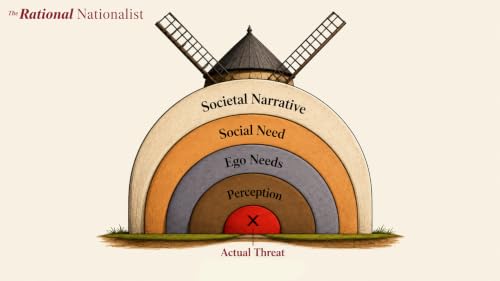
    In this episode of The Rational Nationalist, Lee Ellis examines how individuals and societies create "windmills" to fight. Drawing on the story of Don Quixote, he explores the psychological and social forces that cause threats to be exaggerated, narratives to spiral, and well-intentioned responses to become overreactions. From evolutionary instincts and strategic calculations to ego needs and institutional incentives, this episode looks at why the dangers we perceive often grow larger than the realities that inspired them.

    続きを読む 一部表示
    24 分
  • Inside the Mind of a Bureaucrat
    2026/06/11

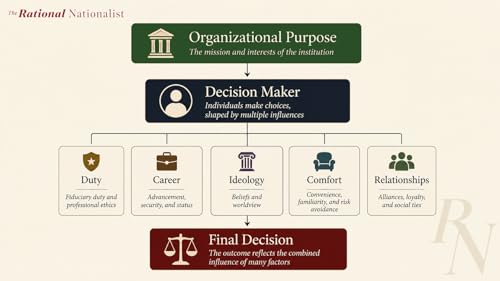
    In this episode of The Rational Nationalist, Lee Ellis examines how personal incentives influence decision-making inside institutions.

    Although individuals are expected to act in the best interests of the organizations they serve, competing pressures—including career advancement, ideology, comfort, relationships, and ego—often shape decisions in ways that diverge from an institution's stated purpose.

    Topics include:

    • Fiduciary duty and organizational purpose • Career incentives and high-profile prosecutions • The Asch conformity experiments • Bureaucratic inertia and institutional culture • Ideology, ego, and self-image • Why organizations often drift from their original mission

    続きを読む 一部表示
    20 分
  • Can Government Be Efficient?
    2026/06/04

    In this episode of The Rational Nationalist, Lee Ellis examines why governments often appear less efficient than other organizations and explores whether that outcome is inevitable.

    Using socialism, bureaucracy, and institutional incentives as a case study, the episode examines how organizations develop interests of their own, how bureaucratic structures expand over time, and why the goals of institutions, offices, and individuals often diverge from their original mission.

    Topics include:

    • Government efficiency and public trust • Organizational interests vs. stated intent • Bureaucratic growth and mission drift • Personal incentives within institutions • Why voters often feel they aren't getting value for their tax dollars • Whether effective government is possible

    続きを読む 一部表示
    23 分
  • Forecasting Chaos
    2026/05/28

    In this episode of The Rational Nationalist, Lee Ellis examines forecasting, probability, and the challenges of political prediction through the lens of game theory, chaos theory, and mass psychology.

    Using the 2028 election as a case study, the episode explores deterministic vs. probabilistic thinking, why simple models often outperform complex ones, the psychology of certainty, and how incentives shape political forecasting and political behavior.

    続きを読む 一部表示
    27 分
  • The Global Chessboard
    2026/05/21

    In this episode of The Rational Nationalist, Lee Ellis expands the discussion of mass politics from the national to the global level, examining how ideological coalitions, institutional power, and competing political systems shape the emerging world order.

    The episode explores how the ideological divisions of the global populace correspond to the institutions shaping the current geopolitical order.

    続きを読む 一部表示
    29 分