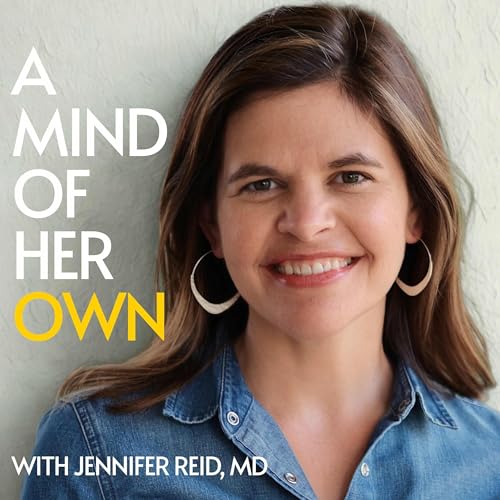
『A Mind of Her Own』のカバーアート

A Mind of Her Own

A Mind of Her Own

著者: Jennifer Reid MD
無料で聴く

A Mind of Her Own is a science-backed podcast dedicated to women's mental health, hosted by Dr. Jennifer Reid, MD, a Columbia and UCLA-trained psychiatrist, award-winning educator at the University of Pennsylvania, and author of Guilt Free: Reclaiming Your Life from Unreasonable Expectations. Dr. Reid sits down with clinicians, researchers, and writers to explore topics that matter: invisible labor, reproductive mental health, physician burnout, guilt, identity, and the forces that shape how women seek care and how they thrive. Now available for CME credit!

amindofherown.substack.comA Mind of Her Own
個人的成功 心理学 心理学・心の健康 自己啓発 衛生・健康的な生活
エピソード
  • "Being Alive Is a Terminal Condition."
    2026/06/18
    Dr. Luyi Kathy Zhang, MD has sat with thousands of people and their families in the final moments of their lives, learning from the choices they’ve made and what often goes unsaid. In this episode, she joins Jennifer Reid, MD to talk about caregiver guilt, the “burden of being a burden,” and why she treats self-care less like an indulgence and more like a clinical skill in her daily work. What makes Dr. Zhang’s perspective so disarming is that she refuses to treat death as a subject that requires hushed tones. She brings the same matter-of-fact warmth to a hospital room at Bellevue as she does to her writing and videos about her experiences working in end-of-life care. She and Dr. Reid also discuss how listeners can start on a path to less guilt and more meaning in their lives today. Her ABCs of Deathbed RegretDr. Zhang shares the framework she returns to again and again at the bedsides of the dying. It’s not a list of regrets about money or career, but 3 quieter, more human wishes so many people have spoken about in their final days.Authenticity. “I wish I had been more true to myself.” The regret of having lived as who was expected, rather than who they actually were.Bravery. “I wish I had the courage to pursue my dreams.” The risk that felt too frightening to take, looked back on as the one that mattered most.Connection. “I wish I had kept in touch.” The relationship left untended, or never repaired.As Dr. Zhang puts it, her hope isn’t that we wait for a deathbed to feel the pull of one of these, but that we notice which one lands hardest right now, and treat that as the signal worth acting on.About Dr. Luyi Kathy ZhangDr. Luyi Kathy Zhang is a hospice and palliative care physician, certified coach and hypnotist, author, and TEDx speaker. She is an assistant professor at NYU School of Medicine and directs the End of Life Serenity Unit at Bellevue, the nation’s oldest public hospital. Having sat with thousands of dying patients and heard their deepest secrets, biggest regrets, and final wishes, Kathy now shares that deathbed wisdom through her writing, speaking, and content, on a mission to help the rest of us start living the life we truly want, long before we reach the end of it.Dr. Zhang’s Website: https://luyikathyzhang.com/Her TEDx talk!On Instagram as Dr. Luyi Kathy Zhang https://www.instagram.com/dr.luyikathyzhang🎙️ Some Exciting News!A Mind of Her Own has recently joined the Learn At Pinnacle app, so if you work in health care, you can receive FREE CE credit just for listening!(This includes Category 1 AMA CME credit and many others.)Download the free app at the link above or at: https://learnatpinnacle.com/educationConnect with your host, Jennifer Reid, MDDr. Jennifer Reid is a physician, the host of A Mind of Her Own, and the author of Guilt Free: Reclaiming Your Life from Unreasonable Expectations — available at major retailers.🌐 Website: jenniferreidmd.com Instagram: @JenReidMD Threads: Jennifer Reid, MDFeeling inspired by this conversation? Start your own Guilt-Free Group at jenniferreidmd.com/guilt-free-groups or download a book club guide at jenniferreidmd.com/book-clubs.Thanks for checking out A Mind of Her Own! Subscribe for free to receive new posts and support my work.If you enjoyed this episode, please follow A Mind of Her Own and leave a rating or review on Apple Podcasts — it makes a huge difference in helping other people find the show! 🎙️Seeking a mental health provider? Try Psychology TodayNational Suicide Prevention Lifeline: 1-800-273-8255Dial 988 for mental health crisis supportSAMHSA’s National Helpline - 1-800-662-HELP (4357)-a free, confidential, 24/7, 365-day-a-year treatment referral and information service (in English and Spanish) for individuals and families facing mental and/or substance use disorders.Disclaimer:The views expressed on this podcast reflect those of the host and guests, and are not associated with any organization or academic site. Also, AI may have been used to create the transcript and notes, based only on the specific discussion of the host and guest and reviewed for accuracy.The information and other content provided on this podcast or in any linked materials, are not intended and should not be construed as medical advice, nor is the information a substitute for professional medical expertise or treatment. All content, including text, graphics, images and information, contained on or available through this website is for general information purposes only.If you or any other person has a medical concern, you should consult with your health care provider or seek other professional medical treatment. Never disregard professional medical advice or delay in seeking it because of something that have read on this website, blog or in any linked materials. If you think you may have a medical emergency, call your doctor or emergency services (911) immediately. You can also access the National Suicide Help Line...
    続きを読む 一部表示
    42 分
  • Beyond Distraction: A New Understanding of Adult ADHD
    2026/06/11
    Does this sound familiar?“I’m busy all day, but I don’t get anything done. I want something to show for my efforts.”“Everyone in my life is tired of my lateness and unreliability.”“I can’t get motivated unless I’m facing a deadline, and what I produce isn’t as good as it could be.”In this episode of A Mind of Her Own with Jennifer Reid, MD, we hear from adult ADHD expert, J. Russell Ramsay, PhD about a new way of viewing ADHD: as fundamentally a self-regulation problem, not an attention problem. The name is misleading. What’s really impaired is the ability to organize behavior across time in order to consistently follow through on what you intend to do.CBT adapted for ADHD works differently than standard CBT. The focus isn’t on changing negative thoughts. It’s on reverse-engineering the how of not doing things, then building explicit step-by-step plans. The goal is slowing down the executive function deliberately, making implicit steps external and visible.The Core Executive Functions Affected in ADHD:* Inhibition (pausing before responding automatically)* Nonverbal working memory (mental simulation and planning)* Verbal working memory (internal self-talk and staying on track)* Emotional regulation and motivation (generating drive in the absence of immediate consequences)* Reconstitution (flexible, creative problem-solving)Emotional dysregulation is a core feature, but it’s invisible in the DSM. Emotions don’t appear in the diagnostic criteria at all, yet they drive much of what people actually struggle with: impulsive reactions, difficulty tolerating discomfort, and using guilt as a misguided motivator.Women are significantly under-diagnosed and diagnosed later. CDC data from 2024 found that 50% of people with ADHD were diagnosed at age 18 or older, and 61% of those were women. Girls’ symptoms often appear on the playground rather than in the classroom, with social disruption rather than academic chaos, making them easier to overlook. Women are also more likely to be diagnosed first with anxiety or depression.Self-mistrust is a hallmark and often mistaken for low confidence. After years of inconsistent follow-through, many adults with ADHD stop trusting themselves to do what they set out to do. This isn’t simply low self-esteem; it’s a learned pattern of doubting one’s own reliability, often amplified by the unspoken message: it must be something I’m doing wrong.High functioning doesn’t mean unaffected. Many people mask symptoms for years through compensatory strategies: all-nighters, parental scaffolding, sheer willpower, until the scaffolding is removed or life demands multiply (new job, parenthood, caregiving, perimenopause).Front-end perfectionism drives procrastination. The biggest cognitive distortion in ADHD isn’t negativity, it’s the belief that conditions must be perfect before starting. Waiting to feel focused, energized, or “in the mood” guarantees perpetual delay. The reframe: Do I have enough to begin?ADHD also brings real strengths. Creativity, the ability to hyper-focus in stimulating environments, hands-on intuitive knowledge, persistence when engaged, and the capacity for innovative thinking are all genuine advantages, not consolation prizes.Resources Mentioned* Book: Once I Get Started: The Adult ADHD Program for Turning Your Intentions into Actions — Dr. Russell Ramsay (Avery/Penguin Random House, May 2025)* Book: You Mean I’m Not Lazy, Stupid or Crazy?! — Kate Kelly & Peggy Ramundo (mid-90s classic, still widely cited)* Book: The Power of Habit — Charles Duhigg (source of the “keystone habit” concept)* Book: The Extended Mind: The Power of Thinking Outside the Brain — Annie Murphy Paul (on environment, cognition, and the need for solitude)* Book: Living Well with Adult ADHD: Practical Strategies for Improving Your Daily Life — Dr. Laura Knouse & Dr. Russell Barkley (Guilford Press, 2025)* Researcher: Dr. Margaret Sibley — Professor of Psychiatry & Behavioral Sciences, University of Washington; leading work on adult ADHD diagnosis guidelines through the American Professional Society of ADHD and Related Disorders (APSARD)* Researcher: Dr. Russ Barkley — foundational work on ADHD as executive dysfunction* Assessment tool: QB Test (Qbtech) — computerized continuous performance task used to objectively measure attention, impulsivity, and activity* Website: cbt4adhd.com — Dr. Ramsay’s practice, contact form, and resourcesAbout Dr. Russell RamsayDr. J. Russell Ramsay is a licensed psychologist and board-certified cognitive-behavioral therapist specializing in the assessment and psychosocial treatment of adult ADHD. He was the co-founder and co-director of Penn’s Adult ADHD Treatment and Research Program, one of the earliest and most influential programs of its kind, established in 1999. Dr. Ramsay is the author of six books on adult ADHD, including his most recent, Once I Get Started (2025). He has lectured ...
    続きを読む 一部表示
    1 時間 2 分
  • "It's Your Body." Optimal Health in Perimenopause.
    2026/06/04
    “Every woman deserves the chance to have a real discussion about hormone therapy — and make whatever decision is right for her. I’m here to give information and answer questions. It’s your body.”— Dr. Jacqueline RiedelThe doctor who finally has time for youDr. Jacqueline Riedel, DO spent 15 years in family medicine where she learned this: women’s hormonal health in midlife was profoundly under-treated and misunderstood. In a busy hospital-based clinic, she’d start a long-overdue conversation with a patient about perimenopause symptoms… and have to cut it off because the schedule demanded it.So she left. She opened Magnolia Midlife Women’s Health, a direct-care practice built on something simple but radical: unhurried, conversational visits where women can actually ask their questions, get real answers, and leave feeling seen.In this conversation, she covers what’s really happening hormonally in your 30s, 40s, and 50s and why everything you were told to fear about hormone therapy probably isn’t the full story.Perimenopause starts earlier than you thinkDr. Riedel sees women with perimenopause symptoms long before any changes in the menstrual cycle. If you’ve been dismissed, or told your symptoms are just stress or mom-brain, you’re not alone. Symptoms she commonly sees:• New insomnia: can’t fall asleep or waking for no apparent reason• Anxiety, often misread as “just life stress”• Persistent, unexplained fatigue• Hot flashes and night sweats• Mood changes including irritability, low mood, brain fog• Cycle irregularities such as heavier periods, irregular timingDr. Riedel’s approach: map symptoms to your cycle. When do they happen? Are there patterns? She also rules out other common causes, including thyroid issues and iron deficiency before exploring hormone therapy as an option.MYTH BUSTINGThe fears holding women back from reliefTwo decades after the Women’s Health Initiative (WHI) study was misread and sensationalized, fear still dominates the conversation around hormone therapy. Dr. Riedel sets the record straight.Myth 1: Hormone therapy causes breast cancer.Fact: Long-term WHI follow-up showed women in the hormone treatment group had lower rates of breast cancer. Even a first-degree family history is not a contraindication. And if breast cancer does occur in someone using MHT, their risk of dying is actually lower than in those not using it.Myth 2: The doses in MHT are dangerously high.Fact: Menopausal hormone therapy doses are far lower than those in oral contraceptive pills. If you’d prescribe the pill, you can’t logically call MHT dangerous.Myth 3: Vaginal estrogen has systemic effects and should be avoided in cancer history.Fact: Topical vaginal estrogen has negligible systemic absorption. It reduces UTIs, yeast infections, urinary frequency, and pelvic floor dysfunction, even in women under active breast cancer treatment, per emerging oncology research. The FDA recently removed the black-box warning.TREATMENT OVERVIEWHow Dr. Riedel approaches careThere’s no single protocol. Dr. Riedel listens first, identifying the top two or three symptoms most affecting quality of life, and builds from there.Progesterone for sleep & anxiety• Stimulates GABA production, a calming neurotransmitter• Helps with sleep onset and staying asleep• Reduces the racing mind at 2am• Often the first place she startsEstrogen for vasomotor symptoms• Addresses night sweats, hot flashes, palpitations• Keeps estrogen levels from dropping to “empty”• Preferred as transdermal (patch, gel, spray) to avoid blood clot risk• Added when progesterone alone isn’t enoughVaginal estrogen for urogenital health• Reduces painful intercourse and dryness• Decreases UTIs and yeast infections• Supports pelvic floor health long-term• About 50% of women need this even on systemic estrogenNon-hormonal options when hormones aren’t right• Newer medications targeting particular neurons in the hypothalamus (hot flash regulation)Things you can do and questions to askDr. Riedel’s conversation offers practical starting points for women navigating this transition on their own or with a provider.01. Track your symptoms in relation to your cycleSleep disruption, anxiety, and mood changes that follow a cyclic pattern are often hormonal in origin. Note when in your cycle you feel worst because this information is gold for any provider visit.02. Ask your doctor to rule out thyroid and iron firstFatigue, brain fog, and sleep issues can also come from iron deficiency or thyroid dysfunction. Simple labs can clarify what you’re actually dealing with before hormones enter the picture.03. Reconsider what’s in your sleep toolkitAlcohol before bed worsens sleep, hot flashes, and anxiety, even though it feels like it helps. Benadryl/ZQuil, Ambien, and benzodiazepines disrupt true sleep architecture. CBT for insomnia has strong evidence and virtually zero side effects. 06. ...
    続きを読む 一部表示
    47 分
adbl_web_anon_alc_button_suppression_t1
まだレビューはありません