エピソード

  • Ecovillages as laboratories for circular economies: Transforming Waste into Wealth through Regenerative Community Design
    2026/04/01

    Ecovillages are intentional communities established with the goal of improving social, cultural, economic, and ecological sustainability through locally owned, participatory methods. These settlements act as living laboratories by seeking alternatives to environmentally damaging systems and testing regenerative practices that can be scaled for broader society. In this podcast, we explore how circular economy strategies—aiming to eliminate waste and circulate materials—are successfully integrated into the fabric of these communities.

    We feature real-world case studies demonstrating circularity in action. In Findhorn Ecovillage, Scotland, residents generate renewable energy via wind and solar power while operating their own biological sewage plant to recycle wastewater for irrigation. The Awra Amba community in Ethiopia utilizes organic agriculture and recycling programs to achieve self-reliance and environmental preservation. Meanwhile, in Bendungan Village, Indonesia, the implementation of "garbage banks" and specialized machinery allows residents to turn plastic waste into pavement blocks and organic waste into fuel briquettes, creating alternative income while restoring the local river ecosystem.

    The episode also examines the shift from a linear "take-make-waste" mindset to the 9R framework of circularity, focusing on Refuse, Rethink, and Repair at the household level. By embracing shared resources—such as the communal utilities and housing designs seen in Hanover’s Ecovillage—these communities minimize their individual footprints while maximizing their collective social and ecological "handprint". Finally, we discuss how closing nutrient loops through permaculture and organic farming ensures that materials are returned to the earth's biogeochemical cycles to nourish future growth.

    続きを読む 一部表示
    21 分
  • Sociocracy: Principles and Applications of Consent-Based Governance
    2026/03/18

    This podcast series explores "Ecological Resistance in Intentional Communities," focusing on the "real-world laboratory" of Arterra Bizimodu, an ecovillage in Navarre, Spain. Founded in 2014, Arterra serves as the headquarters for GEN-Europe (Global Ecovillage Network) and models a life centered on cooperation, sustainability, and shared governance.

    The show dives deep into Sociocracy (also known as Dynamic Governance), a non-authoritarian organizational structure developed by Dutch engineer Gerard Endenburg in the 1970s. Listeners will learn how this system replaces traditional "power-over" hierarchies with a "power-with" circular structure, where authority is distributed among semi-autonomous teams called circles.

    Key themes include:

    • Consent vs. Consensus: We analyze why many communities are shifting away from traditional consensus, which can lead to "unanimity paralysis," in favor of consent decision-making. In sociocracy, a proposal moves forward if it is "good enough for now and safe enough to try," meaning no member has a "paramount and reasoned objection" that could harm the group's ability to achieve its aims.
    • Structural Innovation: The podcast breaks down the pillars of sociocratic design: nested circles that align authority with expertise; double-linking, which uses two distinct roles (leader and delegate) to ensure two-way information flow between circles; and elections by consent, where roles are filled based on qualifications and group trust rather than popularity.
    • The Neo-Rural Journey: We feature the lived experiences of Arterra's approximately 40 residents, many of whom left urban careers to search for an ecologically aligned existence. The show explores how they use permaculture design, Non-Violent Communication (NVC), and "inner work" to foster mutual trust and emotional responsibility.
    • The Reality of the "Utopia": The series provides a balanced critique, addressing the significant learning curve, the time investment required for participatory governance, and the risk of creating a "soft technocracy" that privileges those most comfortable with structured dialogue.

    Ultimately, this podcast highlights how communities like Arterra Bizimodu act as "seeds" for socio-ecological transition, demonstrating that alternative worldviews grounded in interdependence and shared responsibility are not just ideals, but daily practices.

    Sources:

    • https://ehab-badwi.medium.com/exploring-sociocracy-a-collaborative-and-inclusive-approach-to-organizational-governance-97544cbbb491
    • https://www.educba.com/sociocracy/
    • https://www.sociocracy.info/full-circle-meetings/
    • https://www.collectivespacesfarm.com/how-sociocracy-powers-inclusive-governance-at-collective-spaces-farm/
    • https://www.cohousing.org/sociocracy/
    続きを読む 一部表示
    24 分
  • Redesigning Community: Inside the Regenerative Community Operating System (RCOS) and the Future of EcoHubs
    2026/03/13

    In this episode, we dive deep into the world of EcoHubs and the Regenerative Community Operating System (RCOS)—a bold, open-source initiative designed to solve the age-old challenges of intentional community living.

    For decades, communities have struggled with the same "failure modes": informal power grabs, invisible workloads, unaddressed conflict, and founder dominance. We explore how Stefan Lessle, a systems thinker and developer, founded EcoHubs to move beyond "good vibes" and provide a practical, structural foundation for human-scale living.

    Key topics discussed in this episode:

    • The "Explicit Beats Implicit" Rule: Why making rules, roles, and exit paths explicit is the single most important factor in preventing community collapse.
    • The 7-Layer Architecture of RCOS: We break down the modular "protocol stack" that governs everything from Identity and Scope (Layer 0) to Evolution and Adaptation (Layer 6).
    • The Power of Human Scale: Why RCOS is optimized for groups of 5 to 150 people (Dunbar’s Number) to ensure trust and accountability without the need for heavy bureaucracy.
    • Technology That Serves Life: How EcoHubs selectively uses Web3 tools like DAOs, Snapshot for gas-free voting, and EcoTokens to create a transparent contribution economy without losing the "human touch".
    • Regeneration vs. Sustainability: Shifting the goal from merely maintaining the status quo to actively healing the land, culture, and social fabric.
    • Stress-Testing the Blueprint: A look at how EcoHubs uses real-world failure cases—like charismatic authority or burnout—to validate the resilience of their system.

    EcoHubs is currently an online-first community of researchers, designers, and builders co-creating this blueprint for the future. Whether you are a permaculturist, a tech innovator, or someone simply looking for a more meaningful way to live, this episode offers a glimpse into a world where technology and ecology finally work in harmony.

    "The future is not a place we are going. It is a place we are creating together, one hub at a time."

    Learn more about the vision and how to join the first 500 founding members at EcoHubs.community.

    Sources:

    • https://ecohubs.community/
    • https://blueprint.ecohubs.community/
    続きを読む 一部表示
    26 分
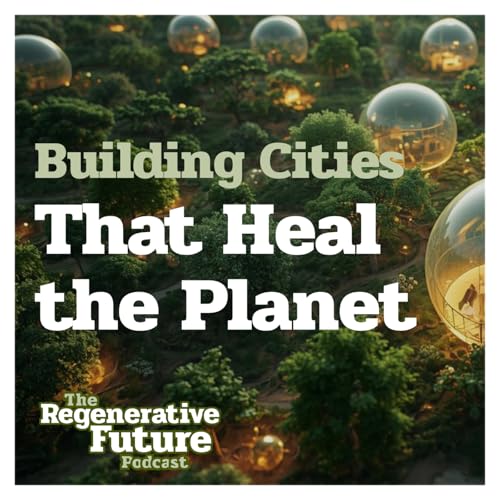
  • Building Cities That Heal the Planet
    2026/03/13

    Imagine a city that doesn't just minimize its footprint, but actually acts like a living organism to restore ecosystems and clean the air. In this episode, we reveal how the science of Ekistics can transform our urban "cells" from mechanical networks into regenerative habitats that truly heal the Earth.

    We dive into the visionary work of Constantinos A. Doxiadis, whose multidimensional framework balances nature, society, and technology to achieve maximum human happiness and safety. Learn how the 2km pedestrian cell provides a blueprint for a city where everything you need is within a 10-minute walk, reclaiming "free social space" for humans by moving automobiles to the periphery or underground. We also explore the emergence of Circular Economy Villages (CEVs), which utilize integrated microgrids and regenerative agriculture to create self-sufficient communities that grow out of the landscape. By re-establishing the human scale within a global network of linked settlements—the Ecumenopolis—we can build a future where the built environment contributes net-positive impacts to its surroundings. Join us to discover why the "perfect" design isn't just about doing less harm, but about fostering a thriving partnership between people and place.

    Sources:

    • https://lifestyle.sustainability-directory.com/term/regenerative-architecture-principles/
    • https://www.re-thinkingthefuture.com/rtf-fresh-perspectives/a13755-regenerative-design-restoring-nature-through-architecture/
    • https://ijrar.org/download.php?file=IJRAR19L1957.pdf
    • https://en.wikipedia.org/wiki/Ekistics
    • https://www.scribd.com/document/339282349/Planning-341
    • https://ijrar.org/download.php?file=IJRAR19L1957.pdf
    • https://www.researchgate.net/publication/353494822_A_network_of_circular_economy_villages_design_guidelines_for_21st_century_Garden_Cities
    • https://www.researchgate.net/publication/353494822_A_network_of_circular_economy_villages_design_guidelines_for_21st_century_Garden_Cities
    • https://www.mdpi.com/2071-1050/15/17/13271
    続きを読む 一部表示
    22 分
  • Scaling Regeneration: From Zoning to Sociocracy
    2026/03/11

    Can a few radical shifts in land-use law and group decision-making actually save our biosphere? Explore how we move from the rigid, sprawl-inducing lines of "Euclidean zoning" to the fluid, regenerative circles of sociocracy to scale the future of community.

    In this episode, we investigate the "architecture of restoration," analyzing the deep-seated structural and social barriers that cause up to 90% of aspiring intentional communities to fail in their earliest years. We break down how the legacy of 20th-century "Euclidean zoning" functions as a structural anti-regenerative force, legally mandating the very metropolitan sprawl and land-use separation that drive our current climate crisis.

    Moving from the legal to the interpersonal, the episode discusses the "pioneer vs. settler" dilemma in growing communities and how to navigate the inherent friction of collaborative human governance. You’ll discover why many groups are leaving traditional consensus behind for the efficiency of sociocracy, a "younger cousin" of consensus based on consent rather than unanimity. We explore how this model uses semi-autonomous "circles" and double-linking to maintain psychological safety and accountability even as a project scales up.

    Drawing on lessons from successful high-impact models like Dudley Neighbors and the Narara Ecovillage, we discuss how these "socio-technical niches" can finally diffuse into mainstream urban planning to rebuild our world through self-perpetuating regenerative dynamics.

    Sources:

    • https://communityfinders.com/why-intentional-communities-fail/
    • https://vet.ucalgary.ca/sites/default/files/teams/65/CURRENT%20PUBS/REGEN%20AG%20PACKAGE/Bridging%20the%20Financing%20Gap%20in%20Regenerative%20Agriculture-Solutions%20for%20Policy%20and%20Practice.pdf
    • https://communityfinders.com/decision-making-in-intentional-communities/
    • https://communityfinders.com/why-intentional-communities-fail/
    • https://case.edu/socialwork/np3-nurturing-communities/sites/default/files/2020-05/Thaden.Pickett.WWV_.%20Community%20Land%20Trusts.2020.pdf
    • https://lifestyle.sustainability-directory.com/term/ecovillages/
    • https://pmc.ncbi.nlm.nih.gov/articles/PMC12673013/
    続きを読む 一部表示
    22 分