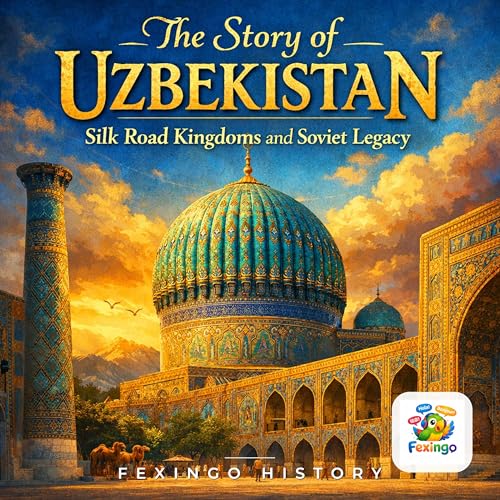
『The Story of Uzbekistan: Silk Road Kingdoms and Soviet Legacy — Fexingo History』のカバーアート

The Story of Uzbekistan: Silk Road Kingdoms and Soviet Legacy — Fexingo History

The Story of Uzbekistan: Silk Road Kingdoms and Soviet Legacy — Fexingo History

著者: Fexingo
無料で聴く

In this series, Lucas and Luna journey through the layered history of Uzbekistan, a land where Silk Road caravans once traversed the Kyzylkum Desert and where the blue-tiled domes of Registan Square still echo the glory of the Timurid Empire. From the Sogdian merchants who thrived under Achaemenid and then Hellenistic rule, to the Arab conquests that brought Islam and the Samanid Renaissance, each episode traces the rise and fall of kingdoms that shaped Central Asian identity. The show delves into the rule of Amir Timur (Tamerlane) in Samarkand, the shaybanid Uzbek khanates, and the brutal Russian imperial expansion in the 19th century. It then tackles the Soviet era: the cotton monoculture that drained the Aral Sea, the jadid reformist movement, and the legacy of Stalin’s purges. Post-independence, the hosts explore the authoritarian nation-building under Islam Karimov, the revival of Silk Road tourism, and simmering tensions in the Fergana Valley. Through primary sources like Babur’s memoirs and Soviet secret police files, Lucas and Luna ask: Can a nation balance its Timurid heritage with its Soviet scars? And what does the future hold for this crossroads of empires? #Uzbekistan #SilkRoad #TimuridEmpire #SamanidDynasty #SovietUnion #CentralAsia #RegistanSquare #JadidMovement #AralSea #Babur #IslamKarimov #Khiva #Bukhara #Samarkand #History #WorldHistory #FexingoHistory #Podcast Keep every episode free: buymeacoffee.com/fexingo© 2026 Fexingo. All rights reserved. 世界 社会科学
エピソード
  • The Tashkent Earthquake of 1966: Uzbekistan's Soviet Reconstruction
    2026/06/12
    In this episode, Lucas and Luna delve into the devastating 1966 Tashkent earthquake—a magnitude 7.5 tremor that leveled much of the Uzbek capital on April 26, 1966. They explore the immediate aftermath, the Soviet Union's massive reconstruction effort that transformed Tashkent into a model Soviet city, and the human stories of displacement and resilience. The conversation covers the role of Soviet seismology, the architecture of the new city (including the metro expansion), and the long-term social and political impacts, including how the disaster inadvertently shaped Uzbek national identity within the USSR. Lucas explains the controversial decision to rebuild on the same fault lines, the influx of workers from across the Soviet republics, and the subtle cultural shifts that followed. Luna asks about the legacy of the earthquake in modern Tashkent—from monuments to memory. This episode offers a fresh angle on Soviet-era Uzbekistan, touching on urban planning, disaster politics, and the paradox of catastrophe as a catalyst for change. #TashkentEarthquake #1966Earthquake #SovietHistory #UzbekistanHistory #Tashkent #CentralAsia #SovietReconstruction #Seismology #UrbanPlanning #DisasterHistory #SovietArchitecture #UzbekSSR #1960sHistory #Earthquake #History #FexingoHistory #Podcast #Resilience Keep every episode free: buymeacoffee.com/fexingo
    続きを読む 一部表示
    6 分
  • The Bukhara Emirate Last Emir Alim Khan
    2026/06/11
    When the Russian Empire collapsed in 1917, Central Asia's ancient emirates saw a chance to break free. Emir Alim Khan of Bukhara, who had ruled under Russian protection since 1911, faced an impossible choice: align with the reformist Jadids, resist the Bolsheviks, or cling to absolute power. This episode traces Alim Khan's rule from his early reforms to his flight to Afghanistan in 1920, the siege of Bukhara by Mikhail Frunze's Red Army, and the violent end of the Manghit dynasty. We explore the emir's controversial legacy, the brutal suppression of the 1918 Kolesov campaign, and the fate of his family. Why did a ruler who initially supported modernisation become a symbol of reactionary tyranny? And what does his story tell us about the Soviet conquest of Turkestan? Along the way, we encounter the Jadid reform movement, the Young Bukharan party, the Treaty of Kiat, and the Kagan enclave. A story of revolution, betrayal, and the death of a thousand-year-old monarchy. #Bukhara #EmirAlimKhan #ManghitDynasty #RussianRevolution #Bolshevik #Jadid #YoungBukharans #MikhailFrunze #KolesovCampaign #Turkestan #CentralAsia #Uzbekistan #SovietHistory #1920SiegeOfBukhara #Kagan #AfghanistanExile #History #FexingoHistory Keep every episode free: buymeacoffee.com/fexingo
    続きを読む 一部表示
    11 分
  • The Tillya Tepe Gold: Afghanistan's Bactrian Treasure
    2026/06/11
    In 1978, a Soviet-Afghan archaeological team led by Viktor Sarianidi uncovered a cache of over 20,000 gold objects at Tillya Tepe, or 'Golden Hill,' in northern Afghanistan. Dating to the first century BCE, these treasures belonged to a nomadic Saka or Parthian elite and blend Hellenistic, Chinese, Indian, and Siberian artistic traditions. This episode traces the discovery, the artistry of the six tombs, and the extraordinary journey of the Bactrian Gold through the Soviet war in Afghanistan, Taliban looting attempts, and its eventual display in Kabul. We discuss the golden crown, the Aphrodite clasp, and the dagger with its sheath, and how the treasure reflects the Silk Road's cultural crosscurrents. The collection's survival and recent exhibitions in Uzbekistan and beyond reveal a shared Central Asian heritage that transcends modern borders. #TillyaTepe #BactrianGold #ViktorSarianidi #Afghanistan #SilkRoad #Kushan #Saka #Parthian #HellenisticArt #NomadicArt #Archaeology #CentralAsia #AfghanTreasures #KabulMuseum #Taliban #Gold #History #FexingoHistory Fexingo founder and producer: Ibnul Jaif Farabi Keep every episode free: buymeacoffee.com/fexingo
    続きを読む 一部表示
    6 分
adbl_web_anon_alc_button_suppression_t1
まだレビューはありません