エピソード

  • Salem Witch Trials Court: How the Court of Oyer and Terminer Worked in 1692
    2026/05/31

    Why did the 1692 Salem witch trials require an entirely new court, and how did that court reach a 100 percent conviction rate? This episode examines the Court of Oyer and Terminer, the special tribunal that prosecuted witchcraft accusations across colonial Massachusetts, and lays out the legal machinery, the magistrates, and the evidentiary standards that decided who lived and who died.

    When Sir William Phips took office, the province faced overcrowded jails, an invalidated court system, and dozens of pending witchcraft charges with no legal venue to resolve them. The court he created relied on spectral evidence and a bench of prosperous, legally untrained men, a combination that shaped one of the most consequential criminal proceedings in early American history.

    Chapters

    00:00 Welcome and Overview

    00:32 Why a Special Court

    02:06 Meet the Judges

    03:43 Earlier Witch Trial Experience

    05:10 Spectral Evidence Explained

    06:26 Ministers Weigh In

    06:49 Oyer and Terminer Results

    08:01 Superior Court Replaces It

    11:04 Reprieves and Stoughton Fury

    12:29 Aftermath and Next Episode

    What you will learn:

    • Why a special court became necessary in 1692

    • How the new Massachusetts charter dismantled the old court system

    • Who sat on the bench

    • What legal training the magistrates actually possessed

    • How spectral evidence functioned as proof

    • Why Connecticut had foreclosed spectral evidence decades earlier

    • How conviction rates differed under the two successive courts

    • Which condemned prisoners avoided execution

    Hosted by Josh Hutchinson and Sarah Jack.

    End Witch Hunts

    The Thing About The Salem Witch Trials

    Buy A Book About The Salem Witch Trials


    続きを読む 一部表示
    13 分
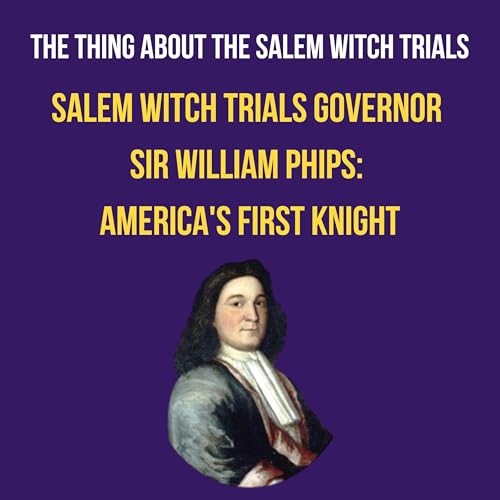
  • Salem Witch Trials Governor Sir William Phips: America's First Knight
    2026/05/24

    William Phips was the last person anyone should have trusted with one of the most consequential legal crises in American history. No formal education. No legal training. No political experience. The man who put him in charge of Massachusetts was Increase Mather, the most powerful Puritan minister in colonial New England.

    Phips arrived at the Salem witch trials as governor of Massachusetts Bay with a life behind him that had nothing to do with governance. There was a Spanish shipwreck, a knighthood, a failed military campaign, and a financial disaster that forced the colony to print currency for the first time. By the time he sailed into Boston Harbor in May 1692, the jails were already full of the accused, the Court of Oyer and Terminer was waiting to be built, and the pressure to act was immense.

    Josh Hutchinson and Sarah Jack examine the full arc of William Phips, the contradictions he embodied, the power he held during the Salem witch trials of 1692, and what he did and did not do with it.

    What You Will Learn:

    • The kind of man Puritan New England handed its witch trials to

    • What it took to become the most powerful man in Massachusetts without ever learning to write

    • How a man who could not read until age 21 came to control the Salem witch trials

    • The Spanish shipwreck that launched a political career

    • Why New England's most powerful minister chose an illiterate treasure hunter for governor

    • The military disaster that forced Massachusetts to print money for the first time

    • What the ministers actually told Phips about the witchcraft cases

    • The accusation that landed inside his own home

    • Who Phips blamed when the Crown demanded answers

    Hosted by Josh Hutchinson and Sarah Jack.

    End Witch Hunts: endwitchhunts.org | aboutwitchhunts.com

    #WilliamPhips #SalemWitchTrials #Salem1692 #AmericasFirstKnight #ColonialAmerica #MassachusettsHistory #WitchTrialsHistory #IncreaseMather #RebeccaNurse #PuritanHistory #EndWitchHunts #ThingAboutSalemWitchTrials #NewEnglandHistory #AmericanHistory

    Links:

    Emerson W. Baker and John G. Reid, The New England Knight: Sir William Phips, 1651-1695: https://bookshop.org/a/90227/9780802081711

    続きを読む 一部表示
    22 分
  • American Revolution: How Families of Salem Witch Trials Victims and Accusers United for Independence
    2026/05/10

    From Witch Trials to Revolution: Salem Village on the Front Lines

    We connect Salem’s darkest legacy to the opening clash of American independence with historian Dan Gagnon, Danvers resident and author of A Salem Witch: A Biography of Rebecca Nurse. Our conversation brings the Revolution into the very streets of Salem and Salem Village (today’s Danvers), where coercive acts, a moved provincial capital, troops on the Salem Common, and General Gage’s presence near the Rebecca Nurse Homestead turned imperial policy into daily reality. Tensions surge as the Massachusetts legislature outmaneuvers Gage in Salem, town meetings defy his bans, and crowds force him to release arrested patriots. The action escalates with Leslie’s Retreat—an armed standoff over a raised bridge—and then the Lexington Alarm, as Danvers militia (including descendants of witch-trial families) race to Menotomy for some of the day’s most savage fighting.

    00:00 Welcome and Introductions

    00:12 Dan Gagnon Background

    01:06 Witch Trials to Revolution

    02:34 Rights and Rising Tensions

    03:05 Salem Becomes Capital

    05:14 Defying General Gage

    06:26 Town Meetings and Protests

    08:15 Leslie's Retreat in Salem

    11:00 Lexington Alarm Response

    14:05 Menotomy Bloody Fighting

    17:07 Losses and Legacy


    Links:

    Rebecca Nurse Homestead: rebeccanurse.org

    A Salem Witch: A Biography of Rebecca Nurse by Dan Gagnon: www.bookshop.org/Shop/endwitchhunts

    End Witch Hunts endwitchhunts.org

    About Witch Hunts aboutwitchhunts.com

    Salem Witch Trials History YouTube: https://youtube.com/@aboutwitchhunts

    続きを読む 一部表示
    18 分
  • Walpurgis Night, Salem Witchcraft, and the Maypole at Merrymount
    2026/05/03

    Every April 30, bonfires burn across Europe on the same night witches were said to gather on a mountaintop and make their covenant with the devil. That image did not stay in Europe. It crossed the Atlantic, embedded itself in colonial New England theology and law, and by 1692 it was being sworn to in witchcraft trials that sent nineteen people to their deaths. In this episode, hosts Josh Hutchinson and Sarah Jack follow that thread from a German mountain to a Danvers pasture — and the path runs straight through a Maypole, a folk magic discovery hidden inside a colonial home, a decades-old grudge over rancid butter, and a pear tree that has been standing since before the trials began and is still standing right now.

    In this episode, you will learn:

    • Why Walpurgis Night and the Salem witchcraft sabbath descriptions share the same historical roots

    • How one colonial settler's May Day celebration became a theological threat to Puritan authority

    • What a single word in William Bradford's writing reveals about how Puritans understood folk magic and social control

    • Why witchcraft gathering testimony carried such evidentiary weight in colonial Massachusetts courts — decades before Salem

    • How one man's actions in the 1620s left a thread running directly through the 1692 witch trials

    • What a 400-year-old pear tree in a Danvers parking lot has to do with the Salem witch trials

    The Thing About the Salem Witch Trials is part of the End Witch Hunts podcast network. Learn more at endwitchhunts.org.

    #SalemWitchTrials #Witchcraft #FolkMagic #WalpurgisNight #ColonialHistory #AmericanHistory #WitchHunts #1692 #Puritans #NewEnglandHistory #MayDay #ThomasMorton #JohnEndicott #EndWitchHunts #SalemHistory

    Salem Witch Trials History YouTube

    The Thing About the Salem Witch Trials

    Salem Witch Trials Daily

    The Thing About Witch Hunts

    Support Our Work, Buy a Salem Witch Trials History Book!

    続きを読む 一部表示
    20 分
  • When ESPN Covered the Salem Witch Trials: Ergot Theory at 50
    2026/04/26

    ESPN has a history podcast, and they used it to cover the Salem Witch Trials on the 50th anniversary of the ergot theory. Hosts Josh Hutchinson and Sarah Jack, descendants of Salem Witch Trial victims, respond to Stupiracy's April 2nd episode on whether moldy rye bread caused the accusations of 1692.

    What you will learn:

    • What the ergot theory is and why it has circulated for 50 years
    • How the historical symptoms from Salem do not match ergotism
    • Who was executed and who died in jail during the Salem Witch Trials of 1692
    • Why the devil, not bread mold, was the legal framework driving the prosecutions
    • The witch legends and actual 1692 witch trials in ESPN's own backyard in Connecticut

    Hosted by Josh Hutchinson and Sarah Jack of The Thing About Witch Hunts Podcast. Learn more at www.aboutwitchhunts.com

    #SalemWitchTrials #WitchTrials #ErgotTheory #Salem1692 #SalemHistory #WitchHistory #RebeccaNurse #MaryEasty #GilesCory #ESPN #Stupiracy #ConnecticutWitchTrials #AmericanHistory #WitchHunts

    Links

    Margo Burns on Moldy Bread Theory

    Best Books on The Salem Witch Trials

    The Thing About the Salem Witch Trials

    Salem Witch Trials Daily

    The Thing About Witch Hunts

    続きを読む 一部表示
    26 分
  • Salem Witch Trials Judge Coerces Confessions from Teens: The April 19, 1692 Story
    2026/04/19

    On April 19, 1692, Salem witch trials magistrates conducted their busiest day of examinations yet. Four accused witches appeared before the court in colonial Massachusetts. Two confessions were recorded. And the Puritan legal proceedings that would lead to nineteen executions shifted into a dangerous new phase.

    In this episode of The Thing About the Salem Witch Trials, Josh Hutchinson and Sarah Jack break down the examinations of Giles Cory, Abigail Hobbs, Mary Warren, and Bridget Bishop using the firsthand courtroom notes of Samuel Parris and Ezekiel Cheever. If you love American history, colonial history, or the true story behind one of the most dramatic legal crises in Puritan New England, this episode is for you.

    In this episode you'll learn:

    • What Giles Cory said under examination, why his answers about a cow house drew the magistrates' suspicion, and how the afflicted responded to Giles Cory's every movement in the courtroom

    • How Abigail Hobbs became the first confessor since Tituba, what her confession revealed about life on the colonial Maine frontier, and why Abigail Hobbs' testimony produced the first legal accusation against Sarah Wildes of Topsfield

    • What Mary Warren claimed about the afflicted accusers that the Salem witch trial court chose to ignore, and why Mary Warren's examination collapsed across four separate appearances before the magistrates

    • How Bridget Bishop defended herself against charges of witchcraft in 1692, what the cuts in Bridget Bishop's coat had to do with spectral evidence, and why her answer about not knowing what a witch was became a trap that led to her hanging

    The Thing About the Salem Witch Trials is hosted by Josh Hutchinson and Sarah Jack of End Witch Hunts nonprofit and The Thing About Witch Hunts podcast. For day-by-day coverage of the 1692 Salem witch trials, follow Salem Witch Trials Daily podcast.

    Salem Witch Trials Daily Videos & Course

    The Thing About Salem Website

    ⁠The Thing About Witch Hunts YouTube⁠

    ⁠The Thing About Witch Hunts Website

    Sign the Petition: MA Witch Hunt Justice Project

    Massachusetts Witch-Hunt Justice Project

    Support the nonprofit End Witch Hunts Podcasts and Projects

    続きを読む 一部表示
    27 分
  • Salem Witch Trials Survivor: Sarah Cloyce's Story
    2026/04/12

    What does the American Red Cross have to do with the Salem Witch Trials? The answer runs through one of the most defiant women of 1692.

    Sarah Cloyce was the youngest of the three Towne sisters, the sibling who survived when Rebecca Nurse and Mary Easty did not. Born in Salem in 1642, Sarah lived a relatively ordinary Puritan life until March 1692, when her sister Rebecca was arrested for witchcraft and Reverend Samuel Parris delivered a sermon that changed everything. Sarah's response, walking out of the meetinghouse and reportedly slamming the door behind her, put a target on her back. Eight days later, she was formally accused.

    Josh Hutchinson and Sarah Jack tell the full story of Sarah Cloyce's accusation, her examination at the Salem Town meetinghouse on April 11, 1692, and her nine months of imprisonment in chains before the charges against her were finally dismissed in January 1693. They also cover the joint petition Sarah authored with her sister Mary Easty while both were imprisoned, Peter Cloyce's remarkable devotion to his wife throughout her ordeal, and the family's journey west to what would become Framingham, Massachusetts, where Salem End Road still marks the path the witch trial refugees traveled.

    And that famous descendant? Sarah Cloyce's daughter Hannah married Samuel Barton, and five generations later, Clara Barton, founder of the American Red Cross, was born in Oxford, Massachusetts on Christmas Day 1821.

    What You Will Learn:

    • What one act in a church doorway made Sarah Cloyce a target of the accusations

    • What role the afflicted claimed she played at the devil's sacrament

    • Why one of the most active accusers of 1692 held back when it came to Sarah

    • What her husband did during her nine months of imprisonment that set him apart

    • Why Sarah survived when her sisters did not

    • Where Sarah and the other Salem refugees went, and what they left behind

    • How Sarah Cloyce's bloodline connects directly to one of the most celebrated women in American history

    The Thing About the Salem Witch Trials is hosted by Josh Hutchinson and Sarah Jack, descendants of Salem Witch Trial victims. New episodes every week.

    Also mentioned: the PBS miniseries Three Sovereigns for Sarah (1985) starring Vanessa Redgrave, authors Antonio Stuckey and Janice C. Thompson, and Salem Witch Trials Daily, the companion daily podcast.

    Visit aboutsalem.com for more

    Visit youtube.com/@aboutwitchhunts for The Salem Witch Trials Daily Podcast

    続きを読む 一部表示
    15 分
  • Salem Witch Trials: Was Mercy Lewis the Ringleader of the Afflicted Girls?
    2026/04/07

    She accused 16 people, was named a victim in 13 indictments, and may have been the most powerful force driving the Salem witch trials of 1692. So why does history overlook Mercy Lewis?

    What You'll Learn

    • Why some historians consider Mercy Lewis the ringleader among the afflicted girls

    • How surviving the Wabanaki wars shaped her role in the Salem witch trials

    • The full content of her April 1st visions, including the biblical passages a glittering multitude sang

    • What she claimed George Burroughs offered her on top of a high mountain

    • How her near-death episode sent the Marshal of Essex County riding through the night to re-arrest Mary Esty

    • Why former employers testified she was a pathological liar

    At 19, Mercy Lewis was a maidservant in the Thomas Putnam household, carrying the trauma of war, probable orphanhood, and displacement from Maine. Her visions were among the most vivid and theologically detailed of the entire crisis. Her accusations helped send people to the gallows.

    Were those visions vivid dreams, trauma responses, or deliberate fabrications? Josh Hutchinson and Sarah Jack dig into the evidence.

    Follow 1692 day by day on Salem Witch Trials Daily Podcast. Resources and episodes at www.aboutsalem.com.

    Links

    Buy the Books Mentioned in this Episode

    Salem Witch Trials Daily Videos & Course

    The Thing About Salem Website

    ⁠The Thing on YouTube

    ⁠The Thing About Witch Hunts Website

    Sign the Petition: MA Witch Hunt Justice Project

    www.massachusettswitchtrials.org

    Support the nonprofit End Witch Hunts Podcasts and Projects

    続きを読む 一部表示
    19 分