エピソード

  • What is the Shape of the Universe
    2026/04/05

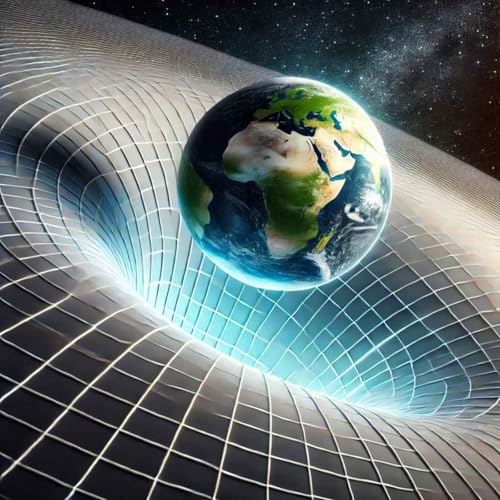
    For most of history, we viewed our world as a flat plane until observation triumphed over intuition. Today, we face a similar crossroads: space appears flat to our instruments, but could it possess a curvature so immense that it is imperceptible from our single vantage point? This episode explores the geometry and global structure of the cosmos, moving from Einstein's vision of a finite universe without boundaries to modern attempts to find "circles in the sky".

    Our most powerful tool in this search is the Cosmic Microwave Background (CMB). By measuring the apparent size of hot and cold spots in this 13.8-billion-year-old light, cosmologists create a "cosmic triangle".

    While the simplest tests for the universe's shape have come up empty, they set a new minimum scale for the cosmos. Any possible curvature or finiteness lies hidden beyond our current cosmic horizon.

    続きを読む 一部表示
    23 分
  • What is Standard Model of Cosmology
    2026/03/29

    In this episode, we pull back the curtain on Lambda CDM, the "guiding star" of modern cosmology. For over two decades, this framework has served as our most reliable map for understanding the universe’s 14-billion-year history, from the first fraction of a second to the accelerating expansion of today.


    Despite its triumphs, Lambda CDM isn't perfect. We still don't know what dark matter is, why dark energy has the value it does, or why local measurements of expansion disagree with early-universe calculations—a mystery known as the Hubble Tension.


    Until a challenger emerges that fits the data better, Lambda CDM remains our most coherent storyline of how we arrived at a universe full of stars, planets, and us.


    続きを読む 一部表示
    34 分
  • Why Neutrinos Are Weirdest Particles in the Universe
    2026/03/22

    In this episode, we dive into the world of neutrinos—particles so elusive they could travel through a light-year of solid lead without being stopped. These "little neutral ones" are the ultimate cosmic messengers, carrying secrets from the Big Bang, the core of the Sun, and violent stellar explosions directly to us.

    We also look beneath our feet at geoneutrinos—ghost particles produced by radioactive decay in Earth’s crust and mantle. By capturing these, scientists are beginning to perform "planetary tomography," mapping the hidden heat and structures of our own world.

    Whether they are revealing the chaotic heart of our galaxy or helping us watch a supernova explode hours before its light reaches us, neutrinos are proving that the most influential things in the universe are often the ones we cannot see.


    続きを読む 一部表示
    31 分
  • Can We Ever Test Quantum Gravity
    2026/03/15

    Our two best descriptions of reality, General Relativity and Quantum Mechanics, are fundamentally incompatible. For nearly a century, this disconnect has been the most serious enigma in physics.


    In this episode, we explore the quest for the "holy grail" of science: Quantum Gravity. While Einstein’s vision of smooth, curved spacetime governs the dance of galaxies, the jittery, probabilistic world of quantum mechanics rules the microscopic realm. When forced together at the heart of a black hole or the moment of the Big Bang, our mathematical equations break down into nonsensical infinities.


    #EinsteinRelativity #WarpedSpacetime #GeneralRelativity #PhysicsExplained #Wormholes #PhysicsPodcast

    続きを読む 一部表示
    24 分
  • Why Black Holes are Surrounded by a Firewall
    2026/03/08

    In this episode, we explore The Burning Horizon. For decades, the classical view of black holes—informed by Albert Einstein—suggested that crossing the event horizon would be a smooth, uneventful journey into darkness. But a modern realization in physics suggests that this boundary might actually be a "firewall" of high-energy particles that would instantly erase anything attempting to enter.

    We delve into the Fuzzball Theory, which replaces the empty pit of a black hole with a tangled ball of strings as large as the horizon itself. We also examine Black Hole Complementarity, the idea that an astronaut could both be scrambled into radiation and drift safely through the horizon depending on who is watching.

    続きを読む 一部表示
    32 分
  • How To Kill A Black Hole
    2026/03/01

    At the heart of our galaxy lies a beast four million times heavier than the Sun—a place where the laws of physics sign a non-disclosure agreement.

    In this episode,we travel 26,000 light-years away to the edge of Sagittarius A. We aren't just here to sightsee; we’re here to ask the ultimate provocation: Can anything kill a black hole? While these titans seem eternal, we explore the theoretical "evil master plans" that could one day topple them.

    From the "spaghettification" of the human body to the "impossible" family trees of intermediate-mass holes, join us as we investigate if anything in this universe is truly permanent.

    We then, continue our journey through the wonders of relativity, exploring the warped fabric of spacetime and the mysteries that still elude our greatest detectors.


    #EinsteinRelativity #WarpedSpacetime #GeneralRelativity #PhysicsExplained #Wormholes #PhysicsPodcast


    続きを読む 一部表示
    26 分
  • Mystery of Early Massive Black Holes
    2026/02/22

    This episode investigates a profound "impossible timeline" in our cosmic history. While the first stars only began to shine roughly 200 million years after the Big Bang, astronomers have discovered massive quasars—engines of unimaginable brightness powered by supermassive black holes—existing just 670 million years after the dawn of time.

    We examine the unique prediction of the heavy seed model—early galaxies where the central black hole is actually more massive than all the stars combined. With the James Webb Space Telescope (JWST) now peering back to the cosmic dawn, we are finally receiving answers to how these impossible giants were forged.

    続きを読む 一部表示
    19 分
  • What Really Happened at The Big Bang
    2026/02/15

    Welcome back to Wonders of Relativity, where we take us on a cinematic odyssey back to the dawn of everything.

    We explore the universe’s first 1 second of existence, a fleeting moment that forever defined the laws of physics and the fabric of reality.

    From the "mind-melting" heat of the Planck Epoch to the explosive stretching of Cosmic Inflation, discover how the universe grew from the size of a bacterium to the scale of the Milky Way in a fraction of a heartbeat.

    #EinsteinRelativity #WarpedSpacetime #GeneralRelativity #PhysicsExplained #Wormholes #PhysicsPodcast

    続きを読む 一部表示
    38 分