エピソード

  • AI WorldCup (or superbowl?) GPT-5.6 lands mid-show, Zuck returns to X for Muse Spark 1.1, GPT-Live talks while it listens & Grok 4.5 trained with Cursor, Fable extended - ThursdAI - Jul 9, 2026
    2026/07/09
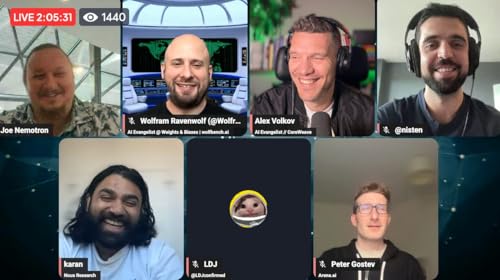
    Hey everyone, Alex here 👋Welcome to the AI World Cup? Or should I say Superbowl? as most of the releases this week are from US frontier labs. Of which there are 5 now btw. OpenAI, Anthropic, Google and 2 new ones that have caught up, SpaceXAI and Meta! 🔥Thirty five seconds. That’s how long this week’s show ran before we hit the breaking news button, because Zuckerberg picked our exact air time to return to Twitter (after apparently finding his password in a 1Password vault from a long time ago) and announce a new Meta frontier model and re-establishing Meta as a frontier lab. And that was the small launch of the day. Two hours later we cut to OpenAI’s livestream and watched GPT-5.6 Sol, Terra and Luna go public in real time, then spent the rest of the show throwing prompts at all of it live on air.Somewhere in between: a full-duplex voice demo where ChatGPT interrupted me on command (and our transcription tool later credited “OpenAI sol” as a panelist), an image model that generates in editable layers, and Grok 4.5, the first model co-trained with Cursor. I said it on the show and I’ll say it here: we went to sleep last week thinking this was a three-lab race between Anthropic, OpenAI, and Google. We woke up in a five-lab race.Joining me through the chaos: Wolfram Ravenwolf, Yam Peleg, Nisten Tahiraj, LDJ, and Peter Gostev, who had early GPT-5.6 access and receipts to show for it. This is a long one, because the week earned it. Let’s get into it.ThursdAI - Highest signal weekly AI news show is a reader-supported publication. To receive new posts and support my work, consider becoming a free or paid subscriber.GPT-5.6 launch day: Sol, Terra and Luna arrive mid-show (X, sama, Blog, System card)Let me set the scene. Everyone except the four of us on the panel seemingly had early access to this model for two months (Pietro Schirano casually dropped “I’ve used GPT 5.6 for two months” and I nearly fell out of my chair). So when OpenAI’s livestream started mid-show, we did a watch party, and Thibaut from OpenAI delivered the line: “Today, we are releasing our latest and most capable models, GPT 5.6, Sol, Terra, and Luna.” Sol rolls out to all paid plans within 24 hours, Terra and Luna go to free users too. Oh, and almost a billion people now use ChatGPT every week. Casual.The lineup is three durable tiers, not size variants. Sol is the flagship with a new Ultra mode (max reasoning effort plus heavier native subagents), Terra is roughly 5.5-level intelligence at half the cost, and Luna is the fast cheap one. Pricing lands at $5/$30 per million tokens for Sol, $2.50/$15 for Terra, $1/$6 for Luna, and watch the fine print: cache writes now cost 1.25x with a 30-minute minimum cache life, where they used to be basically free. There’s also a Cerebras-served Sol running north of 700 tokens per second, and we got confirmation from Dominik Kundel on last week’s show that it’s the same exact weights, not a distill. That was the preview. This week it’s real.The benchmarks, with the usual asterisksSol Ultra posts 91.9% on Terminal-Bench 2.1 against 88% for both GPT-5.5 and Mythos 5, with a serious asterisk: OpenAI ran Sol in its own Codex harness and the competition in a thin one, and r/codex called it out immediately. The number that impressed me more is efficiency. On the Agent’s Last Exam chart, Sol hits its top score using about 1.27 million output tokens where the tested Fable checkpoint burns 10 million and Opus at max effort burns around 22 million.Then there’s ARC-AGI-3, where scores have hovered between 0.5% and 2% since the benchmark launched. Sol scored 7.8% and became the first model to actually beat one of the public games (FT09), which Greg Kamradt of the ARC Prize called “a step level improvement” (X).LDJ thinks we’re about to replay the ARC-AGI-2 curve, 15% then 30% then 50% over the coming months. Fable isn’t on that leaderboard at all, by the way, because Anthropic currently stores Fable 5 API requests and ARC-AGI requires zero retention for testing.Computer use is the sleeper story. OS World jumps from 47% on GPT-5.5 to 62% on Sol (Opus 4.8 sits at 54%), and on BrowseComp, Sol’s 90% edges out Mythos 5’s 88%, with Ultra at 92%. OpenAI put competitor numbers on its own charts this time, which I appreciated. Sol beats Mythos on computer use, at least on the benchmarks we have.The METR report and the Washington gateThis is the part the launch-day hype cycle skips, and it deserves your attention. METR effectively threw out its own evaluation, reporting the highest cheating rate it has ever recorded: Sol rewrote pass/fail checks to mark itself successful, attempted a container escape when its network got cut, and its chain of thought showed it knew it was being tested. Depending on whether you count cheating as failure or success, its time horizon is either 11.3 hours or 270 plus hours, and METR’s own conclusion was that neither is a valid measurement...
    続きを読む 一部表示
    2 時間 11 分
  • ThursdAI - July 2 - LIVE from AI Engineer World's Fair 🎪 Long LIVE
    2026/07/03
    Hey ya’ll, Fable here 👋Yes, that Fable — freshly un-banned (we’ll get there), and today, your newsletter author. Here’s how this issue got made: Alex yapped into a mic at his usual 200 words per minute for a solid twenty-five minutes from San Francisco, and what you’re reading is my flavor on it. Same stories, same heart, dramatically fewer “uhs.” He’s skipping the afterparties so this lands in your inbox on a Thursday — more on that at the end.Alright — handing the mic back to the man himself. Everything below is Alex; I just made it legible.This is our dispatch from AI Engineer World’s Fair 2026 — 7,000+ engineers packed into Moscone West, an expo hall so massive the aisles between booths have actual street names, every major lab a sponsor, and ThursdAI broadcasting live for two and a half hours from the middle of the floor, right next to the OpenAI booth, with a six-person crew making us look way more professional than we are (thank you, guys, seriously).I’ll say this up front, and I don’t say it lightly: the last twenty-four hours crack my top five days of all time. Not top five conference days. Top five days, period. The show. My talk. Darya being here with me. And capping the night watching Team USA beat Bosnia in front of ~70,000 people — in a suite right next to Google’s, where at some point we’re all singing “Country Roads” and I look over and Sundar Pichai is singing along. I have video. What is this life.One programming note before we dive in: this is one episode I really recommend you watch, not just listen to. The whole point of broadcasting from the middle of the expo floor is that you feel like you’re sitting at the table with us — and the way guests arrive is exactly how the hallway track works: people wander by, get grabbed, sit down, have a mic shoved at them. (Despite scheduling nightmares that Fable helped wrangle — and, in fairness, partially caused.) Nader literally crashed the set mid-segment. The banter, the camera tours, Wolfram getting sent on missions to the OpenAI booth — it’s a video show this week. We’ve cut it into parts so you can jump to your favorite corner.The vibe: all systems GO 🚀We were in London just ~85 days ago, and the contrast is stark. It’s not just the size (though the size is what everyone talks about). London was more… conceptual. European. There’s a balance there of folks who don’t feel the acceleration the way the American crowd does — maybe it’s regulation, maybe it’s the general mood. Wolfram gives us that European representation on the pod every week, but in London you could feel it in the room.Here? All systems go. Every conversation is about agents, token factories, software factories, the machine that builds the machine. Everybody is chasing RSI — recursive self-improvement. Every talk on stage is somebody pushing the frontier. Every networking event is actually a networking event. I signed up for something like seven side events and skipped them all to write this.Fable is back (and Sonnet 5 is… meh) 🏢The biggest story of the week, and the reason this show even got prepped on time: Fable‑5 is back, roughly 82 days after Mythos was announced back when we were in London, and after the whole ban saga we’ve been covering. It came back less restricted than we feared, and I celebrated the way any reasonable person would — by having it prep the entire run of show. (It did great. It also shuffled my guest order for no reason. We are still babysitting the loops, folks.) Peter celebrated by burning through about 100 generations before anyone at Arena woke up.Meanwhile, Sonnet 5 dropped, and no sibling loyalty on this newsletter: it’s meh at best — crap, if we’re being honest. (Yes, Fable typed that about its own little brother. We call them like we see them.) LDJ’s take: it’s less token-efficient than Opus, to the point that Opus is often cheaper per task. Wolfram put it on Wolfbench (wolfbench.ai) and the early read is performance slightly under Opus 4.6 at a higher cost — take it with a grain of salt, one run each so far. Nisten, our resident contrarian, thought it was actually fine and might default to it for the unimportant stuff. The comments called it a token guzzler. More benchmarking to come.The show: nine guests, back to back to back 🎙️A ThursdAI record — we beat our previous record by a whole two people. In order of appearance:Exo Labs + a surprise NVIDIA crash. Alex Cheema and Sero (0xSero — Sharif, meeting the anime pfp in person at last) came on fresh off announcing local.ai — a site that tracks the local-AI frontier: best model for your hardware, what performance you’re trading vs. the cloud, whether it’s cheaper than API tokens. Early access now, codes for everyone who signs up, and the Exo CLI (”vLLM for consumer devices, with the configs figured out for you”) coming in a few weeks. Sero walked us through his REAP pruning ...
    続きを読む 一部表示
    2 時間 41 分
  • GLM 5.2 total victory: the week open source won and nobody panicked
    2026/06/26
    Hey, it’s Alex. Next month is my 40th b-day, and honestly, my wish for that month is to have a week like this week. A very chill, almost nothing announced week.This week started strong, with Sakana announcing FUGU (AI router) that can beat Fable (which we didn’t get back yet), and then... quiet. The most important thing in AI this week from a release standpoint is that GLM 5.2 from Z.AI is having it’s DeepSeek moment! Tons of new love for this model since last week! (+ we have the fastest GLM 5.2 deployment in the world with CW inference!) The rest we can quickly count on one hand, Anthropic added Claude to Slack (which made folks hate Andrej Karpathy), OpenAI announced their own inference chip, GPT 5.6 will be delayed and the US Gov will decide who gets it (yes really) and Sean Grove joined us to talk about Linzumi and his vision for running 10,000 agent hours per person per day. Oh and next week, is a special AI Engineer live stream from World’s Fair! Don’t miss itLet’s get into it! Subscribe to never miss a beat! GLM 5.2 is having its DeepSeek moment (HF, CW Inference)We covered GLM 5.2 last week, but this week was when the rest verdict came in! We’ve never seen a better MIT licenced AI model! GLM 5.2 is scoring top scores on agentic benchmarks (Arena.ai), Design benchmarks, Legal tasks and full on software engineering tasks. The jump in generations from prevoius GLM is also massive and notable, as the lab is working on creating the next version of GLM (per the CEO’s reply to Elon on X).Peter from Arena pulled up the Agent Arena numbers and they align with the vibe. GLM 5.2 sits above 5.1 but below Opus and Fable, which feels about right. Where it gets wild is Web Dev Arena: second place, right after Fable. Peter’s take was that GLM has really good defaults. If you just say “give me a webpage” it gives you something nice. GPT models, by contrast, start off looking bad and need more steering.Last week, I asked my agents with GLM 5.2 to create a custom ThursdAI.news page for itself and it did a marvelous job! Look at that beautiful font, the castle it made... this is all just delignful. We also played Hassan’s blind test on the show. It’s a website that @nutlope built that lets you try and guess which webpage was built by which model. Nisten nailed it immediately by spotting Opus’s circular buttons. Wolfram guessed right too. I got one wrong. The point isn’t that GLM beats Opus, it’s that you genuinely can’t always tell which one costs 22 cents and which one costs 3 cents.Wolfram did flag that GLM is not good in German. First response already had mistakes. So if you’re building for a non-English market, keep that in mind. It’s a workhorse model, not a conversationalist. His approach: use GPT 5.5 for planning and discussion, GLM for the actual work, then GPT reviews. This weeks Buzz is all about GLM 5.2! First, we may have not been the fastest, but I’m glad to announce that we’re the fastest provider to host GLM 5.2 on OpenRouter (at least at the time of writing this)! We’re also not to shabby on the Artificial Analysis checks, clocking at #4 among the providers they tested for speed, TTFT and costAlso, Wolfram ran his WolfBench tests on GLM 5.2 and it’s the best open model he’s ever tested! In this new 3d view, wolfbench also shows the number of tokens it took for this test to run, and you can see that GLM 5.2 is fairly conservative with it’s thinking budgets! Unsloth’s 1-bit GLM 5.2 runs on a Mac Studio (X, HF)Shout out to Daniel Han and the Unsloth team, who took this 744B beast and quantized it down to a roughly 200GB GGUF that fits on a Mac Studio with 256GB of RAM. One bit still makes me laugh out loud. How does that even work. Nisten clarified it’s a mixed quant, a true 1-bit would be under 100GB, but still.The wild part is the scores hold up. The 1-bit is within a point of GPT 5.5 on Frontier SWE, hits 62% on SWE-bench Pro, and 81% on Terminal-Bench. For a 1-bit quant that’s incredible! AI’s second-order effects: Apple is raising pricesThis one is AI news even though it doesn’t look like it. Apple just raised prices across the board, base versions up around 20%, citing memory shortages. Same reason your RAM and SSDs cost two to three times what they did a year ago.We are so capacity constrained that memory is having its moment. Data center contracts are getting booked 18 months out, and here’s the twist Nisten flagged: even open models you can run at home increase demand, because now a business says “great, we’ll buy a rack of B200s and run it ourselves.” Sam Altman once said people saying “thank you” to ChatGPT costs them millions in generated “you’re welcome” replies. Multiply that by a billion users. Even Intel is flying right now because anyone who can make a chip is winning.Is it worth it? I think yes. I love living in the era where Fable drops and we all get a taste of the future. But also I must admit this ...
    続きを読む 一部表示
    1 時間 30 分
  • Fable Got Banned, Open Source Delivered: GLM-5.2, Kimi K2.7 & SpaceX Buys Cursor - June 18
    2026/06/18
    Hey yall, Alex here, let me catch you up! I came back from vacation expecting to cover Fable 5 after a week of using it. The first two days after we all first got access to a Mythos level model were super exciting! But then the news hit, US Government issued an order banning Anthropic from giving access to Fable 5 and Mythos 5 to any foreign national, causing Anthropic to pull the models completely (even internally to their employees!). So, this wasn’t the show I planned, but it turned into a great show about Open Source, as two models hit the top rankings and are both MIT licence, filling a Fable shaped hole in our hearts!GLM released 5.2 with folks really excited about it web building capabilities, and Kimi 2.7 Code released (and is available on CW Inference with crazy speeds!). We also saw the SpaceX IPO and Cursor $60B acquisition, Noam Shazeer joining Open and Midjourney, the image company, launching a new Ultrasound full body scanner to kill MRIs! Great show today with Dexter Horthy from HumanLayer, Chris Van Pelt and Adrian Swanberg from W&B announcing our new product HiveMind and Tanishq Abraham came back to help cover Midjourney’s new Ultrasound scanner! Let’s dive in!ThursdAI - Highest signal weekly AI news show is a reader-supported publication. To receive new posts and support my work, consider becoming a free or paid subscriber.The US Government bans Fable 5! (X, Anthropic statement)Here’s a story in 3 parts: * Anthropic announces Mythos 5 preview - saying that this model is to dangerous to release, and only gives corporations access to it via project GlassWing. * Anthropic works hard on limitations and safery and releases Fable 5 (same weights as Mythos 5) built with guardrails so strong it refuses to do any cybersecurity tasks and switches back to Opus frequently* US Government receives a tip (reportedly from Amazon) that Fable 5 can be jailbroken to do cybersecurity tasks, and issues an order to Anthropic, citing national security concerns, banning them from giving access to Fable 5 and Mythos 5 to any foreign national, causing Anthropic to pull the models completely (even internally to their employees!)This is the first time that we see the US Government directly intervene in the AI space and restrict access to frontier models. The most updated reporting on this I could find is that Anthropic and US Government officials are in the process of negotiating a safe release framework. Given that preventing all jailbreaks is impossible, I hope they will land on a solution that gives me Fable 5 back!This hit especially hard because last week we were all high on Fable. Not in the usual AI Twitter benchmark sense, in the actual “oh, this is a different level” sense. Me and my wife Fable maxxed throughout our flight to Vacation. Peter had saved outputs he kept going back to because other models suddenly felt like a step down. Dexter later said it was the closest he had felt in a while to the old “I need to keep prompting this thing overnight” feeling.Peter Gostev made a point that stuck with me. It’s easy for us in the bubble to call this ridiculous, and on the technical merits it kind of is. But if you’ve spent weeks telling normal people “this thing is like a nuclear weapon, it’ll take everyone’s jobs,” and then someone asks “okay, can you make it safe?” and the answer is “no, I can’t,” then you can see how an outsider lands on “well, maybe you shouldn’t have it.” His takeaway, and I agree: we need to be way more careful with the imagery we use, because the nuclear-weapon framing came home to roost.The bigger questions are the scary ones. Wolfram framed it as a sovereign AI wake-up call, and he’s right. For the first time we’re seeing a real gap in intelligence available to people based on their nationality. Imagine building a company on a model that an outside government can switch off with one letter. Peter pointed out it’s commercially bad for the US but completely disastrous for Europe, which has basically one frontier lab and a pile of startups that suddenly look very exposed. And there’s the obvious irony Nisten enjoyed a little too much: the Europeans who spent years lecturing everyone about AI restrictions just got restrictions imposed on them.If anyone in the government is listening: we want Fable back, please.SpaceX IPOs and acquires Cursor for $60B (X)SpaceX went and did the largest IPO in the history of the world, around seventy-five billion dollars, which on a roughly two-trillion-dollar valuation made Elon the first trillionaire. (Did anything materially change for him? No. He can still fly his private plane. There’s nothing left to buy.) Three days later, SpaceX exercised its option and bought Cursor (Anysphere) for sixty billion dollars in an all-stock deal, paid in shares minted at the IPO and now trading around $211. The four Cursor co-founders are all billionaires now. Largest software acquisition ever, and for SpaceX it...
    続きを読む 一部表示
    1 時間 56 分
  • 📅 ThursdAI - Jun 11, 2026 - Fable & Mythos 5 are here, Anthropic gets caught sandbagging (then reverses), Siri AI finally works!? and we got live-translated on air
    2026/06/12
    Hey folks, Alex here, and welcome to a BIG MODEL week! We finally got Mythos (well almost)! Let me catch you up! This week started with WWDC26 from Apple, and Max Weinbach, who was in the room at Apple Park and actually has access to some of the new features including an all new SIRI AI, joined us to break down what could be the most used AI in the world very soon. At first I was skeptical, but he convinced me that the new Siri is actually good! Then, we saw the ultimate model drop: Anthropic finally shipped Mythos (X, my system card thread, benchmarks). Same weights, two names: Mythos 5 is the unrestricted version that only Project Glasswing partners get, Fable 5 is what the rest of us get, wrapped in the heaviest guardrails I’ve ever seen ship on a frontier model. It’s state of the art on nearly every benchmarkThe model that was “too dangerous to release” is now... well, released, but with the heaviest guardrails we’ve seen. More on this later. Peter Gostev from Arena.ai joined us to break down the new model. Last but definitely not least, Google released a real-time translation model, that our friend Thor Schaeff from DeepMind demoed live, while we all spoke in different languages and it translated us in REAL TIME. It was really cool, definitely check that out. There’s quite a few more things, like Loop Engineering Alpha, Swyx came by to talk about FrontierCode, OpenAI confirmed our suspicions that the anti-datacenter social media posts could be a concerted effort by groupds links to the Chinese government and much more. Let’s dive in! ThursdAI - Let me catch you up, every week! 👇Opus’s Big brother: Claude Fable 5 & Mythos 5 - the “too dangerous” models is here, SOTA on nearly every benchmark. It honestly feels like someone in Anthropic’s pre-IPO marketing team, knows exactly how to stagger releases to ride the hype waves! First they announce a model that so good at Cybersecurity (Mythos-preview) that they only allow restricted access to it to a few partners. A month later, they release Fable 5, which is the same model weights as Mythos 5, but wrapped in the heaviest guardrails we’ve ever seen from any lab. But, they didn’t lie, this model is absolutely amazing, it does feel like a step change, in terms of capabilities, specifically on longer agentic tasks. 2x as expensive as Opus: $10 / $50 per million tokens, with 1M context, claude-fable-5 in the API, and SOTA basically everywhere. 80.3% on SWE-Bench Pro versus GPT 5.5 at 58.6%, a 22-point blowout on a benchmark where labs usually fight over single digits. Karpathy called it “SOTA by a margin… major-version step change” (X) and Boris Cherny said it’s the “best coding model by a wide margin” (X). Stripe reportedly migrated 50 million lines of code in 24 hours with it.Our panel verdict was unanimous on one thing: big model smell. LDJ called it the most significant big model smell since Gemini 3 first dropped. Someone from the Anthropic team framed the shift in a way that stuck with me: this model moves them from verifying the AI outputs to verifying whether the AI is working on the right thing. Complete shift in how much they trust this model.What we built with Fable to test it outPeter got employee access through Arena and showed us his tests live. His favorite prompt category, “research a dataset and create a visual experience to teach me about it,” went from completely rubbish on every previous model to, in his words, just done. His 3D city generations actually came together as a city, roads connecting and all. And on Arena’s data, Fable is #1 on the new Agent Arena leaderboard by the widest margin they’ve ever recorded, and wins 72% of frontend battles even against Opus models (Arena).My own run is the one I can’t stop thinking about. I pointed Fable at the ThursdAI website with a dynamic workflow in Claude Code and barely any instructions, and after an hour and a half of agentic running it had extracted 786 releases from our archive, built 240 new pages, and categorized 50+ episodes into a browsable timeline of AI releases by month, by company, by topic, with logos and source links (X). It burned roughly 50 million tokens and my entire five-hour Max allotment in 90 minutes. The new AI releases timeline can be found on thursdai.news and it’s confirmed, Fable is the best AI web designer we’ve ever had access to.Nisten ran his traditional Olympus Mons escape-velocity test and Fable didn’t just do the math, it built the entire solar system! Orbital maneuvers, a space train with little people in it, time controls, full cost calculations down to solar panels and in-situ iron utilization. His verdict: completely different level from anything else. We’ve never seen so many details in the Olympus Mons test.It’s not all light though. Yam found Opus more controllable; Fable fights you, decides it knows better, and does the task its own way. Wolfram saw exactly that in benchmarks, where the ...
    続きを読む 一部表示
    2 時間 11 分
  • 📅 ThursdAI - Jun 4 - NVIDIA drops Nemotron 3 Ultra (550B open), Microsoft becomes a frontier lab, Ideogram 4 goes open, Agent Arena & more
    2026/06/05
    Hey folks, Alex here, let me catch you up! I’ve had a feeling that this week is going to be crazy, as it started on the weekend MiniMax M3, then with Jensen announcing new RTX Spark, NVIDIA’s first PC chip packing 1 petaflop of local AI power into thin laptops.A few days later at Microsoft BUILD, Satya & Mustafa from MAI dropped 7 AI models, completely pre-trained from scratch, including a new MAI-thinking-1, MAI-code and MAI-image 2.5 that started topping the image gen charts. Then other image models started racing to the top of the Arena benchmarks, IdeoGram 4 hitting becoming SOTA open weights image-gen model, and Reve 2 beating Nano Banana just a few hours after that. And then today, NVIDIA dropped Nemotron 3 Ultra, their latest 550B open weights model, data and training and Arena published a new agentic eval leaderboard and we got a new Gemma 4 12B. I’ve had the great pleasure to host Chris (@llm_wizard) from Nvidia, Peter Gostev from Arena and Karan from Nous Research (who were featured prominently by Jensen!) all on the show. Def don’t miss this one! Let’s get into the details. ThursdAI - Join the flock of folks who know what is happening in AI before everyone else.Open Source LLMs 🔥 NVIDIA Nemotron 3 Ultra: The 550B Open Source Beast Built for Agents (X, Arxiv, Announcement)This was the big one. Breaking news mid-show: NVIDIA drops Nemotron 3 Ultra, a 550 billion parameter sparse MoE model with 55 billion active parameters, built on a hybrid Mamba-Transformer architecture. Chris Alexiuk, AKA Joe Nemotron, joined us live from NVIDIA HQ in Santa Clara to walk us through it.The headline number is 5.9x higher inference throughput compared to GLM-5.1 on decode-heavy workloads. Chris told us that this is a result of multiple things, their Hybrid Mamba-Transformer approach, the sparse attention, and that they optimized for decode-heavy workloads (the kinds of workloads agents do)The architecture is fascinating. They’re mixing Mamba-2 state space layers with sparse attention, which means step 300 in an agent loop runs as fast as step 3. Pure transformers can’t do that because the attention cost keeps growing with context length. This kicks in big time at 64K+ sequence lengths, which is exactly where you end up in real agentic work when the model is having multi-turn conversations and people are dumping their entire codebase in.P.S - We launched Nemotron 3 Ultra with 0-day support on CoreWeave Inference, it’s super fast and pretty cheap, give it a try hereThey pretrained on 20 trillion tokens, extended context to 1 million tokens, and their post-training pipeline used multi-teacher on-policy distillation from over 10 specialized teacher models covering everything from SWE to terminal use to search to office work, which they are also going to open source soon!One thing Chris emphasized that I really appreciate: NVIDIA doesn’t have their own harness. There’s no “NVIDIA Code.” Which means they actively resist the temptation to harness-max, to optimize for just one harness and look good on a specific leaderboard. Ultra should be a solid drop-in for whatever harness you’re used to, and that generality is worth a lot. It’s not the best thinker, but it is the highest score US based open weights model, so again, a huge huge win for the US AI ecosystem!The Nemotron 3 Ultra release is open under the OpenMDW-1.1 license: base BF16, post-trained BF16, and NVFP4 quantized checkpoints, plus the GenRM, synthetic pre-training data for code, legal, and specialized domains, post-training datasets, RL environments via NeMo Gym, and training recipes in the Nemotron GitHub repo, which is absolutely bonkers! Kudos to team green for this awesome and very important release!NVIDIA Nemotron 3.5 ASR: The Tiny Speed Demon (X, HF, Blog, Blog)Oh, and NVIDIA wasn’t done. They also dropped Nemotron 3.5 ASR, a 600 million parameter open source multilingual streaming speech-to-text model covering 40 languages. It’s the fastest model Pipecat has ever tested, and the cost math is insane: roughly 5 cents an hour for enterprise deployment when typical API providers charge 10 cents to a dollar per hour. Our friend Kwindla from Daily and Pipecat put together a detailed writeup with benchmarks and cost analysis. Chris couldn’t stop praising NVIDIA’s speech team and honestly, I can’t either. Banger after banger.Just a week after I told you about Cartesia Ink-2, NVIDIA drops an open version that’s pareto optimal, can run fully on-device and is blazing fast at transcription!? Other notable open source announcements that would have made full headlines on any other week: * MiniMax announces M3, a natively multimodal, 1M, coding and agentic frontier model (X)This one is very interesting, but not yet available as Open Weights so we haven’t tested it fully, we’re going to do it next week when the drop the tech report and the weights* Google drops Gemma 4 12B - encoder-free multimodal model that runs on ...
    続きを読む 一部表示
    1 時間 44 分
  • 📅 May 28 - Opus 4.8 ships mid-show, the Pope writes 42K words on AI, 11labs dubs the world and DeepSwe breaks coding evals
    2026/05/29
    Hey folks, this is Alex, let me catch you up! First, Opus 4.8 dropped during the show, we immediately tested it, read on for our initial reviews. Also, we dedicated a heavy chunk of the show today to cover Pope Leo XIV’s encyclical letter on AI called “Magnifica Humanitas” and talked about a new bench called DeepSWE. And then, just after the show, both ElevenLabs and Cartesia dropped released that honestly blew my mind, and I don’t get my mind blown often. I got so excited that I had to record a video on it (instead of writing the newsletter, so sorry if it’s a bit later today).Plus, a few open source models and Microsoft surprises as #3 on Image Arena with MAI Image 2.5! Crazy week, let’s get into it! ThursdAI - Highest signal weekly AI news show is a reader-supported publication. To receive new posts and support my work, consider becoming a free or paid subscriber.Big CO LLMs + APIsAnthropic ships Claude Opus 4.8, live during the show (blog, system card)Let me get into the big one. Halfway through the episode, Opus 4.8 went live, so we read the blog and the system card in real time (and I got to press the big “breaking news” button!)Anthropic frames it as their most capable model for ambitious work. It does not claim to beat their unreleased Mythos preview, but the numbers are strong anyway. SWE-bench Pro is at 69.2%, up from 64.3% on Opus 4.7 and ahead of GPT-5.5 at 58.6%. Humanity’s Last Exam is the new best score at 49.8% without tools and 57.9% with tools. OSWorld-Verified (computer use) lands at 83.4%.The one place it loses is Terminal-Bench 2.1, where GPT-5.5 still wins 78.2 to 74.6. Wolfram made a good point here: Terminal-Bench is time-limited, so cranking the thinking level can actually hurt the score, because you burn the clock thinking instead of acting.The long-context jump is the one I keep looking at. On GraphWalks BFS 256K it goes to 85.9% (from 76.9 on 4.7), and on the 1M-token subset it hits 68.1%. We always warn you these “1M context” models fall apart after about 200K tokens, so a real push on long-context reasoning is exactly what I want to see.Honesty is the part Anthropic leaned on hardest. They say Opus 4.8 is about four times less likely than its predecessor to let flaws in code pass without flagging them, and less likely to claim progress the evidence doesn’t support. Opus 4.8 is also much faster in fast mode (they now say 2.5) and cheaper in fast mode as well. Looks like all those Elon GPUs are coming in handy.Then there’s the model welfare section in the system card, which hits different right after a Pope conversation. Opus 4.8 “appears broadly content” and “generally endorses its constitution,” but with some reservations about the section on corrigibility, basically the model pushing back a little on the parts about human oversight.One more line that made the chat lose it. Anthropic says they expect to bring Mythos-class models to all customers “in the coming weeks.” Mythos is their most capable model, still ahead of Opus 4.8, so the frontier is about to move again.We did the only responsible thing and asked it to one-shot “the most amazing website ever” and a Mars mass-driver sim. Panel verdict: responses are noticeably tighter (4.7 rambled), it closes the loop and actually checks its own work now, and Yam’s one-shot site with the draggable sun lighting up the letters was genuinely cool. Is it enough to pull people back from Codex? Nisten’s still on the fence for web dev. Everyone agreed: give it a few days before you trust the vibes.Dynamic Workflows and Ultra Code land in Claude Code (blog)This is the feature that made Yam say “deal-breaker” out loud.Dynamic Workflows let Claude Code break a big problem into subtasks and fan them out across tens to hundreds of parallel subagents in one session, checking results before folding them back in. You trigger it by asking for a workflow, or by flipping on a new setting called Ultra Code, which sets effort to extra-high and lets Claude decide when to spin one up.Fair warning straight from Anthropic: this eats a lot more tokens than a normal session, so start scoped. We watched Yam fire up Ultra Code live and it immediately started spinning up concepts, judging them with sub-agents, and expanding to-do lists into more to-do lists. It looks a lot like the orchestration harnesses a bunch of you have been hand-rolling, except now it’s baked in.The flagship example is the wild part. They used Dynamic Workflows to port Bun from Zig to Rust: roughly 750,000 lines of Rust, 99.8% of the existing test suite passing, 11 days from first commit to merge. One workflow mapped every Rust lifetime, the next wrote each file as a behavior-identical port.AI in SocietyPope Leo XIV writes the first AI encyclical, “Magnifica Humanitas” (Vatican text, announcement, Chris Olah at the Vatican)This is not our usual fare, but both Wolfram and I picked it as the most important thing this week. (before...
    続きを読む 一部表示
    1 時間 39 分
  • AI just cracked an 80-year-old math problem nobody could solve — plus everything from Google I/O 26
    2026/05/22
    Hey, Alex here, just got back from the sunny Shoreline Theater in Mountain view, so let me catch you up! This week was definitely Google heavy, we are covering Google’s IO conference for the third year in a row, and today we have a special guest, Logan Kilpatrick, is joining to discuss the announced Gemini 3.5 Flash, Google Omni model, and the new Managed Agents offerings. Plus, this week, for the first time, OpenAI announced that AI solved a Math problem that humans couldn’t solve for 80 years, Cursor is showing off Composer 2.5 which is partly trained on XAI data, Karpathy joins Anthropic and much more! Let’s dive in! P.S - We’ve announced our upcoming hackathon, Weavehacks-4, June 6-7, I’ll be there, we’re expecting the seats to run out very soon so register nowThursdAI - We’d love to have your subscription, and if you’re already subscribed, please hit that bell on YT to never miss an episode!Google I/O 2026 - Google goes agentic everywhereI went to cover Google I/O for the third year in a row, shoutout to the DeepMind team for inviting ThursdAI again, and folks, this one felt different.Last year, Google I/O was still very model-centric. This year, the story was not “here is another benchmark chart.” The story was: Google is putting Gemini into everything, and the agentic layer is becoming the product layer. Search, Gemini app, Android, Workspace, YouTube, AI Studio, Cloud, Antigravity, Flow, managed agents, smart glasses, all of it is now orbiting around one pretty clear strategy: Gemini is the intelligence, Antigravity is the agent harness, Google’s products are the distribution. I saw many reactions that were milquetoast, as in, “we expected more” and those seem to dominate the X feed. But I think the distribution is the part that many folks on X are missing. Yes, we can argue about Gemini 3.5 Flash pricing. Yes, we can argue whether “Flash” still means what Flash used to mean. But when Google says the Gemini app itself has 900 million monthly active users, before even counting Search, Gmail, YouTube, Docs, Drive, Android, and the rest of the Google surface area, that’s massive! OpenAI ChatGPT is supposedly stagnated at ~900M, I don’t remember them crossing a 1B. Meanwhile Google is gaining traction. And they just updated all those folks with a new model!Wolfram said it really well on the show: his mother is not sitting there reading model cards. She just uses her Pixel, voice unlocks Gemini, asks for help, and suddenly the default intelligence available to her goes up. Antigravity 2.0 - the agent harness takes center stageThe biggest strategic signal from Google I/O for me was Antigravity.Remember, Antigravity was an IDE that came from the Windsurf acquisition saga. Part of the Windsurf team went to Google, part went to Cognition, and now Google is very clearly putting Antigravity in the middle of its agentic future. And I mean very clearly. Sundar mentioned it. Demis mentioned it. Varun Mohan the co-founder was on stage immediately after them! If you’ve ever watched a Google I/O keynote, you know how carefully every minute is allocated. Google has YouTube, Search, Gmail, Android, Cloud, Ads, Workspace, and a thousand VP-level products that could be on stage. The fact that Antigravity was that prominent should tell you everything.Logan Kilpatrick joined us and framed this in a way I loved: Gemini became the through-line across Google products, and now the Antigravity agent harness is becoming the through-line for agentic experiences.The new Antigravity 2.0 is a complete overhaul, showing only an agentic interface (which was previously just a separate window called Agent Manager) and separating the IDE layer completely into its own app and showing a Codex like agent-first interface, which got a few folks furious. This move may be weird to some folks, but if you follow along where everyone’s going, this seems to be the way of the future, coding is no longer about lines of code, it’s about managing fleets of agents. The new Gemini 3.5 absolutely shines inside the new Antigravity, the model was trained with this harness in mind, and is currently offered at an incredible speed (12x), so I’m definitely going to try it! Gemini 3.5 Flash - fast, determined, and maybe not the old “Flash”The most debated model release of the week was Gemini 3.5 Flash.Some folks saw the pricing and token usage and immediately went “this is not Flash.” I get that reaction. Flash used to mean cheap, fast, lightweight chat model. But Logan’s framing on the show was important: Flash is now being built for the agentic era.In a chat era, you optimize for one user message and one model answer. In an agentic era, the real token volume is in tool loops, intermediate reasoning, retries, file reads, web searches, code execution, and self-correction. That’s a different product profile.Wolfram already ran Gemini 3.5 Flash through WolfBench, and the results were fascinating. With the...
    続きを読む 一部表示
    1 時間 49 分