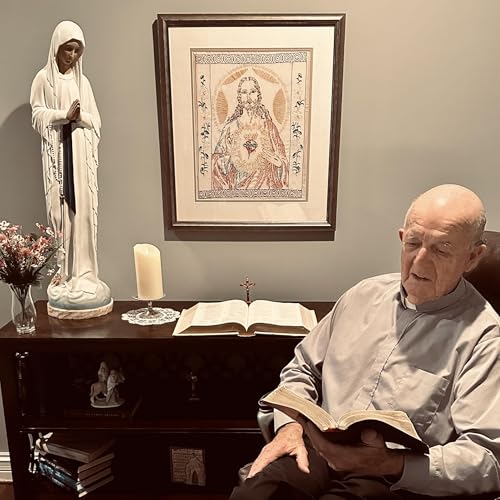
『Treasures of Our Faith with Deacon Richard Vehige』のカバーアート

Treasures of Our Faith with Deacon Richard Vehige

Treasures of Our Faith with Deacon Richard Vehige

著者: Deacon Richard Vehige
無料で聴く

今ならプレミアムプランが3カ月 月額99円

2026年5月12日まで。4か月目以降は月額1,500円で自動更新します。

概要

Daily readings from one of the Fathers of the Church, Saints or Catholic official documents.2023 キリスト教 スピリチュアリティ 聖職・福音主義
エピソード
  • The firstborn of the new creation
    2026/05/04

    You will notice changes have been made to the introduction of my daily recording. The format is more concise and intended to help you better understand the meaning of the material being presented. I pray you find these upgrades helpful.

    On Monday of the Fifth Week of Easter our Church invites us to first read and reflect on a passage from the book of Revelation (129:11-21) entitled "The victory of the Word of God". Our treasure, which follows, is from a sermon by Saint Gregory of Nyssa, bishop.

    Saint Gregory of Nyssa was a fourth century archbishop of Constantinople and a theologian. He is numbered among the Doctors of the Church. He was a contemporary and close friend of Saint Basil the Great. He is widely considered the most accomplished rhetorical stylist of the patristic age. He was a classically trained orator and philosopher.

    The primary contribution of Saint Gregory of Nyssa to the teachings of the Catholic Church is his profound development of the spiritual and mystical understanding of the Christian life, especially the idea that the soul is called to an endless growth in God. He taught that union with God is not a static state but a continual journey deeper into divine life—a concept often described as eternal progress (epektasis), grounded in the infinite nature of God.

    Today's treasure from Saint Gregory's sermon "The Firstborn of the New Creation", teaches that Christ, through His resurrection, inaugurates a completely new humanity and restores what was lost through sin. By calling Christ the "firstborn," Gregory teaches that Jesus is not only preeminent, but the beginning of a renewed creation in which human nature is healed, transformed, and brought to its intended glory.

    The sermon emphasizes that the Resurrection of Jesus is not just an isolated event, but the source and promise of our own new life. Christ's victory over death opens the way for all humanity to share in this renewal, becoming a "new creation" in Him. In essence, Gregory's message is that what Christ has begun in Himself, He intends to accomplish in us—restoring our nature and drawing us into eternal life.

    The teaching from today's first reading, "The victory of the Word of God" (Revelation 19:11–21), is that Christ decisively conquers all evil through His divine authority, establishing the final triumph of truth and justice.

    In this vision, Jesus Christ appears as a victorious rider on a white horse, called "Faithful and True" and "the Word of God." He represents not a worldly conqueror, but a divine judge whose power comes from truth and righteousness. The imagery of the sword proceeding from His mouth shows that His victory is accomplished by His word—His authority, judgment, and truth—not by human force.

    The opposing forces, symbolized by the beast and the kings of the earth, gather to resist Him, but they are swiftly and completely defeated. Evil is exposed as powerless before Christ's sovereignty, and its apparent strength collapses in the face of divine judgment.

    The passage emphasizes that Christ's victory is final and universal: all opposition to God will be overcome. For believers, this is both a warning and a source of hope—evil will not prevail, and those who remain faithful to Christ share in His triumph.

    続きを読む 一部表示
    6 分
  • Christ is the day
    2026/05/03

    You will notice changes have been made to the introduction of my daily recording. The format is more concise and intended to help you better understand the meaning of the material being presented. I pray you find these upgrades helpful.

    On the Fifth Sunday of Easter our Church invites us to first read and reflect on a passage from the book of Revelation (18:21---19:10) entitled "The wedding feast of the Lamb". Our treasure, which follows is from a sermon by Saint Maximus of Turin, bishop.

    Saint Maximus was a fifth century bishop of Turin, a city in northwest Italy famous for the shroud of Turin being kept in the cathedral there. Saint Maximus was a theological writer "who made a great contribution to the spread and consolidation of Christianity in northern Italy". Saint Maximus may best be described as a zealous and effective pastor of souls.

    Saint Maximus is best known for his powerful and practical sermons that helped ordinary Christians understand and live out the faith in daily life during the 4th–5th centuries. His main contribution to the Catholic Church is his clear teaching on how Scripture applies to moral living, especially themes like repentance, charity, and readiness for Christ's return. He emphasized that faith must be shown through concrete actions, not just words, making him an important early voice in pastoral preaching and Christian moral instruction in the Western Church.

    He is the author of numerous discourses delivered to the people by the saint, consisting of 118 homilies, 116 sermons, and 6 treaties. Several hundred of these writings are still in existence. He died in 465.

    The main takeaway from today's treasure from the sermon by Saint Maximus is that Jesus Christ is the true "day" who brings light, truth, and salvation into a world darkened by sin. Just as the physical day drives away night, Christ dispels spiritual darkness and calls believers to live in the light through faith, holiness, and good works. The sermon urges we Catholics to stay awake spiritually, reject sin, and live in a way that reflects the light of Christ each day, not just in belief but in action.

    The primary teaching from the first reading for today concerning "the wedding feast of the Lamb" (Revelation 18:21–19:10) is that God's final judgment on evil leads directly to the joy and fulfillment of union between Christ and His faithful people.

    The passage first shows the complete downfall of "Babylon," symbolizing corrupt worldly power opposed to God. Its destruction is final and irreversible, signifying that systems built on pride, injustice, and idolatry cannot endure. This is followed by a great contrast in heaven: rejoicing, praise, and worship erupt as God's justice is revealed and His salvation is complete.

    Then the focus shifts to the joyful celebration of the "wedding feast of the Lamb," where Jesus Christ is united with His purified people, often understood as the Church. The "bride" represents those who have remained faithful, clothed in righteous deeds given by God's grace. This imagery expresses the deep communion between Christ and His redeemed people—fulfilled love, covenant fidelity, and eternal communion.

    In essence, the teaching is that God's judgment over evil is not the end in itself, but the necessary path to the fullness of salvation: the eternal, joyful union of Christ with those who have remained faithful to Him.

    続きを読む 一部表示
    6 分
  • On the Incarnation of the Word
    2026/05/02

    Today, May 2, as our Church celebrates the memorial of Athanasius , Bishop and Doctor, we are invited to read and reflect on a passage from the book of Wisdom (7: 7-16, 22-30), entitled "The joy of the just united to God". Our treasure, which follows, is from a discourse by Saint Athanasius, bishop.

    Saint Athanasius was born at Alexandria in 295. He served as Patriarch of Alexandria for a period of his life, leading the church in Egypt and playing a significant role in shaping the early church. He accompanied Alexander to the Council of Nicaea and succeeded him as Bishop of Alexandria. His primary contribution to the teachings of the Catholic Church is his unwavering defense of the full divinity of Christ, especially during the Arian controversy. He taught clearly that the Son is not a created being but is fully God, of the same substance (consubstantial) as the Father—a truth definitively affirmed at the Council of Nicaea. His persistence, even during exile and opposition, was crucial in preserving the Church's orthodox faith in the Holy Trinity.

    His writings, particularly "The Life of St. Antony," a biography of the desert father that influenced the growth of monasticism in both the East and the West, are believed to have played a significant role in the conversion of St. Augustine. Saint Athanasius is a Doctor of the Church. In essence, Athanasius is remembered as the great champion of Christ's true divinity and a fearless guardian of the core truths of the Christian faith. He died in 373.

    The main message of today's treasure from a discourse "On the Incarnation of the Word" by Saint Athanasius of Alexandria is that God the Son became truly human in Jesus Christ in order to save humanity from sin and death. Because human beings could not restore themselves to friendship with God, the Word of God took on our flesh, healed it from within, and through His death and Resurrection destroyed the power of death. Athanasius emphasizes that the Incarnation is not just a teaching but the very foundation of salvation: God became man so that humans might be restored to life, renewed in grace, and brought back into communion with God.

    Today's first reading from a passage from the Book of Wisdom (7:7–16, 22–30) explains that true wisdom is a gift from God that is more valuable than anything in the world. It shows that a righteous person does not seek riches, power, or fleeting pleasures, but instead treasures wisdom because it comes from God and leads to friendship with Him. This wisdom is described as pure, holy, and all-powerful, guiding people to live rightly and reflect God's goodness. Ultimately, the passage teaches that the deepest joy of the human heart is found not in created things, but in being united with God through His wisdom.

    続きを読む 一部表示
    7 分
まだレビューはありません