エピソード

  • What G.K. Chesterton Knew About Technology That Took Science 15 Years to Prove
    2026/06/02
    G.K. Chesterton once observed that after learning to do a great many clever things, the next great task would be learning not to do them. That line, from an early essay on Queen Victoria, has taken on new force as American schools reverse decades of tech-first policies—test scores and students' mental health alike in decline. In this episode, Joe and Grettelyn trace the screen crisis back to first principles, exploring how Chesterton's warnings against educational fads, his conviction that machines make us like machines, and his insistence that a thing worth doing is worth doing badly all speak directly to what Jonathan Haidt's data is now confirming. In This Episode: The G.K. Chesterton quote from Varied Types that frames the whole conversation—and why his intuition about educational tinkering was more than a hunchHow the Chesterton Schools Network's longstanding tech-light philosophy has been vindicated by over 15 years of data, a UNESCO report, and the Fortune magazine story that started this episodeWhat Chesterton's insight about machines making us like machines explains about the neuroscience of distraction—and why phone-free classrooms alone aren't enoughWhy G.K. Chesterton's principle that a thing worth doing is worth doing badly is the most important counter-argument to AI in education and the arts Practical steps for parents: building social pacts with other families, the case for delaying smartphones, and the Chesterton Schools Network as a proven alternative Chapters: 00:00: Welcome and Introduction 01:15: The Chesterton Schools Network's Tech-Light Philosophy 03:38: G.K. Chesterton on Learning Not to Do Clever Things 05:42: Jonathan Haidt and the Books Behind the Movement 09:06: UNESCO's Findings on Technology and Learning 13:35: How Devices Short-Circuit Attention and Memory 19:47: Embodied Learning—Handwriting, Doodling, and What Screens Miss 28:21: Schools Reversing Course: The Fortune Magazine Story 35:11: A Thing Worth Doing Badly: Chesterton vs. AI 44:13: Practical Steps for Parents and a Path Forward Resources Mentioned: Varied Types — G.K. Chesterton The Anxious Generation — Jonathan Haidt The Coddling of the American Mind — Greg Lukianoff and Jonathan Haidt Anxious Generation Action Resources Chesterton Schools Network FOLLOW US: Instagram Facebook X SUPPORT: Donate Shop Produced by Saint Kolbe Studios
    続きを読む 一部表示
    53 分
  • The Edwardian Socrates: G.K. Chesterton as Philosopher
    2026/05/26
    Landon Loftin, editor of Chesterton and the Philosophers and a speaker at this summer's Chesterton Conference, joins Joe Grabowski to discuss the first book to put G.K. Chesterton in direct conversation with figures of the Western philosophical tradition. Together they trace how G.K. Chesterton's literary and journalistic genius concealed a rigorous philosophical mind that professional academia has been slow to recognize—and why that neglect says more about the academy than about Chesterton. In This Episode: How a peer-reviewed journal's rejection of an essay on G.K. Chesterton and Hume sparked the idea for an entire edited volumeWhy G.K. Chesterton's best philosophical arguments are embedded in fiction and journalism rather than technical prose, and why that's a compliment to him, not a liabilityThe essay on Chesterton and Aristotle, and how G.K. Chesterton understood virtue as a furious clash of opposites rather than a mild Aristotelian meanG.K. Chesterton's distinctive philosophical method: taking thinkers like Hume and William James more seriously than they took themselves, thereby dismantling their own argumentsA preview of Loftin's Chesterton Conference talk on G.K. Chesterton as "the Edwardian Socrates," and what that comparison reveals about philosophy as a vocation versus a profession Chapters: 00:00: Introduction 00:26: Welcome and introducing Landon Loftin 01:25: Loftin's background: teaching, Owen Barfield, and G.K. Chesterton 03:03: Chesterton and the Philosophers: overview and contributors 04:43: Origin of the book: the rejected Hume essay 08:13: Book structure and Joe's essay on Chesterton and Kierkegaard 14:20: Chesterton and Aristotle: virtue as furious clash of opposites 18:30: G.K. Chesterton's philosophical method: out-Huming Hume 24:46: G.K. Chesterton as defender of philosophy 30:35: G.K. Chesterton's model of disagreement: furious friendship 33:52: Conference preview: "The Edwardian Socrates" Resources Mentioned: Chesterton and the Philosophers, ed. Landon Loftin (Wipf & Stock) 2026 Chesterton Conference — "The Outline of Sanity," June 25–27, Ave Maria, FL FOLLOW US Instagram Facebook X SUPPORT Donate Shop Produced by Saint Kolbe Studios
    続きを読む 一部表示
    37 分
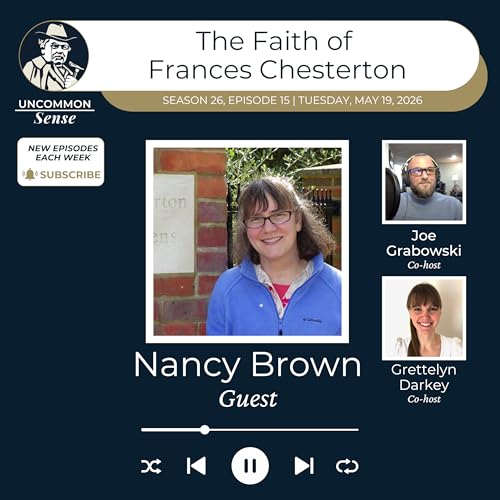
  • How Frances Chesterton Found Her Way to Rome
    2026/05/19
    One hundred years ago, Frances Chesterton quietly entered the Catholic Church on All Saints Day—the feast she chose for herself. In this episode, Grettelyn and Joe sit down with Nancy Carpentier Brown, author of The Woman Who Was Chesterton, to explore Frances's spiritual journey ahead of Nancy's talk at the 2026 Chesterton Conference. In This Episode: How Frances Blogg became a devout Anglican through the Clewer Sisters at St. Stephen's College—and why that formation made her path to Rome harder, not easierThe branch theory, and why Frances's emotional attachment to Anglicanism was every bit as powerful as G.K.'s intellectual arguments for Catholicism Gilbert's extraordinary patience: four years of waiting, never pressuring Frances—and how the Chestertons' story mirrors that of Scott and Kimberly HahnThe pivotal moments behind G.K.'s 1922 conversion: his near-death illness, Frances's anguished letter to Father O'Connor, and the death of his father Frances's reception into the Church on All Saints Day, 1926—quiet, discreet, in High Wycombe with Father Walker—and the New York Times headline that followed a week later Chapters: 00:00: Introduction & Welcome 01:00: Why 2026? The Year of Frances and St. Francis 03:24: G.K.'s Spiritual Formation Before They Met 06:29: Frances's Faith Journey and the Clewer Sisters 09:08: What Held Frances Back: Branch Theory and the Heart 13:22: G.K.'s Illness and Frances's Letter to Father O'Connor 16:27: G.K.'s Father, Cecil, and the Decision to Convert 20:09: Mutual Spiritual Freedom: Neither Held the Other Back 24:42: All Saints Day, 1926: Frances Enters the Church 30:00: Conference Preview and Closing Thoughts Resources Mentioned: The Woman Who Was Chesterton by Nancy Carpentier Brown 2026 Chesterton Conference Orthodoxy by G.K. Chesterton Rome Sweet Home by Scott and Kimberly Hahn FOLLOW US: Instagram Facebook X SUPPORT: Donate Shop Produced by Saint Kolbe Studios
    続きを読む 一部表示
    33 分
  • What Hangs Straight on a Crooked Wall: Chesterton's Marian Poetry
    2026/05/12
    In honor of May, Our Lady's Month, Joe and Gretalyn each bring a favorite Marian poem by G.K. Chesterton to share with the other—without any advance coordination. Gretalyn reads "Images," a meditation on six titles from the Litany of Loreto drawn from Chesterton's 1926 collection Queen of the Seven Swords, while Joe shares "Crooked," a lesser-known 1933 poem from GK's Weekly that captures a more introspective, mature side of his Marian devotion. Together they explore what these poems reveal about Chesterton's lifelong love for Our Lady, the apologetics of Marian devotion, and the paradox at the heart of his faith: that the world only looks right when you learn to see it through her. In This Episode: How Chesterton's "Images" weaves six titles from the Litany of Loreto—Mirror of Justice, Tower of David, House of Gold, Tower of Ivory, Ark of the Covenant, and Seat of Wisdom—into richly layered verseWhy 1926, the year Frances Chesterton entered the Church, gives "Images" a deeper biographical resonanceWhat it means when Marian devotion troubles someone, and why Joe and Gretalyn suggest that reaction is worth examining carefully Chesterton's Marian apologetics in Lepanto—and the single line that cuts to the heart of the controversyWhat "Crooked" reveals about a quieter, more subdued Chesterton in 1933, writing in the shadow of a world beginning to come apart Chapters: 00:00: Introduction & May as Our Lady's Month 02:36: Gretalyn Reads "Images" 07:06: Unpacking the Litany of Loreto 11:03: Chesterton's Lifelong Marian Devotion 14:38: Mary as a Touchpoint for Converts 21:16: Mary in Scripture: Luke and the Magnificat 23:59: Lepanto and the Defense of Mary 27:51: Joe Reads "Crooked" 28:17: Discussion of "Crooked" 33:16: Chesterton's Mature Mariology Resources Mentioned: I Also Had My Hour: An Alternative Autobiography of G.K. Chesterton by Dale Ahlquist Gilbert Magazine FOLLOW US Instagram Facebook X SUPPORT Consider making a donation Visit our Shop Produced by Saint Kolbe Studios
    続きを読む 一部表示
    38 分
  • Celebrating Chesterton's Vision of Sanity at the 2026 Conference
    2026/05/05
    Gretelyn Darkey and Joe Grabowski invite listeners to join them this June at the 2026 Chesterton Society Conference in Ave Maria, Florida. This year's conference celebrates three remarkable centenaries: the publication of The Outline of Sanity, The Queen of Seven Swords, and Frances Chesterton's conversion to the Catholic Church. With speakers including Dale Ahlquist and Nancy Brown, the conference promises talks on distributism, sanity in an insane world, and Frances's journey to Rome. In This Episode: The 2026 conference returns to a university campus setting with dorm-style lodging at Ave Maria, recapturing the old-school Chesterton conference atmosphereThree major centenaries: The Outline of Sanity (1926), The Queen of Seven Swords (1926), and Frances Chesterton's conversion to Catholicism (1926)Dale Ahlquist will explore what Chesterton meant by sanity and how the modern world alters humans to fit conditions rather than shaping the world to fit the human soulNancy Brown will speak on Frances Chesterton's four-year journey to Rome after Gilbert's conversion, offering hope for those navigating similar family situationsAve Maria's Catholic town center, built around a striking church, embodies Chestertonian localism and provides the perfect setting for this year's theme Chapters: 00:00: Welcome and Conference Announcement00:24: Ave Maria, Florida—Location and Registration01:09: Return to University Campus Format03:27: First Theme: The Outline of Sanity 100th Anniversary06:40: Speakers on Distributism and Localism16:09: Second Theme: The Queen of Seven Swords19:59: Third Theme: Frances Chesterton's Conversion25:19: Nancy Brown on Frances's Journey to Rome28:05: Afterglow and Conference Experience34:20: Closing Invitation Resources Mentioned: Conference RegistrationThe Woman Who Was Chesterton by Nancy Carpentier BrownGilbert Magazine FOLLOW US InstagramFacebookX SUPPORT Consider making a donationVisit our Shop Produced by Saint Kolbe Studios
    続きを読む 一部表示
    35 分
  • The Man Who Carried a Swordstick and a Pen: Holly Gyger Lee on Writing Chesterton for Young Readers
    2026/04/28
    GK Chesterton was many things—journalist, philosopher, poet, and debater—but what does his life look like through the eyes of a young reader? In this episode, Joe sits down with Holly Gyger Lee, author of the new young reader's biography The Man Who Carried a Swordstick and a Pen, to explore what drew her to Chesterton, what surprised her in the research, and why a boy who didn't fit the classroom mold became one of the most prolific writers in the English language. From Charlotte Mason's "living books" philosophy to Chesterton's theology of play, this conversation is a delight for readers of all ages. In This Episode: How Holly discovered GK Chesterton through C.S. Lewis—and why The Man Who Was Thursday wasn't the right entry pointThe Charlotte Mason "living books" philosophy that inspired Holly to write a biography for young readersWhat surprised Holly most in her research: Chesterton the unconventional student, and the headmaster's famous remark—"He is six feet of genius"The swordstick, the cloak, and how Frances shaped the image of a man who was a walking anachronism—out of time, and for all timesChesterton's theology of play and leisure, from the Toy Theater essay to his belief that the heavy work is the play Chapters: 00:00: Welcome and Introduction00:54: Holly's Background, Homeschooling, and Life in North Carolina04:01: Discovering Chesterton Through C.S. Lewis09:11: Charlotte Mason, Living Books, and the Inspiration Behind the Biography13:39: The Swordstick, the Cloak, and Chesterton's Persona16:18: Chesterton on Leisure, Play, and the Toy Theater19:14: Taking Children Seriously—Chesterton, Tolkien, Lewis, and MacDonald24:32: Research Surprises: The Unconventional Student28:43: The Junior Debating Club, Frances, and a Life of Hospitality33:37: Holly's Current Projects and Where to Find Her Resources Mentioned: Get the BookHolly's WebsiteHolly's YouTubeGilbert MagazineAmerican Chesterton Society Shop FOLLOW US: InstagramFacebookX SUPPORT: Consider making a donationVisit our Shop Produced by Saint Kolbe Studios
    続きを読む 一部表示
    37 分
  • What Bilbo and Boethius (and Chesterton) Teach Us About Adventure
    2026/04/21
    What does it mean to be inconvenienced? Chesterton has a paradoxical answer. Joe Grabowski and Grettelyn Darkey unpack one of Chesterton's most beloved aphorisms — "An adventure is only an inconvenience rightly considered; an inconvenience is only an adventure wrongly considered" — tracing it from its original context in a real 1906 London flood, through the essay "On Running After One's Hat," and all the way to Boethius, St. Lawrence, and the Christian vocation to embrace the cross. In This Episode: The original context of the quote in Chesterton's essay "On Running After One's Hat" from All Things Considered, prompted by the great London flood of June 1906What running after a windblown hat has to do with Innocent Smith in Manalive—and why the sport of hat-hunting haunted Chesterton's imagination for yearsThe difference between a sunny attitude and a genuinely Chestertonian embrace of inconvenience, and why it matters on a spiritual levelBoethius, St. Lawrence, and St. Peter hanging upside down—what the saints reveal about the adventure of embracing the crossThe thread running through all of Chesterton: how a single paradox in a flood-inspired newspaper column illuminates his entire worldview Chapters: 00:00: Introduction01:52: Parsing the Quote04:50: Bilbo Baggins and Engaging with Life07:49: The 1906 London Flood20:23: Running After One's Hat23:05: Innocent Smith in Manalive28:41: The Thread of Chesterton's Philosophy35:00: Daily Inconveniences37:06: The Spiritual Dimension Resources Mentioned: All Things Considered by G.K. Chesterton (includes "On Running After One's Hat")Manalive by G.K. ChestertonThe Consolation of Philosophy by Boethius FOLLOW US InstagramFacebookX SUPPORT Consider making a donationVisit our Shop Produced by Saint Kolbe Studios
    続きを読む 一部表示
    44 分
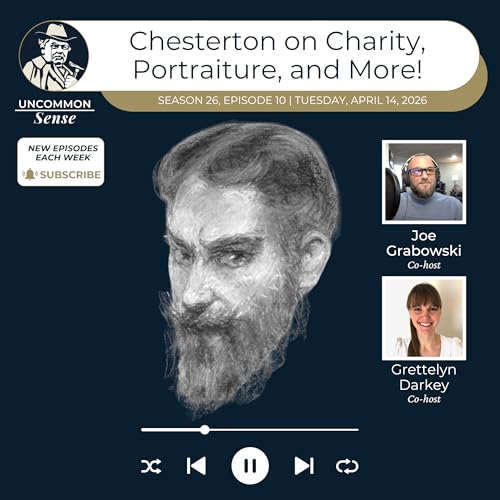
  • Chesterton on Almsgiving, Art, and American Idiom
    2026/04/14
    In this episode, Grettelyn Darkey and Joe Grabowski walk through three newly unearthed Chesterton essays from the latest issue of Gilbert Magazine—exploring almsgiving, portraiture, and a delightful transatlantic linguistic puzzle—and invite you to discover why the magazine is one of the best-kept secrets in Chesterton studies. In This Episode: Why Chesterton's "promiscuous charity" upends our instinct to vet the needy before giving—and what that reveals about the giver's own soulThe overlooked personal dimension of almsgiving versus institutional philanthropy, and how Chesterton draws on virtue ethics to expose the differenceA debate as old as the daguerreotype: does a photograph capture truth, or does a painted portrait go deeper—and what does Chesterton mean when he says truth is a "moral state"?Chesterton's fondness for paradox applied to art, literature, and the limits of realismHow a single American phrase, "rare steak," sent Chesterton on a linguistic rabbit trail through Irish immigration and transatlantic idiom in 1934 Chapters: 00:00: Introduction00:24: Welcome & the Gilbert Read-Along Format02:12: The Significance of Almsgiving04:07: "On Giving Money to Beggars"—Chesterton's Humor and Opening10:03: Prudence, Charity, and Getting the Monkey Off Your Back14:40: Personal Giving vs. Institutional Philanthropy20:49: Transitioning to "Portraits"22:00: Photography vs. Portrait Painting in 190126:29: Truth in Art and Chesterton's Paradox36:28: "A Query for Philologists"—Why Americans Call It "Rare" Resources Mentioned: Gilbert Magazine What I Saw in America by G.K. Chesterton FOLLOW US Instagram: https://www.instagram.com/chestertonsocietyFacebook: https://www.facebook.com/AmericanChestertonSocietyX: https://twitter.com/chestertonsoc SUPPORT Consider making a donation: https://www.chesterton.org/give/Visit our Shop: https://www.chesterton.org/shop/ Produced by Saint Kolbe Studios
    続きを読む 一部表示
    47 分