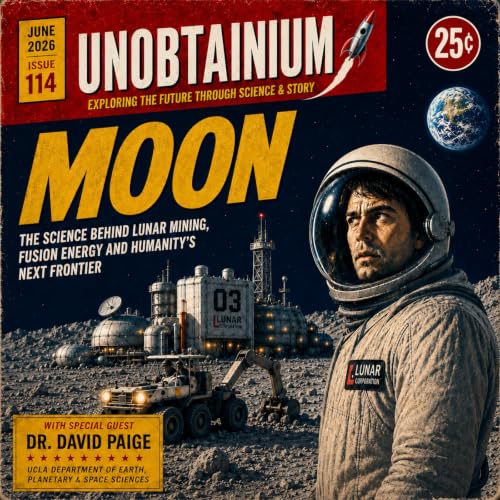
『Unobtainium Podcast』のカバーアート

Unobtainium Podcast

Unobtainium Podcast

著者: Adam Sigel & Dr. Amy Mainzer
無料で聴く

The Unobtainium Podcast is hosted by Adam Sigel, a Hollywood writer-producer, and Dr. Amy Mainzer, an astrophysicist. Together, they explore the science in science fiction. Each episode unpacks the Unobtainium behind movies—what’s real, what’s cinematic, and why filmmakers bend reality. This is for the nerds, sci-fi fans, film junkies, and anyone curious about the science behind the story.

Hosted on Acast. See acast.com/privacy for more information.

2026 Cognito Entertainment. All rights reserved.
SF アート 科学
エピソード
  • Mining on the Moon? Explore the possibilities of Fusion Using Helium-3, a New AI Computer in Space, and the Ethics of Reaching Humanity's Next Frontier with Lunar Expert Dave Page
    2026/07/14
    Is the 2009 movie Moon pure fiction, or is lunar mining the future of clean energy? Could automated harvesters actually strip-mine the lunar surface regolith (moon soil)? Could we really harvest enough helium-3 to power nuclear fusion reactors on Earth? Is it possible to build a permanent moon base via NASA's Artemis missions? In this episode of the Unobtainium podcast, hosts astrophysicist and UCLA Professor Dr. Amy Mainzer and writer/producer Adam Sigel dive into a fascinating Moon movie breakdown. Directed by Duncan Jones (David Bowie’s son) on a modest $5 million budget, the outstanding 2009 Moon is widely celebrated as one of the best hard science fiction movies in the last 20 years. To separate cinematic fiction from orbital reality, the hosts are joined by a leading lunar and Mars expert: Dr. Dave Page from UCLA’s Department of Earth, Planetary, and Space Sciences. The Reality of Lunar Mining and Helium-3 FusionThe central conceit of Moon revolves around a massive industrial operation by Lunar Industries to harvest helium-3 from the Moon’s surface to power clean nuclear fusion back on Earth. Dr. Page suggests that mining the Moon at an industrial scale introduces massive economic and physical hurdles. Unlike nuclear fission (which splits heavy atoms), nuclear fusion jams light atoms together to release an immense amount of energy. While the movie positions helium-3 as an easily fusible miracle isotope that offers an "aneutronic" reaction (meaning it doesn't emit destructive neutrons), Dr. Page points out a major real-world catch: a helium-3 reaction actually requires temperatures five times higher than standard hydrogen isotopes—billions of degrees Celsius—making it incredibly difficult to harness. Scraping the Lunar Regolith: A Scarred Moon?Helium-3 is an ultra-rare primordial isotope created just 20 seconds after the Big Bang. While it is virtually non-existent on Earth, it has accumulated for billions of years in the lunar regolith (lunar soil) via the solar wind. Because the Moon lacks plate tectonics and a traditional atmosphere, its ancient surface acts as perfect "flypaper" for cosmic particles. However, harvesting it requires an astonishingly inefficient scale. To extract just one single gram of helium-3, automated lunar harvesters would need to excavate and heat 100 tons of lunar soil to a glowing 600°C. Dr. Page calculates that providing enough helium-3 to power 75% of Earth would require strip-mining a patch of the moon the size of a small U.S. state annually—an operation that would permanently change the face of the moon visible from Earth within a few centuries. Redefining the Sci-Fi Tropes: Space Isolation and AIBeyond the planetary geology, the Unobtainium team explores the intense human drama of the film's lone worker, Sam Bell, who is on a grueling three-year contract. The hosts note that real-world space agencies, such as NASA, use strict "buddy systems" for long-duration spaceflight to safeguard mental health. They also highlight how the film brilliantly subverts the classic "malevolent AI" trope popularized by HAL 9000 in 2001: A Space Odyssey. Instead of acting as a cold, corporate antagonist, the ship's AI, Gertie, eventually demonstrates genuine compassion. It shifts the film from a standard space thriller into a profound existential commentary on corporate greed, scientific ethics, and what it truly means to be human. Follow Unobtainium Podcast! Website: unobtainiumpodcast.comWatch full episodes on https://www.youtube.com/@unobtainiumpod Stay connected: Instagram: @unobtainiumpod TikTok: @unobtainiumpod Bluesky: @unobtainiumpod.bsky.social X: @unobtainiumpod For Dave Paigehttps://www.space.ucla.edu/david-paigehttps://www.diviner.ucla.edu/daphttps://www.planetary.org/profiles/david-paige#NuclearFusion #SpaceExploration #duncanjonesmoon #helium3fusion #PlanetaryScience #unobtainiumpodcast #MovieBreakdown #ArtemisMission #SciFiMovies #MoonMovie #lunarmining Hosted on Acast. See acast.com/privacy for more information.
    続きを読む 一部表示
    42 分
  • Why is a parasitic alien so terrifying? From Facehuggers to Xenomorphs, we dissect Space Travel, Exoplanets, and the Enduring Nightmares Implanted Within This Sci-Fi Masterpiece .
    2026/07/07
    What makes the deep-space horror classic film Alien (1979) one of the scariest science fiction movies ever made? Amy and Adam explore science, psychology, and the enduring power of Ridley Scott’s masterpiece. In space, no one can hear you scream—but there’s plenty to talk about. Full SummaryIn this episode of the Unobtainium podcast, astrophysicist and planetary scientist Dr. Amy Mainzer (UCLA) and Hollywood writer-producer Adam Sigel break down Ridley Scott’s 1979 cinematic masterpiece, Alien in search of an answer to why this movie is one of the most terrifying sci-fi horror movies of all time. The hosts shift the lens to explore how the film grounds its cosmic dread in real-world evolutionary biology, planetary science, and a dash of quantum physics. The Hollywood Tropes of Space Travel: Cryosleep and Faster-Than-Light TravelThe discussion kicks off with some quick math and a hint that the Nostromo navigates near the real star system Zeta Reticuli, located 37 light-years from Earth. In the film, the crew will travel this distance in just ten months, meaning they are moving at roughly 44 times the speed of light. Dr. Mainzer notes that while true faster-than-light travel is impossible under current scientific paradigms, the film cleverly suggests a quantum physics loophole involving theoretical particles called tachyons. The hosts also debate the practical limits of cryogenic sleep (hypersleep), noting that its inclusion adds a gritty, unglamorous layer of authenticity to space exploration. The Search for Exoplanets and Extraterrestrial LifeAs a planetary scientist, Amy bridges the gap between Hollywood fiction and modern astronomy. She reveals that over the last two decades, space telescopes like the Kepler mission have proven that nearly every star in the night sky hosts its own solar system. However, most known exoplanets discovered so far are hostile gas giants (like Jupiter or Saturn) or "super-Earths" lacking evidence of liquid water or breathable oxygen atmospheres. This reality highlights the terrifying mystery of Alien: what kind of extreme environment would it take to naturally evolve a perfect apex predator? The Xenomorph Life Cycle: Real-World ParasitismOne of the most fascinating aspects of this Alien movie analysis is the biological inspiration behind the creature. Amy and Adam point out that the horrifying xenomorph life cycle—where a parasitic organism implants an egg into a living host, which is ultimately destroyed during birth—is deeply rooted in terrestrial nature. The hosts draw direct evolutionary parallels to the tarantula hawk wasp, a real insect that paralyzes its prey, lays an egg inside it, and allows its larva to consume the host from the inside out. The Real Monster: Corporate Greed and AI CorruptionBeyond the creature's acid blood and phallic, H.R. Giger-designed aesthetic, Unobtainium unpacks the film’s deeper subtexts. Unlike the optimistic, utopian futures of Star Trek or Star Wars, Alien presents a cynical, dystopian vision of space travel driven entirely by commercial interest and resource extraction. The hosts argue that the true antagonist isn't the creature itself, but rather the faceless Weyland-Yutani corporation. This corporate entity is perfectly represented by the corrupted science officer Ash (a synthetic android) and the ship’s artificial intelligence, "Mother"—both of whom view human life as completely disposable in the pursuit of a bioweapon.By blending cinematic history with cutting-edge astrobiology, this episode reveals why Alien remains a towering achievement in science fiction horror.Follow Unobtainium Podcast! Website: unobtainiumpodcast.comWatch full episodes on https://www.youtube.com/@unobtainiumpod Stay connected: Instagram: @unobtainiumpod TikTok: @unobtainiumpod Bluesky: @unobtainiumpod.bsky.social X: @unobtainiumpod #Alien #alien1979 #RidleyScott #SciFi #xenomorph #unobtainiumpodcast#physics #space #science fiction podcast #extraterrestrial #MovieBreakdown #AlienBreakdown Hosted on Acast. See acast.com/privacy for more information.
    続きを読む 一部表示
    36 分
  • Is Godzilla Fission or Fusion? From Radiation Mutation to Blue Atomic Breath, Nuclear Physicist Stephanie Diem Unpacks This Superb Homage Monster Movie.
    2026/06/30
    Episode Description Is Godzilla Minus One just a wonderful homage to the classic monster movies or is it the ultimate warning about nuclear energy? 🦖⚛️ In this episode of Unobtainium, Adam and Amy break down the real science, historical context, and emotional power of Godzilla Minus One. Joining the conversation is Professor Stephanie Diem, a nuclear physicist and engineer, and Professor of Engineering Physics at the University of Wisconsin–Madison, to separate nuclear facts from the King of the Monsters science fiction. Along the way, they discuss the difference between fission and fusion, the realities of radiation, and the challenges of communicating complex science to the public. But the episode also digs into the film's deeper themes: postwar trauma, guilt, sacrifice, resilience, and humanity's complicated relationship with powerful technologies. The result is a fascinating look at how a giant radioactive lizard (or maybe a wayward dinosaur?) became cinema's most enduring metaphor for the atomic age. And why Godzilla Minus One resonated with audiences around the world. From the history of postwar Japan to the cutting-edge future of clean energy, they’re unpacking it all! Full SymmaryWhat makes Godzilla such an enduring pop culture icon? Godzilla Minus One took the world by storm, returning the King of Monsters to his terrifying roots as a symbol of nuclear destruction while delivering a deeply human story about trauma, survivor's guilt, and rebuilding after World War II. In this episode of Unobtainium, Adam and Amy dive into the Godzilla science, history, and emotional power of the film with Professor Stephanie Diem, a nuclear engineer and professor of Engineering Physics at the University of Wisconsin–Madison. They break down the realities of nuclear engineering, including the fundamental differences between nuclear fission vs. fusion, how real-world nuclear reactors work, and whether Godzilla's devastating atomic breath is scientifically closer to a fission reactor or fusion reactions (hint: the blue color tells a lot).The conversation goes deep into the real science behind Godzilla's radioactive origins, including the differences between ionizing and non-ionizing radiation, how nuclear reactors work, and why fusion energy remains one of humanity's greatest technological challenges. Along the way, Stephanie explains the workings of a reactor, from control rods to Cherenkov radiation, and fusion experiments. And how the world has moved beyond the fear of nuclear weapons to look at how nuclear technology is used for clean energy solutions, medical treatments, and space exploration. And they also touch on the challenges of modern science communication. But the episode goes far beyond monster science. Amy, Adam, and Stephanie examine the historical context that gave birth to Godzilla in postwar Japan, the legacy of Hiroshima and Nagasaki, the promise and peril of nuclear technology, and the role of science diplomacy in addressing global challenges. They also discuss why Godzilla Minus One resonates so powerfully with audiences today: beneath the spectacle of a giant radioactive monster lies a moving story about family, sacrifice, resilience, and the value of human life. Topics include: Godzilla Minus One, radiation, nuclear weapons, fission, fusion, reactor design, atomic breath, Cherenkov radiation, clean energy, science communication, postwar Japan, nuclear ethics, science diplomacy, and why one giant monster continues to embody humanity's hopes and fears about technology. Follow Unobtainium Podcast! Website: unobtainiumpodcast.comWatch full episodes on https://www.youtube.com/@unobtainiumpod Stay connected: Instagram: @unobtainiumpod TikTok: @unobtainiumpod Bluesky: @unobtainiumpod.bsky.social X: @unobtainiumpod For Stephanie Diem https://engineering.wisc.edu/directory/profile/stephanie-diem/https://www.linkedin.com/in/steffi-diem/#godzillaminusone #godzilla #moviescience #stephaniediem #scifi #unobtainiumpodcast #physics Hosted on Acast. See acast.com/privacy for more information.
    続きを読む 一部表示
    41 分
adbl_web_anon_alc_button_suppression_t1
まだレビューはありません