

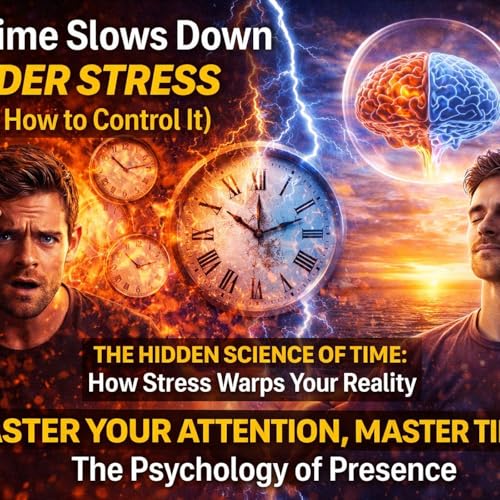
Why Time Slows Down Under Stress And How to Control It
カートのアイテムが多すぎます
カートに追加できませんでした。
ウィッシュリストに追加できませんでした。
ほしい物リストの削除に失敗しました。
ポッドキャストのフォローに失敗しました
ポッドキャストのフォロー解除に失敗しました

Why Time Slows Down Under Stress And How to Control It
-
ナレーター:
-
著者:
概要
Ep 142. Under stress, the perception of time can shift dramatically. In moments of excitement or positive stress, time can feel fast, fluid, and fleeting. But in moments of fear, uncertainty, or shock, time can appear to slow down—or even feel like it stops entirely. This is not imagination. It is the nervous system adjusting perception in real time to help us survive and respond.
The human brain is built for efficiency and prediction. Through pattern recognition, it constantly anticipates what will happen next in order to conserve energy and respond quickly to potential threats. This predictive nature allows us to move through life efficiently—but it also creates a hidden cost.
We begin to live outside of the present moment.
Our attention shifts toward the past—what has already happened—or toward the future—what we expect might happen. In doing so, we unintentionally sacrifice the richness and clarity of what is happening right now. The present moment becomes compressed, overlooked, or filtered through expectation and fear.
Attention itself requires energy. And when that attention is constantly directed toward anticipated stress, danger, or uncertainty, it creates cognitive fatigue, emotional strain, and unnecessary tension in the nervous system.
This is why self-regulation skills are essential.
When we learn to regulate our physiological response to stress—through breath control, awareness, and intentional focus—we begin to reclaim our attention. We become more accurate in reading our environment. We respond earlier, more efficiently, and with less emotional cost.
Instead of reacting to imagined threats, we begin to respond to reality.
This shift allows us to move through life with greater clarity, reduced distress, and improved performance. It enhances our ability to stay present, conserve energy, and create higher-quality experiences in real time.
And something important happens:
When we improve the quality of our present moment, we naturally begin to build a more stable, more grounded, and more fulfilling future.
Mastering time is not about controlling the clock—it is about mastering attention, perception, and response.
Train your awareness. Regulate your state. Experience time fully.
Walk well.
Hey folks, let me know what you think about the Running Man Podcast. Let me know where you're from and how you are doing in your little part of the world!
Support the show
intro outro music for episodes 1 through 111 done by Jonathan Dominguez Rogue musician. He can be found on youtube at Lazyman2303.
New musical intro and outro music created by Ed Fernandez guitarist extraordinaire. To get in contact with Ed please send me an email at runningmangetskillsproject@gmail.com and I will forward him the contact.
Donations are not expected but most certainly appreciated. Any funds will go toward further development of the podcast for equipment as we we grow the podcast. Many thanks in advance.
https://www.buzzsprout.com/2216464/support