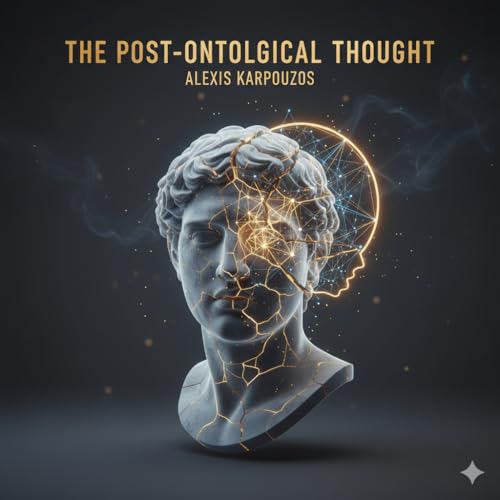
『alexis karpouzos's podcast』のカバーアート

alexis karpouzos's podcast

alexis karpouzos's podcast

著者: alexis karpouzos
無料で聴く

今ならプレミアムプランが3カ月 月額99円

2026年5月12日まで。4か月目以降は月額1,500円で自動更新します。

概要

Alexis karpouzos (Born, April 09, 1967 in Athens) is an Greek-born Philosopher, Spiritual Teacher and Author. Alexis karpouzos passionate engagement with tensions at the heart of creativity give strength to his call for an individual and collective evolutionary leap forward. Alexis karpouzos is the teacher of the essence of spiritual conscious evolution and its social contribution. The poetic thought of Alexis karpouzos is a expressions of soul's inner experiences, expression of universality. The inspiring visual images and the symbolic use of language offer a description of elevating experiences of consciousness, a glimpse of higher worlds. The philosophy of alexis karpouzos speak to the human experience from a universal perspective, trancending all religions, cultural and national boundaries. Using vivid images and a direct language that speaks to the heart, his philosophy evokes a sense of deep communication with the collective unconscious, a sense of connection to all the creatures of the world, compassion for others, admiration for the beauty of nature, reverence for all life, and an abiding faith in the invisible touch of world. Alexis karpouzos thoughts are often terse and paradoxical, challenging us to to break out of the box of limiting beliefs and see things from a new perspective. Above all, alexis karpouzos continually calls to us to wake up and exlpore the mysteries within our own selves, i.e the mysteries of universe.alexis karpouzos スピリチュアリティ 社会科学
エピソード
  • THE SILENCE AND THE MYSTERY OF COSMOS - ALEXIS KARPOUZOS
    2026/04/14
    THE SILENCE AND THE MYSTERY OF COSMOS — Alexis Karpouzos The history of human thought is, in many ways, the history of an attempt to speak the cosmos—to name it, to measure it, to translate its vastness into concepts, laws, and systems. From myth to metaphysics, from theology to modern science, the universe has been approached as something that can be rendered intelligible. Yet in the thought of Alexis Karpouzos, the cosmos withdraws from this ambition. It does not refuse knowledge, but it exceeds it. Its most profound dimension is not what can be said, but what remains irreducibly silent. This silence is not emptiness in the sense of lack. It is not a deficiency waiting to be filled by explanation. Rather, it is a generative openness—a pre-conceptual field from which all forms, meanings, and distinctions emerge. Before there is language, before there are categories such as being and non-being, order and chaos, subject and object, there is a silent unfolding. The cosmos, in this view, is not constructed upon a foundation, but arises from an unfounded depth that cannot be stabilized into a final principle. To encounter the cosmos, then, is not simply to observe it as an external object, but to participate in its unfolding. The human subject is not outside the cosmos, looking in; it is one of its transient configurations. Consciousness itself is an event within the cosmic process, a local articulation of a much broader movement. And yet, consciousness introduces a rupture: it names, distinguishes, and separates. It transforms the silent continuity of the cosmos into a world of objects and oppositions. This act of differentiation is necessary, but it comes at a cost. The more the world is articulated, the more the underlying silence recedes from awareness. We come to believe that reality consists only of what can be defined and measured, forgetting that every definition presupposes an indeterminate background that makes it possible. The mystery of the cosmos is not located in what we do not yet know, but in what cannot, in principle, be fully known. In this sense, silence is not the opposite of knowledge, but its condition. Every statement emerges from a horizon that it cannot exhaust. Every concept stabilizes a movement that continues beyond it. The cosmos is not a closed system governed by fixed laws alone, but a dynamic field in which order and disorder, structure and transformation, continuously interweave. What we call "laws" are temporary regularities—patterns that arise within a deeper, non-totalizable process. This perspective also transforms the way we understand time. The cosmos does not unfold in a simple linear progression from past to future. Rather, it expresses a more complex temporality—what might be called a "timeless time," in which emergence and dissolution coexist. In such a temporality, nothing is absolutely fixed, yet nothing is simply lost. Every form is both appearing and disappearing, sustained by an invisible rhythm that does not belong to chronological time. The silence of the cosmos is thus inseparable from its mystery. But this mystery is not something to be solved. It is not a problem awaiting a final answer, but a dimension of reality that invites a different mode of relation. Instead of seeking to dominate or fully comprehend the cosmos, thought is called to attune itself to its unfolding. This requires a shift from control to participation, from certainty to openness. In the thought of Alexis Karpouzos, this shift has profound implications. It challenges the metaphysical desire for ultimate foundations and the epistemological demand for complete transparency. It also calls into question the human tendency to position itself at the center of the universe. If the cosmos is fundamentally silent and unfounded, then no perspective—including the human one—can claim absolute authority. Yet this is not a nihilistic conclusion. On the contrary, it opens a space for a more intimate relation to existence. When the need to fix meaning dissolves, a different kind of understanding becomes possible—one that does not reduce the world to what can be grasped, but remains receptive to what exceeds it. The mystery of the cosmos is not an obstacle, but a condition of its richness. To think the cosmos in this way is to accept that not everything can be said, and that what cannot be said is not less real. Silence becomes not a limit, but a depth. It is the space in which thought begins, the horizon it can never fully reach, and the groundless ground from which all worlds arise. In this silent mystery, the cosmos is not a problem to be solved, but an event to be lived.
    続きを読む 一部表示
    5 分
  • THE ONTOLOGY OF TIME - ALEXIS KARPOUZOS
    2026/04/12
    *]:pointer-events-auto scroll-mt-[calc(var(--header-height)+min(200px,max(70px,20svh)))]" dir="auto" data-turn-id= "request-694d082d-6a58-832a-905a-dbd4ec5ef901-3" data-testid= "conversation-turn-136" data-scroll-anchor="true" data-turn= "assistant"> In this episode, we attempt to approach one of the most radical concepts of contemporary thought: "timeless time," as developed by Alexis Karpouzos. This is neither an abstract metaphysical idea nor a poetic metaphor, but a profound reconfiguration of how we understand time, existence, and the self. Timeless time is not eternity, nor an endless linear duration. It is a rupture with linearity, a movement beyond "before" and "after," beyond cause and effect as fixed sequences. It invites us to think of the world not as a chain of events, but as a field of continuous transformation, where everything unfolds within an invisible rhythm that does not pass, but modulates. Time, in this sense, is not something we move through—it is something that moves through us. Within this perspective, life and death cease to be opposites. They are not two separate states that follow one another, but two expressions of the same unfolding. Every moment carries within it both emergence and dissolution, presence and withdrawal. What we call "beginning" and "end" are not absolute points, but ways in which consciousness organizes the flux in order to make it graspable. Beneath this organization, the rhythm remains indivisible. This leads us to a deeper insight: that the divisions we experience—between past and future, self and other, order and chaos—are not primary features of reality, but secondary articulations produced by perception. Before these distinctions arise, there is no fragmentation, no separation—only a dynamic continuity without fixed identity. Even after distinctions emerge, this deeper continuity is never lost; it simply becomes invisible to a consciousness that has learned to think in opposites. Alexis Karpouzos invites us to move beyond this dualistic habit of thought. Not by denying distinctions, but by seeing through them—by recognizing that every opposition is a temporary stabilization within a deeper, non-dual field. In this sense, timeless time is not outside the world, but immanent within every experience, silently sustaining the movement of becoming. This has profound implications for how we understand ourselves. The self is no longer a fixed identity moving through time, but a transient configuration within this rhythmic field. Memory, anticipation, intention—all the structures that seem to define us—are revealed as patterns within a flow that exceeds them. To encounter timeless time is therefore not to gain control over life, but to relinquish the illusion that control was ever possible. And yet, this is not a loss—it is a transformation. When time is no longer experienced as a linear progression toward an end, anxiety about the future and attachment to the past begin to loosen. What emerges is not passivity, but a different kind of attention: a presence attuned to the unfolding of each moment without the need to fix it. This episode does not aim to explain timeless time in a definitive way—because such a concept resists final definition. Instead, it opens a space of inquiry. What if time is not something that carries us toward death, but a field in which life and death are continuously intertwined? What if meaning does not lie at the end of a process, but within the very movement of transformation itself? To think timeless time is to enter a different relation to existence—one that is less about arriving, and more about participating. A relation in which the question is no longer "Where am I going?" but "What is unfolding here?" And perhaps, in that shift, something fundamental changes: not the world itself, but the way it becomes visible to us.
    続きを読む 一部表示
    5 分
  • THE POST - ONTOLOGICAL THOUGHT - ALEXIS KARPOUZOS
    2026/02/13
    A Paradigm Shift in 21st Century Philosophy The Post-Ontological Thought of Alexis Karpouzos offers a groundbreaking re-examination of traditional metaphysics and philosophy. Emerging from a landscape where classical ontological inquiries often centered on the static nature of being, Karpouzos's thought departs significantly, proposing a fluid, dynamic approach to understanding existence. His work intertwines metaphysics with contemporary social sciences, challenging us to rethink the foundations of reality, presence, and consciousness. 1. Deconstructing Metaphysics Deconstructing metaphysics begins with questioning the fundamental assumptions that have long governed philosophical inquiry about being and existence. Karpouzos critically engages with classical ontological paradigms, emphasizing that metaphysics should no longer be seen as a static foundation but as a dynamic process intertwined with social and existential realities. Karpouzos replaces fixed essences with fluid, emergent processes. His methodology involves deconstructing Western binaries—such as being/non-being and reality/illusion—moving toward a "reconstructivism" focused on relationships and becoming. 2. Beyond Being: The Emphasis on Becoming At the heart of Karpouzos' philosophy lies a profound shift from "being" to "becoming." He advocates that existence is a continuous process rather than a fixed state. Philosophy, in this view, ceases to be an inquiry into what exists and becomes a study of how things emerge, transform, and connect within a web of interactions. 3. The Post-Ontological Turn The post-ontological turn signifies a movement away from conventional metaphysical absolutes towards fluidity, contingency, and relationality. Karpouzos rethinks fundamental concepts like essence, existence, and causality, proposing that these categories are constructs emerging from interconnected processes. This approach aligns with contemporary debates on complexity, chaos, and emergence. +2 4. Critique of Traditional Metaphysics Karpouzos critiques traditional metaphysics for its tendency to reduce existence to a static, essentialist framework. He highlights how these classical systems neglect the living, dynamic aspects of reality. This critique is also social and political, questioning how ontological assumptions shape power dynamics and societal structures. 5. Implications for Contemporary Debates The post-ontological perspective has profound implications for consciousness, identity, and social justice: Consciousness: Viewed as an emergent process shaped by social interaction and existential reality. Social Sciences: Fosters a nuanced analysis of power and inequality, aligning with Actor-Network Theory and relational sociology. 6. Key Concepts: Emergence, Relationality, and Processuality Central to this framework are three pillars: Emergence: New forms of organization or consciousness arising from complex interactions. Relationality: The shift from viewing entities as independent to understanding them as nodes in an intricate web. Processuality: The emphasis on ongoing change over fixed states. 7. Relevance in the 21st Century In an era of rapid technological and ecological transformation, Karpouzos's emphasis on interconnectedness provides tools to navigate climate change, social fragmentation, and information overload. It promotes a human-centered view where we are not isolated individuals but active participants co-creating the fabric of reality. 8. Comparative Philosophy While sharing affinities with Process Philosophy (Whitehead), Phenomenology, and Systems Theory, Karpouzos diverges through his integrative ambition. Unlike post-structuralism, he maintains a constructive ontology, advocating for active engagement in shaping reality through collective effort and dialogue. 9. Future Directions The evolution of post-ontological philosophy beckons for further interdisciplinary research, bridging: Physics: Quantum physics and the nature of reality. Neuroscience: The fluid nature of the mind. Indigenous Wisdom: Engaging with non-Western relational epistemologies. Conclusion The Post-Ontological Thought of Alexis Karpouzos represents a transformative shift, replacing static essentialism with a dynamic vision of reality. By rethinking the relationship between being and becoming, Karpouzos offers a philosophy that is not merely an abstract exercise but a participatory project—an active process of world-building for the 21st century.
    続きを読む 一部表示
    14 分
まだレビューはありません