エピソード

  • The Big Bang: How the Universe Began — Einstein’s Blunder, Cosmic Signals & the Science of Creation”
    2026/04/04

    What really happened at the beginning of the universe?


    In this episode of Deep Dive, we explore the Big Bang theory, the leading scientific explanation for the origin of the universe. From Einstein’s cosmological constant mistake to Hubble’s discovery of expanding galaxies, we break down the evidence that changed everything.


    Discover how:

    • The universe is expanding through redshift observations

    • The cosmic microwave background radiation (CMB) became the strongest proof of the Big Bang

    • Scientists predicted the exact hydrogen and helium ratio after the universe was born

    • Modern telescopes act like time machines, showing us early galaxies


    We also uncover the fascinating story behind the accidental discovery of cosmic radiation—including interference from pigeons!


    If you’re interested in:

    cosmology, Big Bang explained, origin of the universe, space science, astrophysics, dark matter, Einstein theory, galaxy formation, science podcast, universe mysteries


    👉 This episode is for you.


    🎧 Follow Deep Dive for more:

    Science explained through real stories, mysteries, and mind-blowing discoveries.

    続きを読む 一部表示
    28 分
  • Missiles, Markets & Oil: The Hidden Science of the Iran–Israel Conflict
    2026/03/14

    The Iran–Israel conflict is not just a geopolitical crisis — it is also a story of physics, technology, energy markets, and global finance.


    In this episode of Deep Dive, we analyze the war through the lens of science and economics.


    We explore:

    • The physics behind ballistic missiles and modern air defense systems

    • How military technology and AI targeting systems influence modern warfare

    • Why the Strait of Hormuz is one of the most important economic choke points in the world

    • How war instantly affects oil prices, global markets, and inflation

    • The hidden financial networks that fund modern conflicts


    This episode explains how a regional war can reshape energy supply, global trade, financial markets, and geopolitical alliances.


    If you enjoy science explained through real-world mysteries and global events, follow Deep Dive so you never miss an episode.

    続きを読む 一部表示
    33 分
  • Theoretica: Science, Ancient Mysteries & Theories of the Unknown
    2026/02/28

    Theoretica is a science podcast exploring the world’s most fascinating scientific theories, ancient mysteries, and unexplained phenomena through evidence-based analysis.


    Each episode examines topics such as cosmology, the Big Bang, dark matter, simulation theory, consciousness, ancient civilizations, lost technologies, UAP sightings, ghost reports, and the scientific arguments surrounding God and the universe.


    Rather than promoting belief or conspiracy, Theoretica applies physics, neuroscience, astronomy, archaeology, and psychology to critically analyze the unknown.


    If you’re interested in scientific explanations, deep research, cosmic questions, and rational investigation of mysterious claims, this podcast is for curious minds who want clarity without sensationalism.


    New episodes weekly.

    #cosmiccalendar #theoretica #spacescience

    続きを読む 一部表示
    12 分
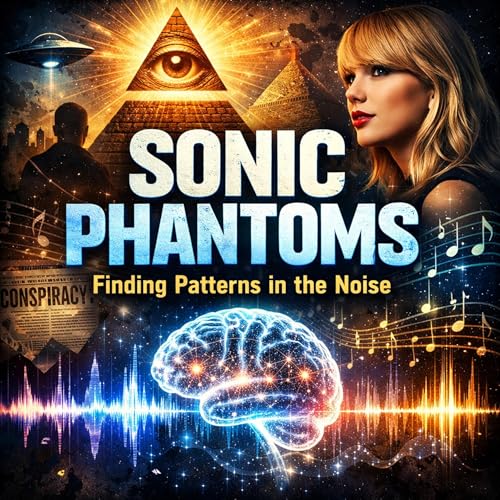
  • Sonic Phantoms: Why We Hear Meaning in Noise
    2026/02/21

    Why do we see secret symbols everywhere? Why do fans hunt for hidden clues in every lyric? And why do repetitive sounds sometimes feel like they’re whispering messages to us?


    In this episode, we explore apophenia — the human tendency to find patterns and meaning in randomness. From conspiracy theories about the Illuminati to the Easter egg culture surrounding pop icons, we examine how our brains are wired to connect dots that may not exist.


    We then dive into the phenomenon of “sonic phantoms” — how repetitive rhythms and ambient noise can trick the brain into hearing voices, melodies, or hidden messages.


    Is this the root of creativity… or the seed of paranoia? And how does understanding this cognitive bias help us navigate today’s misinformation age?


    A deep exploration into how the human mind turns noise into narrative.

    続きを読む 一部表示
    22 分
  • Lost Lands of Lemuria & Kumari Kandam: Myth, Geology, and a Sunken Past
    2026/02/15

    In the 19th century, scientists were puzzled. Identical lemur fossils and ancient plant species like Glossopteris were found across India, Madagascar, and Africa. To explain it, zoologist Philip Sclater proposed a lost continent beneath the Indian Ocean: Lemuria.


    But long before that theory, Tamil tradition spoke of Kumari Kandam — a vast southern land where ancient Sangam assemblies were said to flourish before being swallowed by the sea.


    In this episode of Deep Dive, we explore where mythology, colonial-era speculation, and modern geology intersect. We examine Helena Blavatsky’s later pseudoscientific “root race” claims, the revolutionary theory of Continental Drift, the discovery of the Mauritia microcontinent, and how rising sea levels after the last Ice Age reshaped coastlines.


    Were these lands real continents, cultural memory, or misunderstood science?


    And as sea levels rise again today, could history repeat itself for modern coastal civilizations?


    Follow Deep Dive for science that respects tradition, questions assumptions, and separates myth from measurable reality.

    続きを読む 一部表示
    37 分
  • The science of manipulation: How power controls the human mind?
    2026/02/07

    Powerful individuals and systems have always influenced human behavior. But how does manipulation actually work inside the brain?


    In this episode of Deep Dive, we explore the science behind coercive control, psychological influence, and the mechanisms that allow manipulation to occur in social systems. Using insights from neuroscience, behavioral psychology, and sociology, we examine how authority, trust, fear, and cognitive bias can shape human decisions.


    This episode does not focus on scandal, but on the scientific mechanisms that explain why manipulation works and how societies can recognize it.


    If you enjoy science explained through real stories and mysteries, follow Deep Dive on Spotify and leave a rating on Apple Podcasts so you never miss an episode.

    続きを読む 一部表示
    29 分
  • Ancient Monoliths: Engineering Genius or Alien Myths?
    2026/02/07

    How did ancient civilizations move and shape stone blocks weighing tens—or even hundreds—of tons, without modern machines? And why do alien theories keep appearing whenever human engineering seems too impressive to believe?


    In this episode of Deep Dive: Science Podcast, we explore the world’s most famous ancient monoliths and examine the real engineering methods behind them. From simple tools and physics to organization, time, and human ingenuity, we separate scientific evidence from popular alien myths.


    Instead of asking “Did aliens help?”, we ask a better question: Why do we underestimate ancient human intelligence?


    If you enjoy science, history, and critical thinking without exaggeration or fantasy, follow Deep Dive and join us as we challenge myths with evidence.

    続きを読む 一部表示
    12 分
  • Ghost Encounters Explained by Science (Not Myths)
    2026/01/31

    Are ghost encounters real — or is science playing tricks on our senses?


    In this episode of Deep Dive: Science Podcast, we investigate ghostly experiences using real physics and psychology, from infrasound and brain perception to energy conservation and simulated reality theories.


    Instead of myths, we explore what science can explain — and what still remains unanswered.


    If you enjoy science that challenges beliefs and explores the unknown, follow Deep Dive and join the exploration.

    続きを読む 一部表示
    15 分