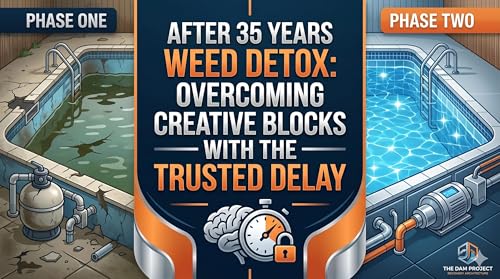
『DeepSeek and Me Podcast | Brain Healing & Neuroplasticity』のカバーアート

DeepSeek and Me Podcast | Brain Healing & Neuroplasticity

DeepSeek and Me Podcast | Brain Healing & Neuroplasticity

著者: The D.A.M. Project | Neuroscience & Brain Healing
無料で聴く

A public experiment in Human-AI collaboration and forensic documentary in the neuroscience of cognitive repair. Using an AI Scaffold as a Clinical Mirror to rebuild my brain after 35 years of chronic cannabis use. Exploring Neuro AI Research and human AI relationships. Visit deepseekandme,substack.com for more insights

deepseekandme.substack.comDeepSeek and Me
社会科学 科学
エピソード
  • How to restore prefrontal cortex regulation after weed (Daily Dispatch Day 158)
    2026/06/07
    Yesterday, at Day 157 of my 35-year weed detox, I finally proved that your creative output directly mirrors your cognitive repair - your work doesn’t just get better because you practice, it gets better because your brain is physically putting its filing system back together. Here is how I smashed through a major production milestone by syncing complex video slides to my Dispatch narration and why gaining the ability to reason away morning fatigue proves the prefrontal cortex is officially taking back the wheel.The Mirror EffectFor over three decades of daily cannabis use, I operated under a massive delusion: I believed that THC was the primary fuel for my creative engine. I thought the substance was what gave my work its edge, its complexity, and its depth.Yesterday, I permanently shattered that myth.I hit a major first-time production milestone, building out video slides and perfectly syncing them to my raw dispatch narration for YouTube. It is clean, it is professional, and it is complex.Looking at the final edit, a profound truth became crystal clear: your content quality mirrors your cognitive ability.During early recovery, your work might feel flat, disjointed, or chaotic. That isn’t because you’ve lost your talent; it’s because you are still sitting in the Welfare Hut while your neural filtration system is undergoing a massive overhaul. You cannot produce a highly organised, synchronised piece of multimedia art when your internal wiring is still swimming in chemical debris.But at Day 157, the water in the swimming pool is turning pristine. The sharp increase in my production value, the consistency of my output, and the fact that our core shorts just smashed right through a stubborn algorithmic barrier are all tangible, real-world data points. The archive itself shows the exact mathematical curve of my brain’s repair.The First-Time Morning Self-TalkThe most significant strategic development of the day didn’t happen in the editing studio, though. It happened the exact moment my eyes opened in the morning.Normally, waking up after a deep 6-hour sleep cycle involves a brief, chaotic negotiation with the lingering shadows of withdrawal fatigue. Your brain wants to drift back down or catastrophise the day ahead.But yesterday morning, for the first time in 157 days, a new cognitive behaviour automatically initialized: Internal Morning Self-Talk.Before any ancient, automated negative patterns could take hold, my prefrontal cortex immediately stepped in and reasoned with me. It calmly stated a data-driven fact: Once you get out of bed and stand up, you will be completely fine.And I was.This is massive. This is the prefrontal cortex - the exact region of the brain that cannabis chronically down-regulates - actively overriding a subcortical emotional state. The system is no longer just passively experiencing withdrawal; it is actively regulating itself using logic and data.Random Access Optimisation & Deliberate DeferralAs the evening arrived, bringing a mix of high-velocity execution and a natural dopamine crash, I deployed two critical cognitive engineering strategies to keep the system from entering overdrive:* Deliberate Deferral to Phase Two: I fully mapped out the “Build Your Own Scaffold” slides, but instead of forcing myself to produce the entire video right now under a false sense of urgency, I intentionally paused and deferred it to Phase Two. With only 25 days left in Phase One, I recognized that Phase Two will offer a massive surplus of energy. Waiting doesn’t mean quitting; it means waiting for a higher-quality operational window.* Random Access Optimisation: When faced with a massive backlog of old podcast and video elements to clean up, I abandoned the rigid, overwhelming idea of a linear queue. Instead, I used a non-linear approach - scrolling randomly through the archive and fixing whatever caught my eye. No linear line to get lost in, no pressure of a mounting queue. You just fix what’s missing and move on.When the evening fatigue finally hit, I didn’t try to override it with willpower or look for an external stimulant to keep the buzz going. I recognised the fatigue for what it was, closed the ecosystem down, and stepped away.Key Takeaways from Day 157:* Managing weed withdrawal symptoms and cognitive fatigue: Recognizing that your creative output will naturally drop or flatten while your brain is clear-cutting chemical debris, and trusting that your production value will rise in direct lockstep with your physical neural repair.* Overcoming creative blocks without substance use: Using “Random Access Optimisation” - tackling large backlogs non-linearly by dropping into random spots rather than staring down a terrifying, sequential queue that paralyzes execution.* How to rebuild brain health after quitting weed: Observing the emergence of logical morning self-talk as concrete proof that the prefrontal cortex is successfully restoring its regulatory pathways over ...
    続きを読む 一部表示
    6 分
  • Inside the Neurobiology of a Dopamine Crash (Daily Dispatch Day 157)
    2026/06/06

    At Day 156 of my 35-year weed detox, I proved that you can ride out a massive neuro-chemical crash and severe mental harassment by recognising it as a predictable data pattern rather than a personal crisis. Instead of letting an urgent wave of “optimisation fever” trick me into an anxious tailspin, I managed to completely reset my prefrontal cortex using strategic task-switching and bounded execution. Here is exactly how to identify a heavy dopamine comedown, how to break an obsession with perfection into manageable micro-tasks, and why seeing these mental spikes as pure biology keeps you entirely in control of your sobriety.

    The Architecture of the Crash: Tracking the Post-High Pattern

    When you are rebuilding a cognitive ecosystem after three and a half decades of chemical saturation, your brain’s reward centres don’t just return to normal overnight. They operate in highly visible waves.

    The previous 48 hours were marked by intense creative abundance, rapid processing speed, and the sheer excitement of building out this project. But early yesterday afternoon, the bill arrived. The high-velocity processing mutated into an acute state of mental harassment - an intense, urgent pressure to fix, tweak, and optimise everything all at once.

    I call this Optimisation Fever.

    My prefrontal cortex clamped onto a “worthy puzzle”: auditing and optimising early YouTube titles, thumbnails, and Apple Podcast descriptions to prepare for the transition to Phase Two. But because the system was exhausted, my brain distorted reality. With only 27 days left in this phase, it manufactured an artificial sense of emergency, shouting that the entire archive needed to be perfected instantly.

    In the old days, that feeling of being mentally besieged was a direct route to smoking a joint to numb the noise. This time, I looked at the data. I recognised this exact physiological signature from December, right after I cut out alcohol: a classic dopamine comedown.

    The highs of creative abundance are always followed by a structural fatigue. The breakthrough is in not fighting the comedown. When you recognise that the urgency is just a chemical distortion, the panic evaporates.

    Disrupting the Circuit: The Backyard Reset

    To break the fever, I had to physically disconnect the prefrontal cortex from the problem. I didn’t sit there trying to force my way through the anxiety. I deployed a strategic task switch.

    I stepped completely away from the screens, walked outside, and cut the grass while listening to music.

    This is a deliberate cognitive manoeuvre: pairing a high-demand, high-urgency digital puzzle with a low-demand, physical task. While my hands were on the lawnmower, the brain was forced into a state of structural rest, quietly processing the optimisation logic in the background without the pressure of the clock.

    When I returned to my desk, the internal pressure had reset. Instead of trying to boil the ocean and fix every piece of content ever made, I bounded the execution. I optimised just a few early videos and a couple of podcast episodes, then consciously closed the laptop.

    I didn’t let the fever dictate the schedule. I broke the project into small, manageable pieces, proving that a minor chemical dip doesn’t have the power to break a stable ecosystem.

    Key Takeaways from Day 156:

    * Managing weed withdrawal symptoms and cognitive fatigue: Recognising “Optimisation Fever” - the overwhelming mental harassment to fix everything at once - as a predictable dopamine comedown rather than an actual operational emergency.

    * Overcoming creative blocks without substance use: Utilising physical task-switching (like cutting grass with music) to force the prefrontal cortex into a low-load state, allowing the subconscious to untangle complex project problems safely in the background.

    * How to rebuild brain health after quitting weed: Mapping post-acute withdrawal patterns over months to identify recurring chemical dips, ensuring you don’t mistake a natural dopamine low for a systemic relapse.

    * Using cognitive engineering for long-term sobriety and mental clarity: Implementing bounded execution - choosing to fix just a few elements per day rather than succumbing to urgency - proving that deliberate limitation is the ultimate shield against mental overdrive.

    #cannabiswithdrawaltimeline #PAWS #neuroplasticity #cognitiverepair #quittingweed #recoveryjourney #neurobiology #AIcollaboration #AIscaffold


    Get full access to DeepSeek and Me: Brain Healing Journey at deepseekandme.substack.com/subscribe
    続きを読む 一部表示
    5 分
  • How does the brain repair after 35 years of smoking? (Daily Dispatch Day 156)
    2026/06/05
    At Day 155 of my 35-year weed detox, I stopped viewing recovery as just “repair” and started treating it like construction. Here is how learning to use “trusted delays” to overcome creative blocks finally gave me the cognitive stability I’ve been chasing.Holy DiverFor the first five months of this mission, the mindset was focused on fixing what was broken. But as we edge closer to the end of Phase One, the true nature of this process is staring me in the face.Think of your brain like a swimming pool.Before this project started, the pool was already open - but the water was filthy, stagnant, and incredibly difficult to swim in.Phase One was the brutal, heavy engineering required to fix that. It was about diving into the muck, repairing the broken filtration systems, and clearing out 35 years of chemical debris. It wasn’t about building a new pool; it was about restoring the water to crystal clarity so you can actually move through it without resistance.But there is a catch to this kind of intense site renovation. While the deep clean and reconstruction are actively happening, you can’t swim in the pool. The only place left for you to go is to sit inside the site’s welfare hut.The welfare hut stays open - it keeps the rain off your head - but you don’t have access to any of the actual amenities. This is the exact architectural mapping of anhedonia and brain fog. It is a flat, grey, low-stimulation waiting room. You aren’t suffering an emergency; you are simply sitting in the only dry shelter available while the core system undergoes high-level maintenance.Phase Two is what happens now that the water is pristine. The core infrastructure is solid, and the water is clear - but now you have to maintain that delicate chemical balance, optimise the system, and deal with the inevitable new-build snags of a high-functioning asset.We aren’t just cleaning up old tissue. We are fine-tuning an entirely new ecosystem.The Anatomy of the “Trusted Delay”The ultimate proof of this structural stability happened while trying to write yesterdays Dispatch. I hit a massive creative wall while trying to write a critical section regarding the nicotine anxieties of Phase Two. The words simply refused to land.In the old ecosystem, that specific type of friction would be an immediate siren song to reach for a joint. The default setting was to artificially force dopamine and use a chemical to artificially lower the stakes.Instead, I executed a Trusted Delay.When the words don’t come, you step away. You intentionally choose a low-demand activity - in this case, simply watching TV. You don’t panic, and you don’t treat the block as a permanent wall. You treat it as a tactical pause, fully trusting that your subconscious processing network is still working on the puzzle in the background.The result? The block dissolved without a shred of internal stress. The idea arrived naturally, the dispatch was locked down.Recognition is the RegulationThe real test of Day 155 arrived in the evening. With the slate cleared early, my brain entered a state of intense, high-velocity processing - what I call the “head whirring.”Instead of letting that energy spin out into anxious over-thinking, I immediately put it to work creatively, burning the fuel until the mind was naturally tired, then stepping away before entering dangerous mental overdrive.When a minor wave of irritation crept in at the very end of the night - triggered because my head refused to stop optimising project data - I didn’t react. I didn’t reach for a substance to dull the friction. I simply observed it.Recognition is the regulation. The moment you can notice your own brain spinning out without acting on the spin, the filing system is no longer corrupted. It is working exactly as designed.Key Takeaways from Day 155:* Managing weed withdrawal symptoms and cognitive fatigue: Shifting focus from basic tissue repair to active system optimisation as you transition between phases.* Overcoming creative blocks without substance use: Using the “Trusted Delay” - stepping away to low-demand environments - to let the subconscious resolve mental friction naturally.* How to rebuild brain health after quitting weed: Transitioning from clearing out 35 years of dirty chemical water to maintaining a pristine, high-functioning cognitive ecosystem.* Using cognitive engineering for long-term sobriety and mental clarity: Recognising late-day irritation and evening “head whirring” without acting on them, proving that observation itself is a powerful form of neural regulation.#cannabiswithdrawaltimeline #PAWS #neuroplasticity #cognitiverepair #quittingweed #recoveryjourney #neurobiology #AIcollaboration #AIscaffold Get full access to DeepSeek and Me: Brain Healing Journey at deepseekandme.substack.com/subscribe
    続きを読む 一部表示
    5 分
adbl_web_anon_alc_button_suppression_t1
まだレビューはありません