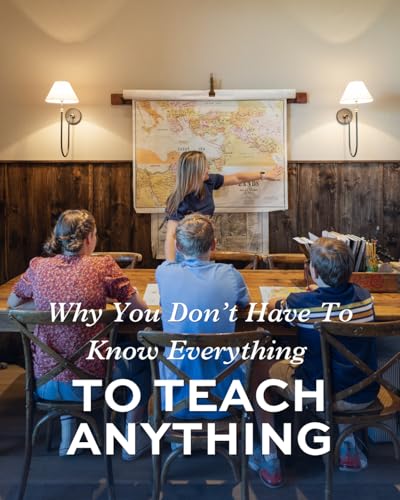
『Everyday Educator』のカバーアート

Everyday Educator

Everyday Educator

著者: Classical Conversations Inc.
無料で聴く

今ならプレミアムプランが3カ月 月額99円

2026年5月12日まで。4か月目以降は月額1,500円で自動更新します。

概要

Classical Conversations supports homeschooling parents by cultivating the love of learning through a Christian worldview in fellowship with other families. We believe there are three keys to a great education: classical, Christian, and Community. 人間関係 子育て
エピソード
  • 5 Habits Every Homeschool Mom Needs to Teach Any Subject with Confidence
    2026/04/21

    Do you ever feel like you're not qualified enough to teach your kids? In this episode of the Everyday Educator podcast, host Kelli Wilt and Amy Jones sit down to explore how Classical Conversations' five core habits of grammar — naming, attending, memorizing, expressing, and storytelling — can transform the way homeschool moms approach any subject, including geography. Whether you're in Foundations or beyond, these practical tools will give you the confidence to teach well without needing to be the expert.

    Kelli Wilt, Lead of Program Development for Classical Conversations Multimedia and longtime CC director and tutor, walks through each habit with real-life examples — from how children name stuffed animals to how National Memory Master finalists draw the entire world from memory. You'll come away with a fresh perspective on why classical education works and how to put it into practice at your kitchen table today.

    Kelli and Amy also discuss how the five core habits apply far beyond geography — from chemistry labs to literature — equipping your children with lifelong learning skills that go with them wherever God leads.

    This episode of Everyday Educator is sponsored by:

    Classical Conversations just released "The Habits of a Classical Education"—the long-awaited successor to "The Core." This resource helps you naturally integrate the Five Core Habits into daily life, enabling classical, Christian education where relationships and lifelong learning flourish.

    It's here! Order your copy of "The Habits of a Classical Education: Practicing the Art of

    Grammar" here during the April sale!

    続きを読む 一部表示
    1 時間 7 分
  • Top Homeschool Secrets to Success
    2026/04/14

    What if the secret to classical homeschooling isn't the right curriculum — it's the right habits? In this episode of the Everyday Educator podcast, host Lisa Bailey sits down with Amy Jones and Kelli Wilt to introduce The Habits of a Classical Education: Practicing the Art of Grammar. Together they unpack the five core habits of classical learning, why wonder is the foundation of a truly classical Christian education, and why this book works alongside any curriculum you're already using. Whether you've been homeschooling for a week or a decade, this conversation will remind you why you started.

    Lisa Bailey opens by sharing a realization she came to after years of homeschooling her own daughters: the best homeschool days were the ones that were more about home than about school. That insight is at the heart of The Habits of a Classical Education, CC's newest resource — a book that helps families develop the rhythms and relationships that make learning come alive, whatever curriculum they're using.

    Kelli Wilt, lead of program development at Classical Conversations, introduces the five core habits using the acronym NAMES: Naming, Attending, Memorizing, Expressing, and Storytelling. Her own strongest habits are storytelling and memorizing — skills she developed almost by accident on long van rides with her children, weaving family history and memory work into the journey without her kids ever realizing it was intentional. She's quick to note that the habits didn't come out of nowhere: they're the fruit of a decade of conversations about how God designed human beings to learn.

    Amy Jones, who hosts the Everyday Educator and was a co-author of the book, admits that memorizing is her hardest habit — not because she doesn't value it, but because she had never fully appreciated how foundational it is until working on this book. Her insight is one of the episode's best: the habits aren't subjects. They're a spine, a way of approaching anything new. She walks listeners through the simple exercise of teaching a child something — anything — and noticing that naming, attending, memorizing, expressing, and storytelling show up naturally in every real act of learning.

    The episode's most beautiful section comes when the conversation turns to wonder. Amy quotes a line she encountered in her reading: "You learn nothing without wonder." Wonder, she explains, is God's invitation to his world. It's not an extra. It's the engine. And the habits, properly practiced, don't just cultivate wonder in a child's natural areas of interest — they introduce children (and adults) to wonders they never knew they had. Creation is the curriculum, as Leigh Bortins says, and the habits are the way we learn to read it.

    What You'll Learn

    • The five core habits of classical learning and the acronym that makes them easy to remember (NAMES)
    • Why these habits aren't subjects — they're the way God designed every human being to learn
    • Why the habits work alongside any curriculum you already own, not instead of it
    • How Kelli and Amy each approach the habits differently — and what that means for your own family
    • Why wonder is not a warm fuzzy feeling — it's an essential component of real education
    • How the book is organized so that busy moms can read it in sections at soccer practice
    • Why you don't have to be a perfect homeschooler for this to work — and what the book actually promises
    • Why the habits apply to adults and older students too — not just little ones in the grammar stage
    • What it means that education ought to be more about home than schooling

    This episode of Everyday Educator is sponsored by:

    Classical Conversations just released The Habits of a Classical Education—the long-awaited successor to The Core. This resource helps you naturally integrate the Five Core Habits into daily life, enabling classical, Christian education where relationships and lifelong learning flourish.

    It's here! Order your copy of The Habits of a Classical Education: Practicing the Art of Grammar here during the April sale!

    続きを読む 一部表示
    52 分
  • How to Prepare for the CC Senior Thesis: A Parent's Guide
    2026/04/07

    Your student is approaching Challenge 4 — and suddenly the words "senior thesis" are everywhere. What exactly is it? Who's involved? And how do you help without taking over? In this episode of the Everyday Educator podcast, host Lisa Bailey sits down with Timothy Knotts, Director of Challenge Development at Classical Conversations, and CC grad and Challenge 4 tutor Daniel Shirley to walk parents through every stage of the Senior Thesis project — from choosing a topic all the way to the live defense. Consider this your field guide.
    Lisa opens by clarifying what the Senior Thesis actually is: a two-part project involving a research paper and a live defense in front of an audience that includes parents, peers, judges, and often extended family. It's one of the few programs in classical education that asks students to stand up, present what they've discovered, and answer unrehearsed questions in real time. Terrifying and wonderful, as Tim puts it.
    The heart of the conversation is the question of how to choose a thesis topic — and both guests are emphatic: the topic must come from genuine passion. Daniel offers three examples of thesis statements students should avoid — "the government should not be involved in mental health," "the Bible is the most important book in history," and "toothpaste is very important for dental hygiene" — and explains what all three have in common: they're too broad, too generic, or too obvious to be genuinely arguable. Tim adds that the thesis must be arguable not just to others, but by the student themselves. If they're not wrestling with it, they're not discovering anything.
    Tim offers a liberating reframe: the thesis statement itself is not set in stone. It should remain in conversation with the research and the writing all the way to the final draft. Students who discover they don't care about their topic two months before it's due — and try to start over — are usually headed for a train wreck. But students who remain open to refining their thesis as they learn more will find the process genuinely rewarding.
    Daniel frames the whole project as an Odyssean adventure: navigating by stars, not by GPS. The path is imprecise and full of course corrections. That's not a bug — that's the point. The capstone is meant to ask the student to truly wonder and discover, not to prove what they already think.

    What You'll Learn
    • What the Senior Thesis actually is: the two parts, the people involved, and what it's really preparing students for
    • Why a thesis needs to be something the student can't not ask — and what happens when it isn't
    • Three examples of bad thesis statements (and what makes them bad) so your student doesn't make the same mistakes
    • Why the thesis should be treated like an adventure — not a dissertation
    • How the thesis statement should stay in conversation with the research and writing, all the way to the end
    • What parents should and shouldn't do — the vice of excess and the vice of deficiency
    • How to use memoria to help your student find a topic they genuinely care about
    • The role of a mentor (not the parent, not the director) and why the same question lands differently from different people
    • Research avenues CC families may not know about: CC Plus, the Steelman Library at SEU, and Adler's Synopticon
    • What book Tim recommends parents and students read together before Challenge 4 even begins

    This episode of Everyday Educator is sponsored by:
    Classical Conversations just released "The Habits of a Classical Education"—the long-awaited successor to "The Core." This resource helps you naturally integrate the Five Core
    Habits into daily life, enabling classical, Christian education where relationships and
    lifelong learning flourish.
    It's here! Order your copy of "The Habits of a Classical Education: Practicing the Art of
    Grammar" here during the April sale!

    続きを読む 一部表示
    53 分
まだレビューはありません