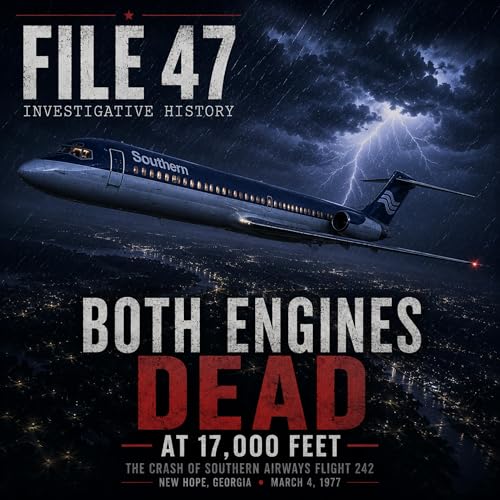
『File 47: Investigative History Podcast』のカバーアート

File 47: Investigative History Podcast

File 47: Investigative History Podcast

著者: M.T. Bevis
無料で聴く

Every story leaves a record. Every record leaves clues. File 47 is an investigative history podcast hosted by historian and author M.T. Bevis. Each episode opens a forgotten file from the past, examining the evidence, myths, decisions, and consequences that shaped history. From ancient civilizations and legendary figures to wars, political crises, and historical mysteries, File 47 investigates the stories we thought we knew. The file is open.M.T. Bevis 世界
エピソード
  • Both Engines Dead at 17,000 Feet. The Pilots Picked a Highway. Twenty People Walked Away. | Southern Airways Flight 242
    2026/06/04

    It was supposed to be a twenty-five-minute flight.

    Huntsville, Alabama to Atlanta, Georgia. Southern Airways Flight 242. A routine late-afternoon hop on April 4, 1977, operated by a DC-9 with 81 passengers and a crew of four. Captain Bill McKenzie had 19,380 flight hours. He had flown through the same stretch of Alabama and Georgia skies that very morning — mild turbulence, light rain, nothing unusual.

    The weather had changed while he was on the ground.

    Ten minutes after takeoff from Huntsville, Flight 242 flew into a thunderstorm that the onboard radar had not adequately shown them. Rain hammered the fuselage. Hail cracked the cockpit windshield. And then, in rapid succession, both engines — both of them — flamed out. A DC-9 with 85 people aboard became a glider at 17,000 feet over northern Georgia.

    What followed in the next several minutes is one of the most extraordinary sequences in the history of commercial aviation. Two pilots who had no power, no real options, and diminishing altitude searching desperately for somewhere to put a jetliner down in the hills and forests of Paulding County, Georgia. Two flight attendants in their twenties — Catherine Lemoine Cooper and Sandy Purl Ward — who received no communication from the cockpit, figured out on their own that something catastrophic was happening, and prepared 81 passengers for a crash landing without being told to. A two-lane highway that appeared beneath the clouds at the last possible moment. A gas station that didn't survive the rollout. A woman named Sadie Burkhalter Hurst who looked out her front door and watched the fuselage of a passenger jet come to rest in her yard.

    Twenty people walked away from Southern Airways Flight 242. Nine people on the ground did not.

    In this episode of File 47: Investigative History, we open the case file.

    We examine the decisions that preceded the flight — the weather briefing that didn't happen, the captain who stayed in the cockpit at Huntsville instead of going inside for an updated forecast, the dispatcher whose call to the weather service found a busy signal and stopped trying. The chain of small decisions, each one defensible in isolation, that assembled into catastrophe.

    We examine the CVR record of the final minutes — what the pilots said to each other, what they said to air traffic control, and the specific exchange in which a controller mentions a small airport at Cartersville, ten miles north, that the crew acknowledges and then cannot reach.

    We examine Catherine Cooper and Sandy Ward — what they did in the cabin while the cockpit was consumed by an engine restart crisis that was never going to succeed, and why the NTSB specifically commended them in a finding that most accounts of this crash have never adequately foregrounded.

    And we examine the ground — the town of New Hope, Georgia, the highway, the gas station, the cars that were on that road, and the community that has gathered at the crash site every April 4th since 1978.

    A companion article is available on Medium — linked in the show notes.

    Subscribe to File 47: Investigative History for new episodes every week.

    続きを読む 一部表示
    23 分
  • The Isle of Man TT Has Killed Over 280 People Since 1911. The Riders Know. They Come Anyway.
    2026/06/01

    Every June, the Isle of Man — a self-governing island of 85,000 people in the Irish Sea between Britain and Ireland — closes its public roads and becomes the site of the most dangerous motorsport event on the planet.

    The course is 37.73 miles of ordinary tarmac. Public roads. Stone walls. Houses. Lampposts. Hedgerows. No runoff. No gravel traps. No tire barriers between the riders and the things that will kill them. The best riders in the world average more than 130 miles per hour around it. The current lap record, set by Peter Hickman in 2023, is 136.358 miles per hour. The top speed on the Sulby Straight exceeds 200 miles per hour — 202.3 mph officially, with 206 mph recorded by onboard data.

    Since the Mountain Course was introduced in 1911, over 280 people have died on it. Riders. Sidecar passengers. Marshals.

    The riders know this number. They know it precisely. They come anyway.

    In this episode of File 47: Investigative History, we open the case file.

    We examine the origins of the TT — why it exists on a small island in the Irish Sea rather than anywhere else in the world, why the British government's prohibition on road racing in 1904 produced one of the most consequential decisions in motorsport history, and what the race was originally designed to prove.

    We examine the Mountain Course itself — 37.73 miles of public road that has barely changed in over a century, the specific physics of what happens when a human being traveling at 150 miles per hour leaves a road with no margin for error, and the 264 named corners — every single one named because every single one has a history.

    We examine the deaths — not as statistics, but as the documented record of individual human beings who made a specific choice about how they wanted to live. The years that were catastrophic. The families that lost fathers and sons and brothers. The 2022 event that killed five people including a father and son in the same race.

    We examine the institutional question — how an event with this death toll continues to receive government sanction, attract commercial sponsors, draw the best riders in the world and more than 40,000 spectators, and survive every call for abolition for over a century.

    And we examine the philosophical question the TT forces into the open — the question of consent, individual autonomy, and what it means that a person can look at the number and say: I understand. I'm going anyway.

    2024 and 2025 were the first consecutive fatality-free TT years in the event's history. That development is real, significant, and complicated. The episode examines what it means — and what it doesn't.

    This is the case file on the world's deadliest race. The riders have been opening it every June for 118 years. We're opening it now.

    A companion article expanding the investigation is available on Medium — linked in the show notes.

    Subscribe to File 47: Investigative History for new episodes every week. If this episode left something with you, leave a rating on Spotify or Apple Podcasts — it's the primary way we reach new listeners.

    続きを読む 一部表示
    26 分
  • Three Astronauts Died on the Launchpad. NASA Had Been Warned. | Apollo 1
    2026/05/30

    On January 27, 1967, at 6:31 in the evening, a fire broke out inside Apollo 1 on the launchpad at Cape Kennedy. The three astronauts inside — Gus Grissom, Ed White, and Roger Chaffee — were dead within seventeen seconds of the first distress call. The hatch that might have saved them could not be opened from the inside under pressure. The pure oxygen atmosphere that NASA had chosen for the cabin, under pressure, turned the spacecraft into an incinerator.

    The fire was not a surprise. Not to the engineers who had been documenting the spacecraft's problems for months. Not to Gus Grissom, who had hung a lemon on the spacecraft's simulator and told his wife he wasn't sure he was coming back from this one. Not to the NASA inspector who had counted over a hundred open safety items on the vehicle and could not get anyone in authority to treat them as the crisis they were. Not, on some level, to the institution itself — which had been moving so fast, under such pressure, toward a deadline that John Kennedy had set before his assassination, that it had stopped being able to hear the warnings it was generating.

    In this episode of File 47, we open the case file.

    We examine the world that built Apollo 1 — the specific institutional atmosphere of NASA in 1966 and early 1967, where the pressure of the lunar deadline, the competition with the Soviet space program, and the organizational complexity of managing a contractor network of unprecedented scale had created conditions in which speed was systematically prioritized over safety in ways that the people inside the institution could feel but struggled to stop.

    We investigate the spacecraft itself — the Block I Command Module, built by North American Aviation, and the long, documented, escalating record of quality control failures, wiring problems, flammable materials, and hatch design decisions that converted a routine ground test into a fatal fire.

    We examine the men. Gus Grissom — the second American in space, the man who almost drowned when his Mercury capsule sank, who had more reason than anyone to understand the specific and personal nature of spacecraft risk. Ed White — the first American to walk in space, whose spacewalk photograph is one of the defining images of the entire Apollo program. Roger Chaffee — the youngest of the three, on his first mission, who died in a spacecraft that never left the ground.

    We examine what happened after. The Congressional investigation. The redesign of the Command Module. The eighteen months during which NASA stopped flying and rebuilt not just the spacecraft but, partially and imperfectly, the institutional culture that had produced the fire.

    And we sit with the question that January 27, 1967 permanently opens: what does it cost when the warnings are there, the people are there, the documentation is there — and the momentum of an institution is greater than the force of the evidence against it?

    The patch they designed for Apollo 1 never flew. It flew on every mission after.

    A companion article expanding the investigation is available on Medium — linked in the show notes.

    Subscribe to File 47: investigative History for new episodes every week. If this episode left something with you, leave a rating on Spotify or Apple Podcasts — it's the primary way we reach new listeners.

    続きを読む 一部表示
    25 分
adbl_web_anon_alc_button_suppression_t1
まだレビューはありません