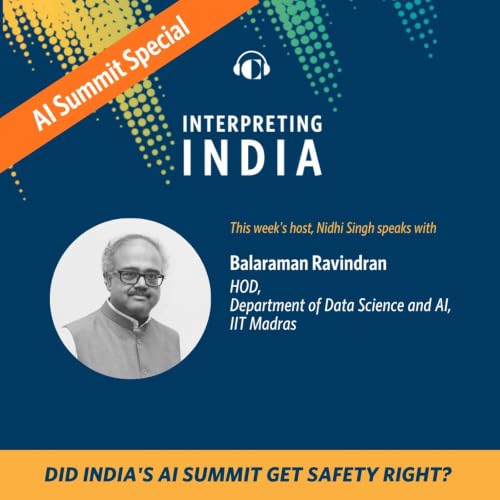
『Interpreting India』のカバーアート

Interpreting India

Interpreting India

著者: Carnegie India
無料で聴く

In Season 5 of Interpreting India, we continue our exploration of the dynamic forces that will shape India's global standing. At Carnegie India, our diverse lineup of experts will host critical discussions at the intersection of technology, the economy, and international security. Join us as we navigate the complexities of geopolitical shifts and rapid technological advancements. This season promises insightful conversations and fresh perspectives on the challenges and opportunities that lie ahead.2024 Carnegie India 政治・政府 政治学
エピソード
  • Did India's AI Summit Get Safety Right?
    2026/06/19

    This episode is part of our special series on the India AI Impact Summit, examining the conversations, decisions, and debates that are shaping global AI governance.

    Professor Ravindran addresses early on the perception that the India summit sidelined safety. More than 60% of the summit's events and discussions were focused on safety, trust, and cross-border collaboration. The framing shifted, and deliberately so. When the summit came to the Global South, leading with existential risk, rather than the very real opportunity AI presents to improve healthcare, education, and public services for hundreds of millions of people, would have been the wrong entry point. The two key deliverables from his working group reflect that balance: the Trusted AI Commons, a repository of benchmarks, testing protocols, and best practices designed for AI deployment in resource-constrained settings, and a high-level governance guidance note endorsed by 22 countries, that calls out the issues every national AI policy should address without being prescriptive enough to limit how different countries approach it.

    On frontier risks, Professor Ravindran notes that the landscape has shifted in ways that would have seemed speculative even a year ago, and that the frameworks being built to manage these risks will need to keep pace with that change. He also reflects on what the growing concentration of the most capable AI models means for countries like India, and why that conversation may need to move from being a company-to-country dialogue to a country-to-country one. His overall view is one of cautious optimism: there will be disruption in the short term, but there will also be a new equilibrium, and the work is to make sure the transition is managed well.

    Episode Contributors

    Professor Balaraman Ravindran heads the Department of Data Science and AI at IIT Madras. He is also the Founding Head of the Wadhwani School of Data Science and AI (WSAI), Robert Bosch Centre for Data Science and AI (RBCDSAI), and Centre for Responsible AI (CeRAI) at IIT Madras. He has more than three decades of experience working in reinforcement learning, and his research interest spans responsible AI and deep RL.

    Nidhi Singh is an associate fellow at Carnegie India. Her current research interests include data governance, artificial intelligence and emerging technologies. Her work focuses on the implications of information technology law and policy from a Global Majority and Asian perspective. She has previously contributed to the Indian Express, The Secretariat, Medianama and HinduBusiness Line.

    Every two weeks, Interpreting India brings you diverse voices from India and around the world to explore the critical questions shaping the nation's future. We delve into how technology, the economy, and foreign policy intertwine to influence India's relationship with the global stage.

    As a Carnegie India production, hosted by Carnegie scholars, Interpreting India, a Carnegie India production, provides insightful perspectives and cutting-edge by tackling the defining questions that chart India's course through the next decade.

    Stay tuned for thought-provoking discussions, expert insights, and a deeper understanding of India's place in the world.

    Don't forget to subscribe, share, and leave a review to join the conversation and be part of Interpreting India's journey.

    続きを読む 一部表示
    40 分
  • Subsea Cables, Trusted Networks, and India's Strategic Opportunity
    2026/06/04

    Pooja opens with a mismatch that frames the entire conversation. India consumes around 20% of global internet traffic but accounts for just 2% of global subsea cable infrastructure. Even with the expansion of landing stations currently underway, the gap between India's digital ambitions and its physical cable footprint is significant. Part of this is historical: cable infrastructure was concentrated in Mumbai and Chennai, and building it out is prohibitively expensive. Part of it is structural: the raw materials, the technology, and crucially the cable-laying ships that make all of it possible are controlled by a very small number of countries.

    On the question of China's expanding footprint, Pooja draws out a tension that runs through the whole conversation: private cable companies are driven by cost and scale, and will naturally gravitate towards cheaper components and partners regardless of where they come from. Sovereign concerns around espionage, trusted supply chains, and national security are a different conversation entirely, and the two do not always find a common language easily. This is where the idea of trusted networks becomes important, frameworks built around like-minded partners who share a common understanding of hardware standards, legal norms, and jurisdictional protections. Australia's approach of using its Exclusive Economic Zone provisions to protect cable infrastructure is one model Pooja thinks India should take seriously and preliminary discussions suggest it already is.

    On Quad, Pooja notes that the cable connectivity and resilience partnership launched at the Leaders’ Summit was significant, and there is work happening beneath the surface even if it is not attracting media attention. She concludes by suggesting that more clarity from the government on where India stands on subsea cables, which bodies are responsible, and the national approach will help the broader conversation, especially aiding relevant stakeholders reach out to the right people within the government. That clarity, she argues, is the essential first step.

    Every two weeks, Interpreting India brings you diverse voices from India and around the world to explore the critical questions shaping the nation's future. We delve into how technology, the economy, and foreign policy intertwine to influence India's relationship with the global stage.

    As a Carnegie India production, hosted by Carnegie scholars, Interpreting India, a Carnegie India production, provides insightful perspectives and cutting-edge by tackling the defining questions that chart India's course through the next decade.

    Stay tuned for thought-provoking discussions, expert insights, and a deeper understanding of India's place in the world.

    Don't forget to subscribe, share, and leave a review to join the conversation and be part of Interpreting India's journey.

    続きを読む 一部表示
    46 分
  • AI Literacy and the Future of Work in India
    2026/05/26

    Jaspreet's framing for the AI and work debate is worth staying with. He is not dismissive of disruption: he thinks AI will destroy certain jobs, create new ones, and the rupture will be real. But he pushes back on the idea that job destruction is the right frame. The more useful question, he argues, is what happens to workers, and the answer to that depends almost entirely on whether people develop the skills to move into the roles that AI creates rather than the ones it displaces. His reference point is the IT sector itself, an industry born out of the last great technology disruption, when fears about computers eliminating clerical work gave way to an entirely new economy of higher-paying, more fulfilling jobs. The same logic, he believes, applies now.

    The bulk of the conversation settles on AI literacy, a concept Jaspreet distinguishes sharply from training. Training teaches you how to use a specific tool. Literacy gives you the grammar to work with any tool, across any context. He lays out a five-step framework from his book, reads, writes, ads, thinks, does, designed as a practical ladder for building that literacy, and is candid that even three years after ChatGPT, most organizations have brought the horse to the water without making it drink. On the policy side, he is supportive of initiatives like AI in school curricula and IIT fellowships, but his bigger ask is that India treat AI the way it treated digital public infrastructure: as a genuine national mission, not a sectoral initiative. On deepfakes and copyright, his view is pragmatic: deepfakes are a known evil that needs specific, exemplary regulation rather than an omnibus AI law, and copyright will likely resolve through a combination of revenue sharing agreements and citation norms, neither side fully satisfied but better than where things stand today.

    Episode Contributors
    Jaspreet Bindra is the founder of AI&Beyond and The Tech Whisperer, and author of 'Winning with AI: Your Guide to AI Literacy.' He has served as the group chief digital officer at the Mahindra Group, as a regional director at Microsoft India, and as a general manager in the Tata Group as part of the select Tata Administrative Services. He was also a member of the founding team at Baazee.com, which later became eBay India.

    Adarsh Ranjan is a research analyst at Carnegie India where his research focuses on AI and emerging technologies, digital transformation, and technology partnerships. His current research explores India’s evolving policy on AI compute and digital transformation in Global South countries.

    Timestamps
    00:08 Introduction to AI and India's Future
    03:15 AI's Impact on Work and Adoption Trends
    11:50 Job Transformation vs. Job Destruction in IT
    16:06 The Importance of AI Literacy
    21:55 Framework for AI Literacy
    28:32 Challenges in AI Adoption
    32:02 Government Initiatives for AI Education
    35:38 Ethics in AI: Deepfakes and Copyright

    Every two weeks, Interpreting India brings you diverse voices from India and around the world to explore the critical questions shaping the nation's future. We delve into how technology, the economy, and foreign policy intertwine to influence India's relationship with the global stage.

    As a Carnegie India production, hosted by Carnegie scholars, Interpreting India, a Carnegie India production, provides insightful perspectives and cutting-edge by tackling the defining questions that chart India's course through the next decade.

    Stay tuned for thought-provoking discussions, expert insights, and a deeper understanding of India's place in the world.

    Don't forget to subscribe, share, and leave a review to join the conversation and be part of Interpreting India's journey.

    続きを読む 一部表示
    45 分
adbl_web_anon_alc_button_suppression_t1
まだレビューはありません