『LEO Round Table with Chip DeBlock』のカバーアート

LEO Round Table with Chip DeBlock

LEO Round Table with Chip DeBlock

著者: Chip DeBlock
無料で聴く

LEO Round Table is a nationally syndicated law enforcement talk show discussing today's news and issues from a law enforcement perspective. Their panelists are among a Who's Who of law enforcement professionals and attorneys from around the country.Copyright 2026 Chip DeBlock ランニング・ジョギング 政治・政府 政治学 日次
エピソード
  • LEO Round Table, June 25, 2026
    2026/06/25
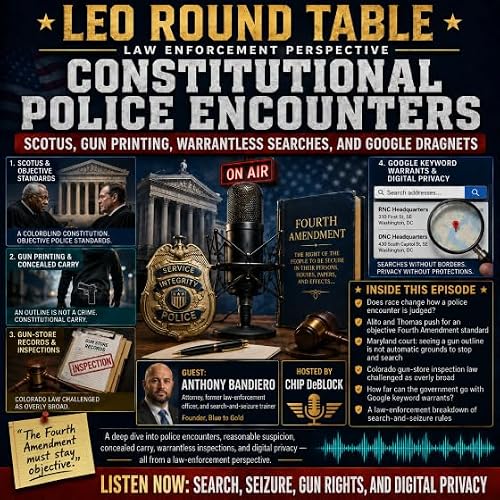
    LEO Round Table with Chip DeBlock S11E124, Two SCOTUS Justices Take On Court Over Constitutional Police Encounters Two SCOTUS justices take on court over constitutional police encounters. Court says police can't just search a suspect over an outline of a gun. Gun stores sue governor over warrantless gun record seizures. Google search found to have been reason hundreds of Americans became involved in Federal investigation. Fourth Amendment Fault Lines: Race, Guns, Google Searches, and Police Encounters Race, Reasonableness, and the Fourth Amendment The episode opens with host Chip DeBlock introducing attorney, former law enforcement officer, and search-and-seizure trainer Anthony Bandiero. The first major discussion concerns a Supreme Court petition involving whether race-based assumptions about a person's perception of police should be considered in determining whether someone has been seized under the Fourth Amendment. Bandiero argues that officers should not be trained to treat people differently based on race and says the Fourth Amendment test must remain objective. The Carter Case and the Problem of Subjective Policing Standards The hosts discuss a case identified in the transcript as United States v. Donte Carter, involving officers on a gun task force, a consensual encounter, a pat-down, and the discovery of a firearm. Bandiero explains that the trial court treated the encounter as consensual, while the appellate court considered race as part of the seizure analysis. He criticizes that approach as unworkable, subjective, and inconsistent with equal treatment under the Constitution. Gun Printing, Concealed Carry, and the Maryland Ruling The program then turns to a Maryland appellate decision involving a man whose gun allegedly printed through his clothing. DeBlock explains that the man had a license to carry, and Bandiero argues that simply seeing the outline of a firearm should not justify a stop or search. The discussion connects firearm printing to broader questions about reasonable suspicion, lawful concealed carry, stereotypes, high-crime-area policing, and the presumption that a person carrying a gun may be acting lawfully. Marijuana Odor, Analogy, and the Need for More Than a Hunch Bandiero and DeBlock briefly compare firearm possession to marijuana-related stops, noting that smelling like a substance does not necessarily prove possession or use. Bandiero uses the example of someone smelling like cigarette smoke after visiting a casino to explain that officers need more than odor, appearance, or a hunch before detaining someone. This section reinforces the broader theme that lawful activity cannot be treated as presumptively criminal without additional facts. Colorado Gun-Store Inspections and the Limits of Warrantless Searches A large portion of the episode focuses on a lawsuit challenging a Colorado law that allows warrantless inspections of gun-store sales records. Bandiero explains the special-needs doctrine and its requirements, including notice, a compelling reason, lack of discretion, and minimal intrusiveness. He argues that the Colorado law is likely unconstitutional because it allows limitless suspicionless searches, contrasting it with federal inspection rules and Supreme Court precedent involving business inspections. Google Keyword Warrants and the Search for Fourth Amendment Balance The final segment examines a report about the Department of Justice demanding that Google identify users who searched for RNC and DNC headquarters during the first five days of January 2021. Bandiero explains the concept of standing and why the court reportedly held that Google could not raise Fourth Amendment claims before the warrant was executed. The episode closes with concern that sealed keyword warrants may create a framework for broad digital investigations without timely notice to affected users.
    続きを読む 一部表示
    44 分
  • LEO Round Table, June 24, 2026
    2026/06/24
    S11E123, New York Governor Announces Program For Free Healthcare To Sex Workers Police Tactics, Public Outrage, and the Politics of Accountability New York Health-Care Program Draws Sharp Commentary The episode opens with Chip DeBlock and Captain Brett Bartlett discussing a report about New York extending a taxpayer-funded health-care pilot program for sex workers. Chip frames the story through his own frustration over private health-insurance costs, while Brett responds with criticism of New York voters and elected officials. The discussion is presented as political commentary, with the hosts objecting to the public funding priorities described in the transcript. Reflecting Pool Arrests and Political Symbolism The hosts then turn to reported arrests connected to the Lincoln Memorial Reflecting Pool, including a former Olympian who said he merely picked up a loose piece of floating paint. Chip presents the issue as possible sabotage of a renovation effort associated with President Trump, while Brett argues that the pool has become a visible symbol of Trump’s work in Washington, D.C. Both speakers distinguish between legitimate vandalism cases and borderline cases that should not be overcharged. LAPD Freeway Shooting and Split-Second Backdrop Decisions A major video segment focuses on LAPD officers chasing an armed carjacking suspect onto the 210 Freeway. Chip describes the danger of foot pursuits on highways, the suspect’s apparent attempt to carjack a driver, and the use of a semi truck as cover by a female officer. Brett questions why officers waited so long to shoot after repeated commands, emphasizing that officers must balance backdrop risks with the danger of allowing an armed suspect to escape. Taser Use on a Handcuffed DUI Suspect The first taser-related story involves former Greene County Deputy Robert Klein, who was fired and arrested after deploying a taser on handcuffed DUI suspect Cornelius Allen at a hospital. Chip explains that a grand jury later declined to indict the former deputy, while Brett discusses the difference between using force for compliance and using force out of anger. The exchange centers on policy, articulation, and the need for officers to explain force decisions clearly to non-police audiences. Central Falls Drive-Stun Incident and Resistance in Police Cars The second taser story involves a Central Falls officer accused of policy violations after drive-stunning a handcuffed, intoxicated man while officers tried to place him into a patrol car. Chip describes the practical difficulty of loading a resisting person into a cruiser, while Brett explains drive-stun use as a form of pain compliance. The conversation expands into truthfulness, body-camera review, and how intoxicated or combative suspects can continue resisting even after being handcuffed. Articulation, Restraints, and Officer Accountability The final portion of the episode focuses on broader training lessons, including how officers must be able to articulate decisions under stress through the lens of law, rules, SOPs, and training. Brett stresses that poor wording after an incident can damage an otherwise justified use of force. The hosts also discuss older restraint methods, risks associated with kicking suspects in patrol vehicles, and the need to balance control, safety, documentation, and accountability. SEO Keywords / Key Phrases police use of force, body cam footage, taser policy, handcuffed suspect, officer accountability, freeway carjacking suspect, law enforcement training, police pursuit tactics, drive stun taser, public safety commentary
    続きを読む 一部表示
    48 分
  • LEO Round Table, June 23, 2026
    2026/06/23
    S11E122, Man With Machete Will Not Go Down Despite Being Shot Multiple Times Deadly Force, Moving Vehicles, Gun Rights, and the Limits of K-9 Deployment A Fatal Walmart Shooting Raises Questions About Responsibility The episode opens with a discussion of a tragic officer-involved shooting in a Walmart parking lot in Mississippi, where a one-year-old child died after officers reportedly fired at a vehicle connected to an alleged shoplifting incident. The host emphasizes several “flags” in the story, including the framing of the incident as a shoplifting, the report that the vehicle drove toward officers, the involvement of more than one law enforcement agency, and the child being held in the front passenger seat rather than secured in a safety seat. The discussion treats the death as tragic while emphasizing that the full facts remain unknown. Use-of-Force Analysis and the Problem of Missing Facts Dr. Joel Shults stresses that the most important parts of the Walmart case are the things not yet known. He notes that family narratives often emerge first while police are unable to comment during an active investigation, which can shape public perception before all facts are released. The speakers discuss the complexity of officers ending up in front of moving vehicles, the controversy around shooting into vehicles, and the importance of expert review involving video analysis, physics, officer perception, timing, and professional standards. They also discuss possible culpability of the adults in the vehicle while cautioning against premature conclusions. Marijuana Users, Firearms, and the Second Amendment The conversation then moves to a firearm-rights case involving marijuana use, described in the transcript as United States v. Hemani. The host explains that the court rejected a categorical federal firearm ban for regular marijuana users unless the government can show actual dangerousness. The guest discusses concurring opinions, the historical-tradition reasoning associated with Second Amendment law, and concerns about governments using broad categories to restrict lawful gun ownership. Both speakers acknowledge law-enforcement concerns while also recognizing the constitutional argument against blanket disqualification. An Albuquerque Officer Pursues an Armed Robbery Suspect The episode next analyzes video of an Albuquerque officer pursuing an armed robbery suspect connected to an Amazon distribution center theft. The suspect reportedly fled from a stopped vehicle, moved through a residential area, appeared on a rooftop, and later attempted to carjack a civilian. The host praises the officer’s physical pursuit and situational persistence, while the guest emphasizes the risk of residential environments, potential victims, and the questionable role of a taser when a firearm is reportedly involved. The speakers discuss the importance of physical readiness, equipment security, and firearm-sling setup during active pursuits. A Machete Suspect, a Police K-9, and Tactical Distance The final major story involves an Oxnard restaurant incident in which a machete-wielding suspect was shot multiple times, remained combative, and later injured a police K-9. The host describes surveillance and body-camera video showing the suspect picking up the machete, using furniture as a barrier, advancing toward officers, and later being engaged by a police dog. Both speakers question aspects of the K-9 deployment, especially because the dog pulled the armed suspect toward officers, reducing the distance officers had created. The guest also discusses rear-exit considerations, triangulation, California use-of-force warnings, Spanish commands, taser limitations, and the myth that a person shot multiple times is automatically no longer dangerous. Closing Support for Sponsors and Law Enforcement Nonprofits The episode closes with sponsor acknowledgments and a reference to The Wounded Blue and Lieutenant Randy Sutton’s nonprofit work. The host asks listeners to support the show’s sponsors, including Galls, Comply Technologies, GunLearn, American Police and Troopers Coalition, and TubeBells. The closing maintains the program’s usual law-enforcement perspective while ending on a practical note of sponsor support and appreciation for listeners. SEO Keywords / Key Phrases officer-involved shooting, use of force analysis, moving vehicle shooting, Second Amendment rights, marijuana firearm ban, armed robbery suspect, police foot pursuit, machete suspect, police K-9 injury, law enforcement tactics
    続きを読む 一部表示
    48 分
adbl_web_anon_alc_button_suppression_t1
まだレビューはありません