エピソード

  • LEO Round Table, June 25, 2026
    2026/06/25
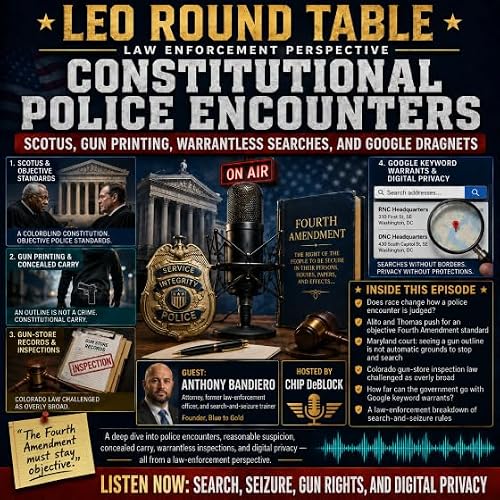
    LEO Round Table with Chip DeBlock S11E124, Two SCOTUS Justices Take On Court Over Constitutional Police Encounters Two SCOTUS justices take on court over constitutional police encounters. Court says police can't just search a suspect over an outline of a gun. Gun stores sue governor over warrantless gun record seizures. Google search found to have been reason hundreds of Americans became involved in Federal investigation. Fourth Amendment Fault Lines: Race, Guns, Google Searches, and Police Encounters Race, Reasonableness, and the Fourth Amendment The episode opens with host Chip DeBlock introducing attorney, former law enforcement officer, and search-and-seizure trainer Anthony Bandiero. The first major discussion concerns a Supreme Court petition involving whether race-based assumptions about a person's perception of police should be considered in determining whether someone has been seized under the Fourth Amendment. Bandiero argues that officers should not be trained to treat people differently based on race and says the Fourth Amendment test must remain objective. The Carter Case and the Problem of Subjective Policing Standards The hosts discuss a case identified in the transcript as United States v. Donte Carter, involving officers on a gun task force, a consensual encounter, a pat-down, and the discovery of a firearm. Bandiero explains that the trial court treated the encounter as consensual, while the appellate court considered race as part of the seizure analysis. He criticizes that approach as unworkable, subjective, and inconsistent with equal treatment under the Constitution. Gun Printing, Concealed Carry, and the Maryland Ruling The program then turns to a Maryland appellate decision involving a man whose gun allegedly printed through his clothing. DeBlock explains that the man had a license to carry, and Bandiero argues that simply seeing the outline of a firearm should not justify a stop or search. The discussion connects firearm printing to broader questions about reasonable suspicion, lawful concealed carry, stereotypes, high-crime-area policing, and the presumption that a person carrying a gun may be acting lawfully. Marijuana Odor, Analogy, and the Need for More Than a Hunch Bandiero and DeBlock briefly compare firearm possession to marijuana-related stops, noting that smelling like a substance does not necessarily prove possession or use. Bandiero uses the example of someone smelling like cigarette smoke after visiting a casino to explain that officers need more than odor, appearance, or a hunch before detaining someone. This section reinforces the broader theme that lawful activity cannot be treated as presumptively criminal without additional facts. Colorado Gun-Store Inspections and the Limits of Warrantless Searches A large portion of the episode focuses on a lawsuit challenging a Colorado law that allows warrantless inspections of gun-store sales records. Bandiero explains the special-needs doctrine and its requirements, including notice, a compelling reason, lack of discretion, and minimal intrusiveness. He argues that the Colorado law is likely unconstitutional because it allows limitless suspicionless searches, contrasting it with federal inspection rules and Supreme Court precedent involving business inspections. Google Keyword Warrants and the Search for Fourth Amendment Balance The final segment examines a report about the Department of Justice demanding that Google identify users who searched for RNC and DNC headquarters during the first five days of January 2021. Bandiero explains the concept of standing and why the court reportedly held that Google could not raise Fourth Amendment claims before the warrant was executed. The episode closes with concern that sealed keyword warrants may create a framework for broad digital investigations without timely notice to affected users.
    続きを読む 一部表示
    44 分
  • LEO Round Table, June 24, 2026
    2026/06/24
    S11E123, New York Governor Announces Program For Free Healthcare To Sex Workers Police Tactics, Public Outrage, and the Politics of Accountability New York Health-Care Program Draws Sharp Commentary The episode opens with Chip DeBlock and Captain Brett Bartlett discussing a report about New York extending a taxpayer-funded health-care pilot program for sex workers. Chip frames the story through his own frustration over private health-insurance costs, while Brett responds with criticism of New York voters and elected officials. The discussion is presented as political commentary, with the hosts objecting to the public funding priorities described in the transcript. Reflecting Pool Arrests and Political Symbolism The hosts then turn to reported arrests connected to the Lincoln Memorial Reflecting Pool, including a former Olympian who said he merely picked up a loose piece of floating paint. Chip presents the issue as possible sabotage of a renovation effort associated with President Trump, while Brett argues that the pool has become a visible symbol of Trump’s work in Washington, D.C. Both speakers distinguish between legitimate vandalism cases and borderline cases that should not be overcharged. LAPD Freeway Shooting and Split-Second Backdrop Decisions A major video segment focuses on LAPD officers chasing an armed carjacking suspect onto the 210 Freeway. Chip describes the danger of foot pursuits on highways, the suspect’s apparent attempt to carjack a driver, and the use of a semi truck as cover by a female officer. Brett questions why officers waited so long to shoot after repeated commands, emphasizing that officers must balance backdrop risks with the danger of allowing an armed suspect to escape. Taser Use on a Handcuffed DUI Suspect The first taser-related story involves former Greene County Deputy Robert Klein, who was fired and arrested after deploying a taser on handcuffed DUI suspect Cornelius Allen at a hospital. Chip explains that a grand jury later declined to indict the former deputy, while Brett discusses the difference between using force for compliance and using force out of anger. The exchange centers on policy, articulation, and the need for officers to explain force decisions clearly to non-police audiences. Central Falls Drive-Stun Incident and Resistance in Police Cars The second taser story involves a Central Falls officer accused of policy violations after drive-stunning a handcuffed, intoxicated man while officers tried to place him into a patrol car. Chip describes the practical difficulty of loading a resisting person into a cruiser, while Brett explains drive-stun use as a form of pain compliance. The conversation expands into truthfulness, body-camera review, and how intoxicated or combative suspects can continue resisting even after being handcuffed. Articulation, Restraints, and Officer Accountability The final portion of the episode focuses on broader training lessons, including how officers must be able to articulate decisions under stress through the lens of law, rules, SOPs, and training. Brett stresses that poor wording after an incident can damage an otherwise justified use of force. The hosts also discuss older restraint methods, risks associated with kicking suspects in patrol vehicles, and the need to balance control, safety, documentation, and accountability. SEO Keywords / Key Phrases police use of force, body cam footage, taser policy, handcuffed suspect, officer accountability, freeway carjacking suspect, law enforcement training, police pursuit tactics, drive stun taser, public safety commentary
    続きを読む 一部表示
    48 分
  • LEO Round Table, June 23, 2026
    2026/06/23
    S11E122, Man With Machete Will Not Go Down Despite Being Shot Multiple Times Deadly Force, Moving Vehicles, Gun Rights, and the Limits of K-9 Deployment A Fatal Walmart Shooting Raises Questions About Responsibility The episode opens with a discussion of a tragic officer-involved shooting in a Walmart parking lot in Mississippi, where a one-year-old child died after officers reportedly fired at a vehicle connected to an alleged shoplifting incident. The host emphasizes several “flags” in the story, including the framing of the incident as a shoplifting, the report that the vehicle drove toward officers, the involvement of more than one law enforcement agency, and the child being held in the front passenger seat rather than secured in a safety seat. The discussion treats the death as tragic while emphasizing that the full facts remain unknown. Use-of-Force Analysis and the Problem of Missing Facts Dr. Joel Shults stresses that the most important parts of the Walmart case are the things not yet known. He notes that family narratives often emerge first while police are unable to comment during an active investigation, which can shape public perception before all facts are released. The speakers discuss the complexity of officers ending up in front of moving vehicles, the controversy around shooting into vehicles, and the importance of expert review involving video analysis, physics, officer perception, timing, and professional standards. They also discuss possible culpability of the adults in the vehicle while cautioning against premature conclusions. Marijuana Users, Firearms, and the Second Amendment The conversation then moves to a firearm-rights case involving marijuana use, described in the transcript as United States v. Hemani. The host explains that the court rejected a categorical federal firearm ban for regular marijuana users unless the government can show actual dangerousness. The guest discusses concurring opinions, the historical-tradition reasoning associated with Second Amendment law, and concerns about governments using broad categories to restrict lawful gun ownership. Both speakers acknowledge law-enforcement concerns while also recognizing the constitutional argument against blanket disqualification. An Albuquerque Officer Pursues an Armed Robbery Suspect The episode next analyzes video of an Albuquerque officer pursuing an armed robbery suspect connected to an Amazon distribution center theft. The suspect reportedly fled from a stopped vehicle, moved through a residential area, appeared on a rooftop, and later attempted to carjack a civilian. The host praises the officer’s physical pursuit and situational persistence, while the guest emphasizes the risk of residential environments, potential victims, and the questionable role of a taser when a firearm is reportedly involved. The speakers discuss the importance of physical readiness, equipment security, and firearm-sling setup during active pursuits. A Machete Suspect, a Police K-9, and Tactical Distance The final major story involves an Oxnard restaurant incident in which a machete-wielding suspect was shot multiple times, remained combative, and later injured a police K-9. The host describes surveillance and body-camera video showing the suspect picking up the machete, using furniture as a barrier, advancing toward officers, and later being engaged by a police dog. Both speakers question aspects of the K-9 deployment, especially because the dog pulled the armed suspect toward officers, reducing the distance officers had created. The guest also discusses rear-exit considerations, triangulation, California use-of-force warnings, Spanish commands, taser limitations, and the myth that a person shot multiple times is automatically no longer dangerous. Closing Support for Sponsors and Law Enforcement Nonprofits The episode closes with sponsor acknowledgments and a reference to The Wounded Blue and Lieutenant Randy Sutton’s nonprofit work. The host asks listeners to support the show’s sponsors, including Galls, Comply Technologies, GunLearn, American Police and Troopers Coalition, and TubeBells. The closing maintains the program’s usual law-enforcement perspective while ending on a practical note of sponsor support and appreciation for listeners. SEO Keywords / Key Phrases officer-involved shooting, use of force analysis, moving vehicle shooting, Second Amendment rights, marijuana firearm ban, armed robbery suspect, police foot pursuit, machete suspect, police K-9 injury, law enforcement tactics
    続きを読む 一部表示
    48 分
  • LEO Round Table, June 22, 2026
    2026/06/22
    S11E121, Bad Guy Armed With Knife Given Tons Of Chances But Fails To Drop The Weapon Knives, Force Decisions, and Command Accountability in Modern Policing Bad Guy armed with knife given tons of chances but fails to drop the weapon. Ex-cop seen grabbing officer's neck on camera avoids criminal trial. Six-Paragraph Summary A Knife Call Turns Into a Tactical Debate The episode opens with Chip DeBlock introducing LEO Round Table and guest Chief Ralph Ornelas before moving into a Tucson police shooting involving a 65-year-old man identified in the transcript as Louis Torres. According to the discussion, officers responded to a report of a man armed with a knife, issued repeated commands in English and Spanish, deployed a Taser multiple times, and used pepper-ball rounds before the situation ended in a fatal shooting when the man reached for the knife again. Chip describes the shooting as a lethal-force scenario once the suspect moved back toward the weapon. Noise, Commands, and the Challenge of Communication A central part of the first discussion focuses on whether the officers had enough opportunity to build dialogue with the man before force was used. Chief Ornelas agrees the shooting was justified but argues that the presence of a helicopter and the rapid move toward less-lethal tools may have interfered with establishing communication, especially if the man was confused or possibly suffering from Alzheimer’s. Chip acknowledges the problem of loud air support but emphasizes officer safety and the difficulty of managing multilingual commands during a tense weapon call. Less-Lethal Options Versus Deadly-Force Reality The strongest disagreement between the host and guest centers on whether officers could or should have used impact weapons when the man dropped the knife but remained close to it. Chief Ornelas argues that officers sometimes need to consider impact weapons or other tactics when they move close enough to a suspect. Chip strongly disagrees, saying that once a suspect reaches for a knife, the threat becomes lethal and officers cannot safely rely on an impact weapon, especially when reaction time gives the suspect a dangerous advantage. East Coast and West Coast Policing Perspectives Chip frames the disagreement as a difference in tactical culture, describing it as an East Coast versus West Coast perspective on reasonable force, necessary force, and less-lethal options. Chief Ornelas says he values the disagreement because it gives viewers different professional perspectives, while still making clear that he views the Tucson shooting as justified. Both men connect their views to decades of law-enforcement experience, training history, and the risks officers face when deciding how close to get to someone armed with a knife. A Sunrise Sergeant’s Conduct Returns to the News The second major story examines former Sunrise Police Sergeant Christopher Pullease, who was shown in body-camera footage grabbing a female officer by the neck after she pulled him away from a handcuffed suspect in the back of a patrol car. Chip explains that the sergeant had pepper spray in his hand, exchanged profane words with the suspect, and later allegedly told officers to turn off their cameras. The discussion also covers his felony battery and evidence-tampering charges, his transfer into Broward Veterans Court, and the possibility that charges could be dismissed if he completes the diversion program. Command Responsibility, Human Failure, and Officer Courage Chief Ornelas focuses on the supervisory failure involved, saying the sergeant lost emotional control and put his officers in a terrible position. Both speakers praise the young female officer for intervening, staying composed, and calling the sergeant “sir” even after being grabbed by the throat. They also discuss the complicated human side of the case, including the sergeant’s military background, the possibility that he needs help, the agency’s interest in protecting the female officer from further pressure, and the importance of holding officers accountable while recognizing the strains of police work. SEO Keywords / Key Phrases police shooting, knife suspect, officer involved shooting, use of force, less lethal force, police body camera, law enforcement tactics, veterans court, evidence tampering, police accountability
    続きを読む 一部表示
    45 分
  • LEO Round Table, June 19, 2026
    2026/06/19
    LEO Round Table with Chip DeBlock S11E120, Comprehensive Terror Plot Thwarted At The White House UFC Event! Comprehensive terror plot thwarted at the White House UFC event. Over a dozen ANTIFA members indicted for conspiring to injure Federal officers. Two people receiving charges following violent dispute at drive-thru. Armed suspect fatally shot following pursuit through apartment complex. Woman fatally shot after trying to enter home with knives. Teen armed with gun shot by officer during confrontation. Explosive Drone Plot, Violent Resistance, and Police Survival Lessons A White House Event Becomes the Center of an Alleged Plot The episode opens with introductions, sponsor acknowledgments, and a rundown of the stories under discussion before moving into the alleged plot targeting a White House UFC event. The host describes how a 19-year-old Ohio suspect came to law enforcement attention after his parents reported concerns about weapons purchases, tactical gear, ammunition, and plans to meet people he had contacted online. The transcript presents the alleged plan as involving explosive drones, crowd panic, and snipers positioned near an evacuation route. Online Extremism, Encryption, and the Limits of Capability Sheriff Mark Crider discusses the alleged plot from an investigative perspective, noting that the case appears to have begun with family reporting rather than an undercover FBI operation. He emphasizes that the central question is whether the suspects had the actual technical ability, equipment, drones, explosives, and coordination needed to carry out the alleged plan. The panel also discusses how social media, encrypted messaging, and online communities can give relatively unsophisticated people access to more sophisticated organizing tools. Federal Charges Against Antifa Members in Minneapolis The show next covers federal indictments against 15 people described in the transcript as affiliated with Minneapolis-based Antifa groups. The host frames the charges as part of a broader federal response to violence directed at federal officers, while Dr. Travis Yates criticizes what he views as political minimization of violent protest activity. Sheriff Crider connects the discussion to local and state policies that restrict cooperation with ICE, arguing that safer jail transfers could reduce street-level confrontations. A Drive-Through Dispute Escalates Into Hot Grease and Stabbing The episode then turns to a Detroit fast-food incident in which two sisters allegedly confronted a worker over a wrong drive-through order. The host describes prosecutors’ claims that the sisters went behind the counter, chased the worker, threw pots and pans, hurled hot grease, and that one sister later used a knife thrown by the worker to stab her. The panel uses the story to discuss how hot grease or boiling water can cause serious bodily injury and how such threats should be evaluated in use-of-force situations. Miami Shooting Video and Pre-Attack Indicators The panel reviews a Miami police video involving undercover officers pursuing a wanted suspect who ran through an apartment complex while armed with a gun. Dr. Yates argues that public discussion should more directly acknowledge the danger of running from police while armed. The conversation then shifts into Yates’s work on pre-attack indicators, his FocusCertified.com training program, and his claim that officer assaults have increased sharply while law enforcement has lacked a validated system comparable to those used by other professions. Suicidal Woman, Body Camera Limits, and Teen With a Gun The final segment covers two additional body camera incidents: a suicidal woman in Illinois who entered a home with knives while officers and an elderly family member were inside, and a Miami-Dade deputy shooting a 15-year-old who was running with a gun. The panel discusses the difficulty of moving a noncompliant or confused person quickly, the importance of obeying police commands during dangerous scenes, and the limits of body camera footage compared with what an officer may see in real time. The show closes with sponsor mentions and acknowledgment of the Wounded Blue.
    続きを読む 一部表示
    45 分
  • LEO Round Table, June 19, 2026
    2026/06/19
    LEO Round Table with Chip DeBlock S11E119, Gunman Opens Fire On Unsuspecting Officer Leading To Gunfight In The Woods! Trump's deal opens Straight of Hormuz but Israel is at odds. Prosecutor indicted after emailing secret docs to personal email. Man shot after holding knife on other individual. Gunman opens fire on unsuspecting officer leading to gunfight in the woods. Traffic Stops, Tactical Choices, and the Consequences of Split-Second Police Decisions Foreign Policy, Force, and Uncertain Diplomacy The episode opens with the host introducing the law enforcement panel and then moving into a discussion about a reported U.S.-Iran memorandum involving the Strait of Hormuz. The host frames the issue around possible regional stability, energy flow, and Israel's stated refusal to withdraw from areas it says are necessary for security. The panelists respond with skepticism toward Iran and a strong preference for military pressure rather than reliance on diplomatic assurances. A Legal Breach and the Question of Intent The panel then discusses a Florida prosecutor accused of renaming and emailing sealed special counsel files to a personal account. The host emphasizes the alleged intentionality shown by changing file names, while the panelists focus on motive, trust, and accountability. They argue that the alleged conduct, if proven, should carry serious consequences because it involved restricted justice-system materials and deliberate concealment. An LAPD Knife Encounter Raises Tactical Questions The first major video segment covers an LAPD response to a reported burglary call that became a violent knife encounter inside a residence. The host describes officers entering after hearing screams, finding one man in a diaper, and then locating two men struggling over a knife. The panelists strongly criticize the delay in using lethal force, arguing that the victim was actively fighting for his life and that less-lethal tools were inappropriate once the knife threat was clear. Less-Lethal Tools Versus Immediate Deadly Threats The LAPD discussion turns into a broader critique of modern policing tactics. The panelists argue that officers sometimes rely too heavily on Tasers, 40-millimeter launchers, or other less-lethal options even when a suspect presents an immediate deadly-force threat. Their core point is that officers must recognize when a situation has passed the point of de-escalation and requires decisive action to protect victims and officers. A Traffic Stop Turns Into a Shooting, Chase, and Manhunt The second video segment examines an Ohio traffic stop in which a rear-seat passenger allegedly produced a gun, shot an officer, fled in the vehicle, exchanged gunfire with responding troopers, and eventually ran into the woods. The host walks through the sequence of the stop, the body-camera view, the chase, the stop-stick attempts, the later gunfire, and the final search aided by air support and a police canine. The panel highlights warning signs during the stop, including the suspect's behavior and hand movements. Training, Backup, and the Warrior Mindset The closing discussion focuses on training deficiencies, officer survival, and the dangers of treating traffic stops as routine. The panelists stress that every vehicle stop carries unknown risks and that officers must consider backup, positioning, cover, and weapon handling under stress. Randy Sutton closes by connecting the discussion to The Wounded Blue's mission, describing an injured Mississippi deputy and promoting the National Law Enforcement Survival Summit as a life-saving resource for officers.
    続きを読む 一部表示
    47 分
  • LEO Round Table, June 17, 2026
    2026/06/17
    S11E118, President Trump Announces End To War And Peace Deal With Iran President Trump announces end to war and peace deal with Iran. Polling data shows sharp decline in pride for America. Officer fired over horseplay incident caught on video. Suspect who pulled shotgun on officer fatally shot. Six-Paragraph Summary A Law Enforcement Panel Opens With Sponsors and the Day’s Topics The episode begins with Chip DeBlock welcoming listeners to the law enforcement talk show and introducing guest Dr. Joel Schultz, a retired police chief joining from Colorado. The host gives sponsor acknowledgments and explains where viewers can find the live and produced versions of the show. He then previews the episode’s topics, including claims about a reported Iran peace agreement, a poll showing declining American pride, a Pasadena police horseplay shooting, and several officer-involved shooting videos. A Skeptical Conversation About Iran and a Claimed Peace Deal The first major discussion centers on a Tampa Free Press article reporting that President Donald Trump announced a completed peace agreement with Iran and the lifting of a naval blockade. Chip expresses distrust toward Iranian officials and uncertainty about whether any agreement will hold. Dr. Schultz adds that market reactions may show optimism, but he remains skeptical because of Iran’s internal factions, regional tensions, and the possibility that separate actors could still provoke a renewed conflict. Declining National Pride and Concern Over American Institutions The conversation shifts to polling data suggesting that only about one-third of Americans say they are extremely proud to be American, a sharp decline from earlier decades. Chip highlights partisan differences in the poll and connects the trend to Americans’ trust in institutions and media sources. Dr. Schultz reflects on patriotism, the bicentennial, institutional loyalty, Juneteenth, and the need to recognize both America’s flaws and its progress. Both speakers describe the decline in national pride as disappointing and alarming. Pasadena Police Horseplay Shooting Sparks Accountability Debate Chip revisits a Pasadena Police Department incident in which one officer shot another during what was described as horseplay involving firearms. He explains the video sequence, including one officer allegedly pointing his weapon before another officer returned the gesture and discharged his gun through a windshield, striking the first officer in the shoulder. Dr. Schultz strongly criticizes the framing of the incident as horseplay, arguing that the behavior should be treated as criminal negligence and that the department should review its safety culture. Practical Jokes, Professionalism, and Police Culture The Pasadena discussion leads both men into stories about practical jokes in police work. Chip recalls a cap-gun prank from his early days as a rookie officer and says his squad eventually stopped the behavior. Dr. Schultz shares a story about being sent to a supposed man-with-a-gun call that turned out to involve a wooden statue, using the example to reinforce his dislike of police pranks. The discussion ties those stories back to professionalism, officer safety, and the seriousness required when firearms are involved. Sacramento Shotgun Call Raises Tactical and Psychological Concerns The final major segment focuses on a Sacramento-area incident in which a deputy responded to a woman-in-distress call and eventually faced a suspect who pulled out a shotgun. Chip criticizes the deputy for allowing the suspect access to the weapon, losing visual control, and letting the suspect use the patrol vehicle for cover. Dr. Schultz analyzes the deputy’s response through the lens of police mindset, cognitive dissonance, and training, arguing that the deputy appeared more comfortable following procedure than taking command of a lethal threat. The episode closes with mentions of The Wounded Blue, LEOAffairs.ch, and the show’s sponsors. SEO Keywords / Key Phrases law enforcement accountability, police use of force, officer safety, police training, firearms safety, national pride, Iran peace deal, tactical response, police bodycam analysis, law enforcement culture
    続きを読む 一部表示
    45 分
  • LEO Round Table, June 16, 2026
    2026/06/16
    S11E117, Trump Nominates Jay Clayton To Be The Director Of National Intelligence Trump nominates Jay Clayton to be the Director of National Intelligence. Former officer acquitted in fatal crash that killed two people. Cop accidentally shot during horseplay incident. Teen fatally shot after charging at officer with a knife. Patel fires analysts who created controversial "Catholic Extremism" memo. Officer caught from multiple angles struggling to get through window. Sergeant charged with stealing camera gear worth $10K. 6. Six-Paragraph Summary A Solo Host Sets the Law Enforcement Table Chip DeBlock opens the episode by explaining that he is hosting solo while the regular panelists are traveling, teaching, attending conferences, or otherwise unavailable. He introduces the show’s law enforcement perspective, sponsor support, streaming partners, social media presence, and the goal of helping listeners understand current news from a policing viewpoint. Intelligence Leadership and Political Fallout The first major topic centers on President Trump’s reported move to nominate Jay Clayton for a permanent intelligence leadership role after controversy over a temporary pick. DeBlock explains his view of the nomination, discusses the political dispute over Section 702, and frames the change as a better direction than the previous temporary appointment. A Fatal Crash, an Acquittal, and Civil Consequences The episode then turns to the case of former Warren police officer James Burke, who was acquitted after a fatal 2024 crash that killed two people. DeBlock discusses the reported speed of the patrol car, the intoxication evidence involving the other driver, the disputed turn, the jury’s decision, and the continuing civil lawsuits, while emphasizing the distinction between tragedy and criminal liability. Horseplay, Firearms, and a Pasadena Shooting Accident A video-based segment focuses on a Pasadena Police incident in which one officer accidentally shot another during horseplay in a police parking garage. DeBlock describes the dashcam footage, the officers’ unsafe handling of firearms, the injury to the officer’s shoulder, the department’s discipline, and the lesson that even joking behavior with weapons can create serious danger. Teen Mental Crisis and a Deadly Knife Encounter The show also covers a Fraser, Michigan, incident involving a 15-year-old boy who was shot and killed after charging officers with a knife during a domestic dispute response. DeBlock walks through the earlier police contact, the return to the grandmother’s home, the ineffective Taser attempt, the crossfire concerns, and the difficult questions surrounding forced entry, containment, mental crisis, and officer-created risk. FBI Accountability, Viral Officer Video, and Closing Stories In the later portion of the episode, DeBlock discusses FBI personnel actions connected to a controversial Catholic extremism memo and broader accountability issues. He also comments on a Culpeper officer falling from a window during a welfare-check entry attempt, a New Jersey sergeant charged in connection with missing journalist camera gear, and closes by promoting law enforcement support resources, sponsors, and the next live show. 7. SEO Keywords / Key Phrases law enforcement news, police accountability, officer-involved shooting, police crash acquittal, intelligence nomination, Section 702, police training, domestic dispute response, FBI memo controversy, police body camera video
    続きを読む 一部表示
    45 分